
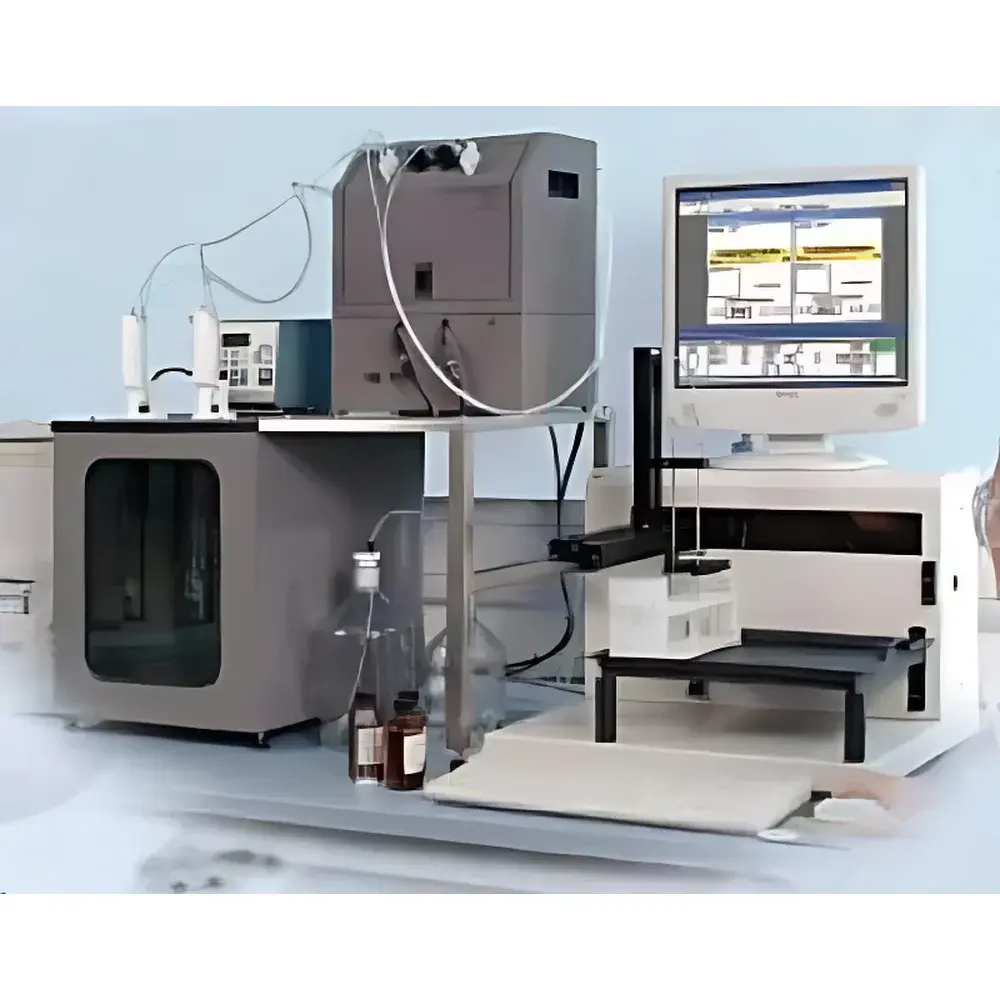
RHEOTEK RPV-1 Polymer Capillary Viscometer
| Brand | SETA |
|---|---|
| Origin | United Kingdom |
| Model | RPV-1 |
| Compliance | ASTM D789, ISO 307, ASTM D4603, ASTM D2857, ASTM D1795, SCAN CM15:99, TAPPI T230-om94, ASTM D1243, USP <911>, ISO 1628 |
| Timing resolution | 0.001 s |
Overview
The RHEOTEK RPV-1 Polymer Capillary Viscometer is a fully automated, dual-capillary kinematic viscosity measurement system engineered for high-precision characterization of polymer solutions, synthetic resins, and industrial-grade viscous liquids in petroleum, pharmaceutical, and polymer manufacturing laboratories. Based on the fundamental principle of gravity-driven capillary flow (Ostwald-type viscometry), the RPV-1 determines kinematic viscosity (ν) by measuring the efflux time of a fixed volume of sample through calibrated glass capillaries under controlled temperature conditions—typically maintained within ±0.01 °C using integrated Peltier-regulated thermostatic baths. Its design adheres to the hydrodynamic requirements of Poiseuille’s law, ensuring traceable, repeatable results compliant with international standard test methods including ASTM D789 (for polyethylene terephthalate), ISO 1628 (polymers in solution), and USP (pharmaceutical polymer viscosity). Unlike rotational or vibrational systems, capillary viscometry provides direct, first-principles-based determination of kinematic viscosity without empirical calibration dependencies—making it the reference method for intrinsic viscosity, relative viscosity, and molecular weight estimation via Mark–Houwink relationships.
Key Features
- Dual independent capillary modules enable parallel analysis of two samples—reducing throughput time by up to 45% compared to single-capillary systems while maintaining full method independence per channel.
- Robotic autosampler accommodates up to 48 vials (standard 10–25 mL) with programmable sequence logic, barcoded sample tracking, and temperature-stabilized rack storage.
- High-resolution timing electronics achieve 1 ms (0.001 s) efflux time resolution, critical for low-viscosity polymer melts and dilute solution measurements where sub-second variations impact calculated intrinsic viscosity by >0.5%.
- Automated post-run protocol includes solvent flush, nitrogen purge, and thermal drying of capillaries and injection lines—eliminating carryover and operator-dependent cleaning variability.
- Modular capillary bank supports interchangeable Ubbelohde- and Cannon-Fenske-style capillaries (kinematic viscosity range: 0.3–100,000 mm²/s), each certified with individual calibration constants traceable to NPL (UK) standards.
- Integrated bath temperature control maintains setpoint stability of ±0.01 °C over 24 h, meeting ISO/IEC 17025 environmental requirements for accredited viscosity testing.
Sample Compatibility & Compliance
The RPV-1 is validated for use with organic solvents (e.g., phenol/o-chlorophenol mixtures, sulfuric acid, formic acid), polymer solutions (PET, PA6, PC, PMMA), crude oil fractions, and biopolymer dispersions. All fluid-handling components—including sample loops, capillary junctions, and waste manifolds—are constructed from chemically inert borosilicate glass and PTFE-lined stainless steel to prevent adsorption or degradation. The system satisfies audit requirements for GLP and GMP environments: electronic records include full audit trails (user ID, timestamp, method version, raw efflux times, ambient humidity/temperature logs), digital signatures, and 21 CFR Part 11–compliant data integrity controls. Method validation packages are available for ASTM D4603 (intrinsic viscosity of PET), ISO 307 (polyamide), and USP (viscosity of hyaluronic acid and chitosan derivatives).
Software & Data Management
The RPV-1 operates under RHEOSOFT™ v5.2—a Windows-based platform supporting IQ/OQ/PQ documentation templates, multi-level user access (operator, supervisor, administrator), and automated report generation in PDF/A-1b and CSV formats. All calculations apply standardized correction algorithms for kinetic energy loss, meniscus error, and thermal expansion (per ISO 3104 Annex B). Software updates—delivered quarterly—extend method libraries to include emerging standards such as ISO 1628-5 (biopolymers) and ASTM WK76283 (recycled PET viscosity profiling). Raw data files (.rheo) are encrypted and immutable; historical datasets remain accessible across software versions via backward-compatible archive import.
Applications
- Quality control of PET resin batches prior to fiber extrusion—monitoring IV drift indicative of thermal degradation or hydrolysis.
- In-process viscosity verification during polyamide polymerization, enabling real-time reaction endpoint detection.
- Stability assessment of polymer dispersions in enhanced oil recovery (EOR) formulations under reservoir-simulated temperatures.
- Regulatory submission support for FDA ANDA filings requiring USP -compliant viscosity data on ophthalmic gels and dermal hydrogels.
- Research-scale molecular weight distribution analysis via multi-concentration intrinsic viscosity sweeps (Huggins and Kraemer plots).
FAQ
Does the RPV-1 support custom capillary calibration certificates?
Yes—each capillary module ships with an NPL-traceable certificate listing capillary constant (C), efflux time repeatability (≤0.15%), and thermal expansion coefficient.
Can the system be integrated into a LIMS environment?
Yes—via ASTM E1482-compliant HL7 and ASTM E2500-07 XML export protocols; optional OPC UA server module enables real-time data streaming to enterprise MES platforms.
Is method validation assistance included with purchase?
SETA provides on-site IQ/OQ execution support and a documented validation template aligned with ISO/IEC 17025:2017 clause 7.8.2 for viscosity measurement uncertainty budgeting.
What solvent compatibility limits apply to the autosampler wetted path?
All fluid-contact surfaces tolerate chlorinated solvents, concentrated acids (≤98% H₂SO₄), and polar aprotic media (DMF, DMSO); HF and molten alkali metals are excluded.
How frequently does the software require recalibration?
No hardware recalibration is required—the system self-verifies timing accuracy daily using internal quartz-referenced oscillators; capillary constants remain valid for 24 months unless mechanically damaged.




