
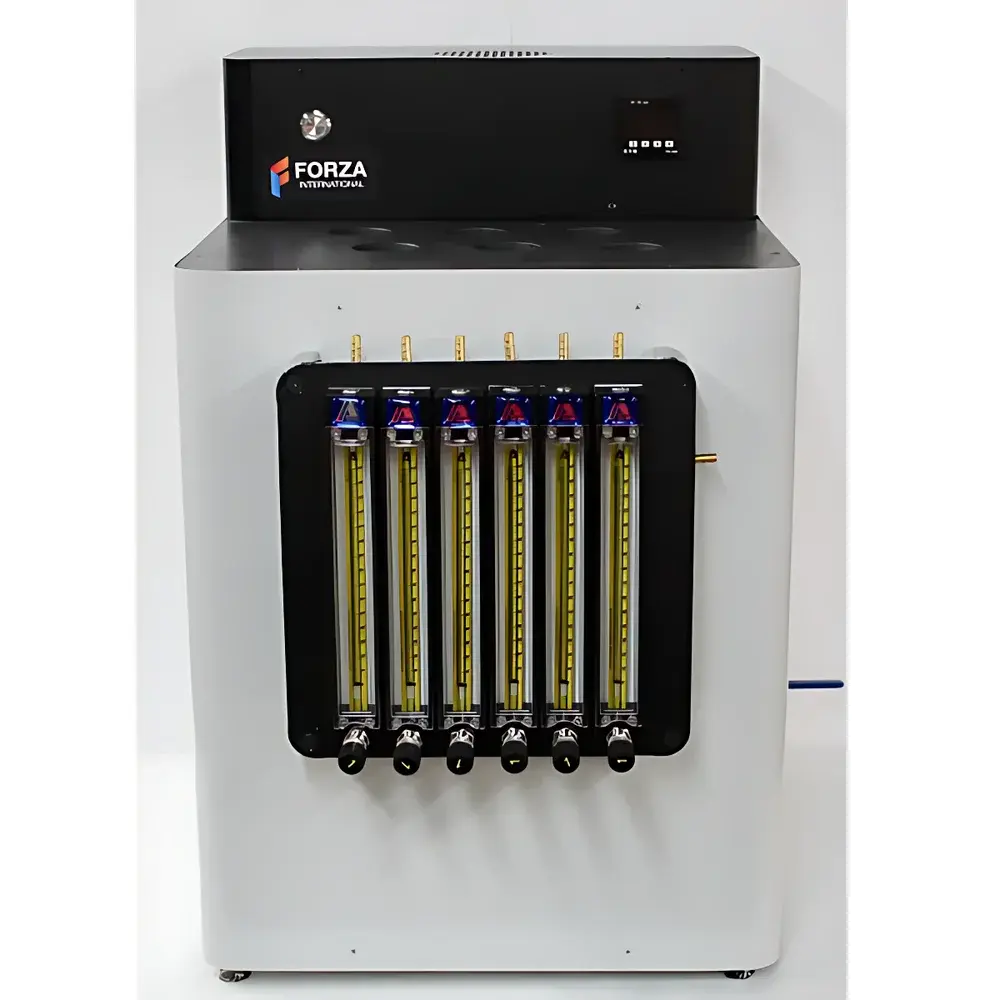
Oxi Plus Oxidation Stability Testing Liquid Bath System
| Brand | FORZA |
|---|---|
| Origin | USA |
| Model | Oxi Plus |
| Temperature Range | 40–150 °C |
| Temperature Control Accuracy | ±0.5 °C |
| Sample Capacity | 4–30 test tubes (method-dependent) |
| Safety Features | Over-temperature cutoff switch, low-level liquid protection switch |
| Flow Monitoring | Glass rotameter included |
| Import Status | Imported |
Overview
The Oxi Plus Oxidation Stability Testing Liquid Bath System is an engineered thermal platform designed specifically for standardized oxidation stability testing of petroleum-based fluids—including lubricating oils, turbine oils, hydraulic fluids, and transformer oils—according to ASTM D943, D2272 (RBP), D2896, D4742, IP 280, ISO 12156-1, and related specifications. It operates on the principle of controlled accelerated oxidation in a precisely maintained liquid bath environment, where oxygen flow, temperature uniformity, and sample immersion depth are critical parameters influencing test reproducibility. Unlike ambient-air ovens or dry-block heaters, the Oxi Plus employs a thermally stable, high-heat-capacity liquid medium (typically silicone oil or mineral oil) to ensure minimal axial and radial temperature gradients across all sample positions—essential for inter-laboratory comparability and regulatory compliance.
Key Features
- Precision PID Temperature Control: Digital microprocessor-based PID algorithm maintains setpoint stability within ±0.5 °C across the full operating range (40–150 °C), with ramp rate programmability and auto-tuning capability for consistent thermal equilibration.
- Modular Sample Configuration: Accommodates 4 to 30 oxidation test tubes simultaneously, supporting multiple standard methods—including ASTM D943 (sludge & acid number tracking), D2272 (rotating pressure vessel), and D4742 (turbine oil oxidation)—without hardware modification.
- Dual Redundant Safety Architecture: Integrated over-temperature cutoff switch de-energizes heating elements if bath temperature exceeds user-defined limit by >3 °C; independent low-level liquid protection switch disables operation when fluid volume falls below minimum immersion threshold—preventing heater dry-firing and tube cracking.
- Calibrated Gas Flow Monitoring: Includes a NIST-traceable glass rotameter (range: 0–10 L/min air or oxygen) with dual-scale calibration (air and O2) for accurate oxidant delivery per method requirements.
- Corrosion-Resistant Construction: Stainless steel bath vessel (316 SS), PTFE-coated immersion heater sheath, and chemical-resistant control panel housing ensure long-term reliability in aggressive oxidative environments.
Sample Compatibility & Compliance
The Oxi Plus is validated for use with standard oxidation test vessels including ASTM D943 glass oxidation tubes (250 mL), D2272 rotating pressure vessel assemblies, and IP 280 sealed copper coil reactors. Its thermal uniformity profile (<±0.3 °C across 30-position array at 100 °C) meets the spatial homogeneity criteria specified in ASTM E74 and ISO/IEC 17025 for accredited testing laboratories. The system supports GLP-compliant operation through configurable event logging (temperature deviation alerts, safety switch actuations) and is compatible with external data acquisition systems meeting FDA 21 CFR Part 11 requirements when paired with validated software interfaces.
Software & Data Management
While the base Oxi Plus operates via front-panel digital interface, optional RS-485/Modbus RTU or USB-to-serial connectivity enables integration with laboratory information management systems (LIMS) or custom SCADA platforms. Temperature setpoints, dwell times, and alarm thresholds are programmable and stored in non-volatile memory. All safety events—including over-temperature cutoff activation and low-level switch engagement—are timestamped and retained for audit trail generation. For fully automated workflows, FORZA provides the OxiLink™ PC application (Windows 10/11), which supports real-time graphing, multi-bath synchronization, CSV export with ISO 8601 timestamps, and electronic signature-enabled report generation compliant with ISO/IEC 17025 Clause 7.8.
Applications
- Accelerated oxidation life assessment of turbine oils per ASTM D2272 and IEC 60296
- Sludge formation and total acid number (TAN) evolution studies in engine oils per ASTM D943
- Base oil stability screening during formulation development
- Antioxidant package efficacy evaluation under controlled O2 flow and thermal stress
- Quality control release testing for industrial lubricants in GMP-regulated manufacturing environments
FAQ
What liquid media are recommended for use with the Oxi Plus bath?
Silicone oil (e.g., Dow Corning 200 Fluid, 50 cSt) is preferred for its thermal stability up to 200 °C and low volatility; mineral oil may be used for tests below 120 °C but requires more frequent replacement due to oxidation byproducts.
Is the Oxi Plus compatible with ASTM D4742 (turbine oil oxidation test)?
Yes—the bath geometry and temperature uniformity meet the immersion depth and thermal gradient requirements of D4742; users must supply D4742-specific reactor vessels and oxygen delivery manifolds.
Can the system be calibrated in-house?
Yes—built-in PT100 sensor ports allow connection of traceable reference thermometers; FORZA provides calibration certificates (NIST-traceable) and SOP templates aligned with ISO/IEC 17025 Section 6.5.
Does the Oxi Plus support automatic data logging without external software?
No—the base unit records only operational status (on/off, alarm flags); continuous temperature logging requires either the optional OxiLink™ software or third-party Modbus-compatible DAQ hardware.
What maintenance intervals are recommended for long-term reliability?
Daily visual inspection of fluid level and clarity; quarterly cleaning of heater sheath and rotameter; annual verification of PID tuning and safety switch response time using certified test equipment.




