
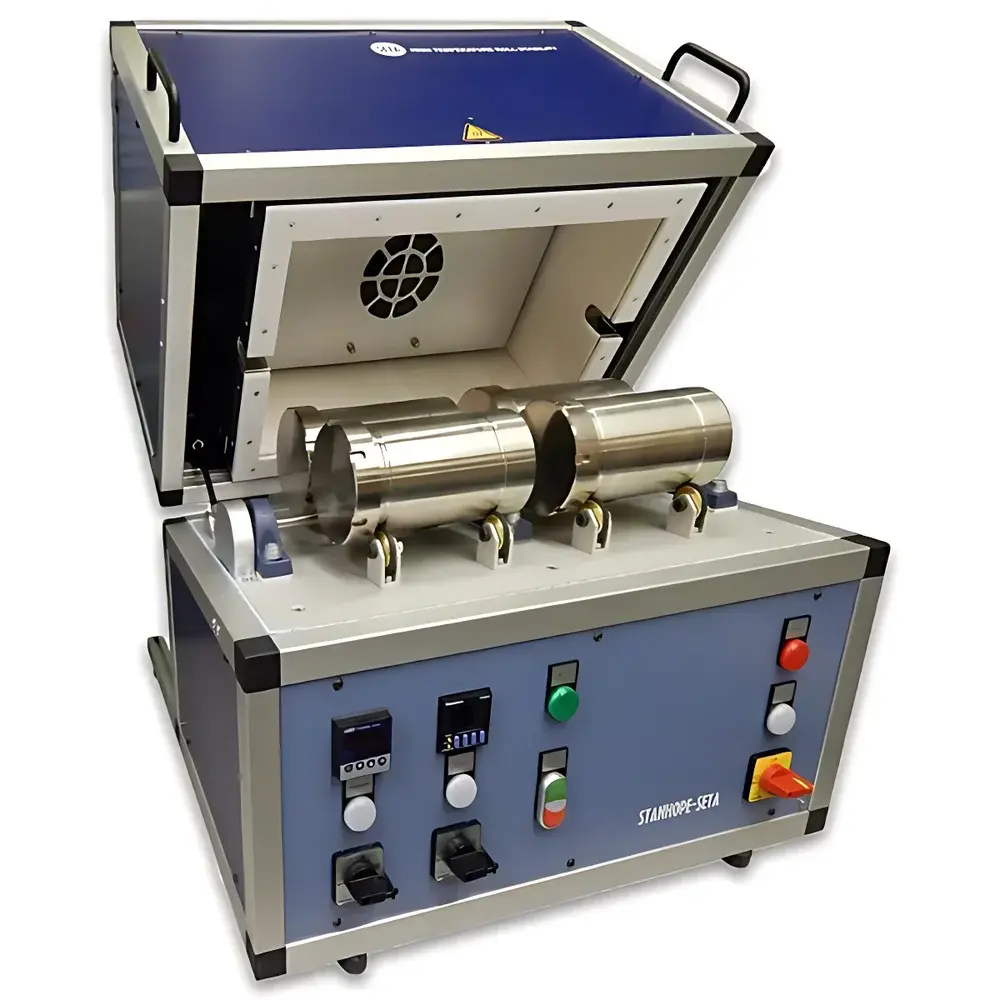
SETA 19450-0 Grease Drum Stability Tester
| Brand | SETA |
|---|---|
| Origin | Germany |
| Model | 19450-0 |
| Temperature Range | Ambient to 200 °C ±0.5 °C |
| Standard Rotational Speed | 165 rpm |
| Adjustable Speed Range | 100–200 rpm |
| Roller Quantity | 4 × (5 kg ±50 g) |
| Compliance | ASTM D1831, ASTM D8022, SH/T 0122 |
| Optional Accessories | RS485 Interface, Variable-Speed Drive (100–200 rpm), Ventilation Hood, Roller Sets in Alternative Materials |
Overview
The SETA 19450-0 Grease Drum Stability Tester is a precision-engineered laboratory instrument designed to evaluate the mechanical shear stability of lubricating greases under controlled thermal and rotational stress. Based on the standardized drum test principle—where grease samples are subjected to repeated rolling action between rotating cylindrical rollers—the instrument quantifies changes in consistency (typically measured as worked penetration per ASTM D217 or NLGI grade shift) following defined exposure cycles. This method directly simulates mechanical degradation mechanisms encountered in real-world bearing and chassis applications, making it essential for formulation validation, quality control, and regulatory conformance in lubricant manufacturing and third-party testing laboratories.
Key Features
- Thermally stable test chamber with digital PID temperature control, maintaining ±0.5 °C accuracy across the full operating range (ambient to 200 °C); critical for replicating high-temperature service conditions such as those in automotive wheel bearings or industrial gearboxes.
- Four precisely weighted rollers (5 kg ±50 g each), manufactured from hardened stainless steel to ensure consistent surface finish, dimensional stability, and resistance to thermal expansion-induced misalignment.
- Fixed-speed operation at 165 rpm—aligned with ASTM D1831 baseline protocol—with optional variable-speed drive enabling speed adjustment between 100 and 200 rpm for method development or comparative studies per ASTM D8022 Annex A1.
- Low-noise, brushless DC motor drive system ensures long-term operational reliability and minimal vibration transfer to the sample assembly—preserving measurement integrity during extended test durations (up to 10,000 revolutions).
- Modular accessory architecture supports seamless integration of RS485 serial communication for automated data logging, ventilation hoods for fume management in enclosed lab environments, and alternate roller materials (e.g., aluminum, ceramic-coated) for specialized compatibility assessments.
Sample Compatibility & Compliance
The SETA 19450-0 accommodates standard 125 g grease samples loaded into ASTM D1831-compliant aluminum cups. Its mechanical design conforms to the dimensional and mass tolerances specified in ASTM D1831 (Standard Test Method for Roll Stability of Lubricating Grease) and ASTM D8022 (Standard Test Method for High-Temperature Rolling Stability of Lubricating Grease), including roller diameter (38.1 mm), length (127 mm), and drum rotation geometry. The instrument also satisfies the procedural requirements of Chinese national standard SH/T 0122 (Roll Stability Test Method for Lubricating Grease), ensuring cross-regional method equivalence for global R&D and certification workflows. All thermal sensors are NIST-traceable, and temperature calibration certificates are available upon request to support ISO/IEC 17025-accredited laboratory audits.
Software & Data Management
When equipped with the optional RS485 interface, the instrument outputs time-stamped temperature and rotational status data to external SCADA or LIMS platforms. While the base unit operates via front-panel digital controls without embedded software, the interface enables synchronization with laboratory data systems for audit-ready recordkeeping. Users may configure automated start/stop triggers based on elapsed time or revolution count, and logged datasets include timestamps, setpoint deviations, and motor current signatures—facilitating root-cause analysis of anomalous consistency shifts. For regulated environments, the system supports 21 CFR Part 11-compliant electronic records when integrated with validated third-party data acquisition software featuring user access controls, electronic signatures, and immutable audit trails.
Applications
- Quality assurance of finished greases against shear-thinning thresholds prior to release.
- Comparative evaluation of thickener systems (e.g., lithium, polyurea, clay) under accelerated mechanical stress.
- Development of high-temperature greases for electric vehicle traction motors and wind turbine pitch bearings.
- Failure analysis of field-failed greases by replicating suspected service conditions (e.g., 180 °C / 165 rpm for 10,000 revs).
- Supporting OEM specification compliance (e.g., GM 6277M, Ford ESB-M1C162-A) requiring documented drum stability performance.
FAQ
What standards does the SETA 19450-0 directly support?
ASTM D1831, ASTM D8022, and SH/T 0122—all verified through mechanical and thermal calibration protocols traceable to national metrology institutes.
Can the instrument operate unattended for extended tests?
Yes; the robust thermal enclosure and sealed drive mechanism allow continuous operation up to 72 hours, with optional external timers or PLC integration for full-cycle automation.
Is temperature uniformity validated across the roller zone?
Yes; thermal mapping per IEC 60068-3-5 confirms ≤0.8 °C axial gradient across the active roller span at 200 °C.
How is roller wear monitored and compensated?
Rollers are supplied with certified mass and surface roughness (Ra ≤0.4 µm); users perform periodic verification using calibrated micrometers and mass balances per maintenance schedule.
Does the system meet GLP documentation requirements?
When paired with compliant data acquisition software and procedural SOPs, the instrument supports GLP/GMP audit readiness—including instrument qualification (IQ/OQ), calibration logs, and raw data archiving.




