
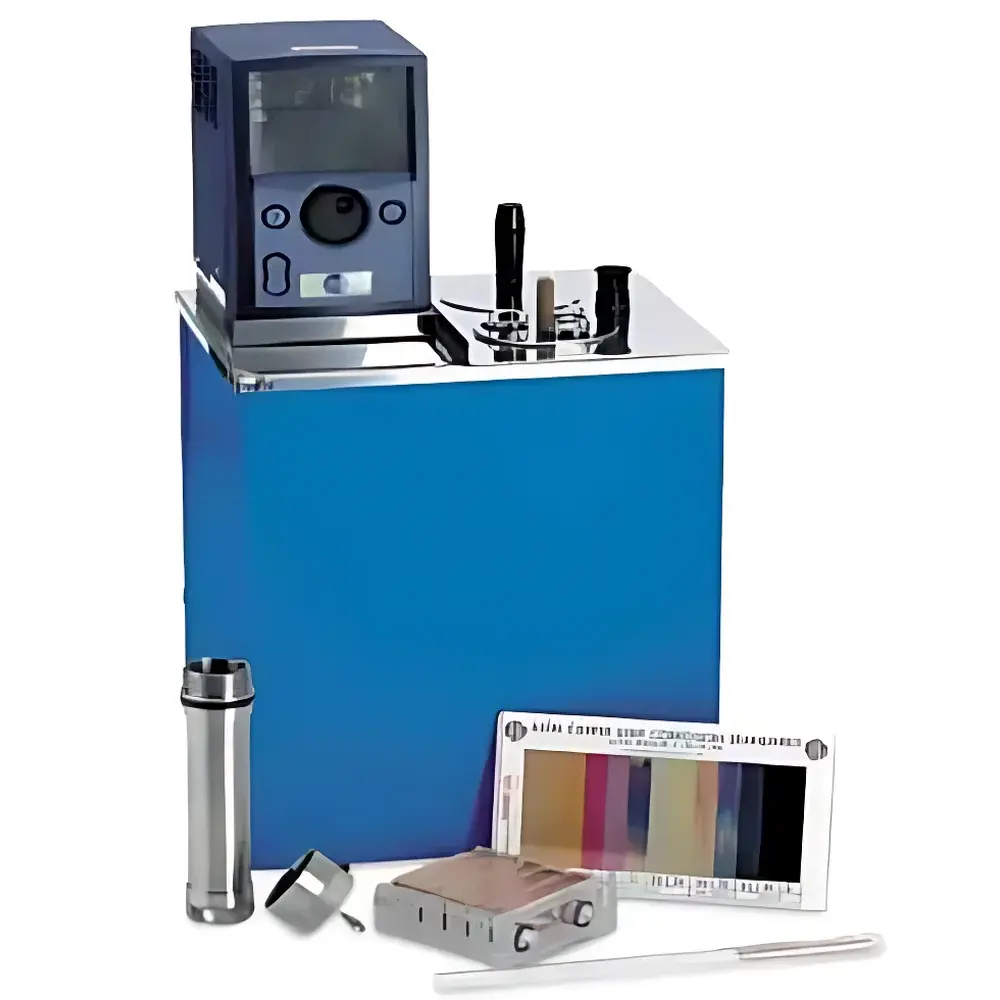
SETA Model 11300-0 Copper Strip Corrosion Bath
| Brand | SETA |
|---|---|
| Origin | United Kingdom |
| Model | 11300-0 |
| Temperature Range | Ambient to 100 °C |
| Test Positions | 2 |
| Sample Types | Copper strips, silver strips |
| Safety Feature | Low-water-level alarm |
| Footprint | Compact design |
| Compliance | ASTM D130, IP 154, ISO 2160, GB/T 5096, SH/T 0023, DIN 51811, EN 2160, JIS K2513, NF M07-015, FTMS 791B 5325 |
Overview
The SETA Model 11300-0 Copper Strip Corrosion Bath is a precision-engineered laboratory instrument designed for standardized evaluation of petroleum product corrosivity toward copper and silver strips under controlled thermal conditions. It operates on the principle of accelerated immersion testing, where polished metal strips are immersed in the test sample and held at a specified temperature (typically 50 °C, 100 °C, or other method-defined setpoints) for a defined duration. Following exposure, strip discoloration is assessed visually or semi-quantitatively against standardized color charts (e.g., ASTM D130 Rating Scale), providing a reproducible index of sulfur compound activity, organic acid content, or other corrosive species present in fuels, lubricants, solvents, and distillates. The bath’s thermostatic stability, uniform heat distribution, and dual-position configuration support concurrent execution of replicate tests or parallel evaluations per ASTM D130, ISO 2160, and equivalent national standards.
Key Features
- Stable temperature control from ambient to 100 °C with ±0.5 °C accuracy across the working range, achieved via PID-regulated heating and calibrated platinum resistance thermometer (PRT) feedback.
- Dual independent test positions accommodate two copper or silver strips simultaneously—enabling duplicate analysis without cross-contamination or time lag between runs.
- Integrated low-water-level alarm system automatically interrupts heating and triggers audible/visual alert when fluid volume falls below safe operational threshold, preventing dry-heating damage and ensuring operator safety.
- Compact footprint (W × D × H ≈ 280 × 220 × 240 mm) optimizes bench space in QC laboratories while maintaining full compliance with method-specified bath geometry and immersion depth requirements.
- Corrosion-resistant stainless-steel bath vessel and insulated housing ensure long-term durability in environments exposed to hydrocarbon vapors and cleaning solvents.
- Front-panel digital display with intuitive push-button interface provides real-time temperature readout, setpoint adjustment, and status indicators—no external software or PC required for basic operation.
Sample Compatibility & Compliance
The SETA 11300-0 is validated for use with standardized copper strip specimens (ASTM D130 Grade 1, 12.7 mm × 19 mm × 1.6 mm) and silver strips (IP 154, ISO 2160 Annex A) across a broad spectrum of petroleum-based materials including aviation turbine fuel (Jet A-1), diesel fuel, gasoline, naphtha, lubricating oils, and biodiesel blends. Its mechanical and thermal design conforms strictly to dimensional, immersion depth, and heating rate specifications outlined in ASTM D130, ISO 2160, GB/T 5096, and SH/T 0023. The unit supports full traceability under GLP and GMP frameworks through documented calibration records and user-accessible temperature verification protocols. While not inherently 21 CFR Part 11 compliant (as it lacks electronic audit trail functionality), its analog-digital hybrid interface permits integration into validated laboratory information management systems (LIMS) via optional RS232 output modules.
Software & Data Management
The SETA 11300-0 operates as a standalone benchtop instrument with no embedded data logging or network connectivity. All operational parameters—including set temperature, elapsed time, and alarm events—are monitored locally via the front-panel display. For laboratories requiring electronic record retention, optional accessories include an RS232 serial interface module (sold separately) enabling connection to external PCs or LIMS platforms for time-stamped temperature logging and event capture. Calibration certificates (traceable to UKAS-accredited standards) and method-specific validation checklists are supplied with each unit to support internal audit readiness and regulatory inspections aligned with ISO/IEC 17025 requirements.
Applications
- Quality control of finished petroleum products prior to release, verifying conformance with refinery specifications and downstream customer requirements.
- Investigation of storage-induced corrosion during tank aging studies or pipeline transport simulation.
- Screening of additive packages for synergistic or antagonistic effects on metal compatibility.
- Supporting root-cause analysis in field failures involving copper-bearing components (e.g., fuel injectors, heat exchangers, electrical contacts).
- Regulatory submission testing for EPA, EN, or JIS certification dossiers where copper strip rating forms part of the mandated specification matrix.
FAQ
What standards does the SETA 11300-0 fully support?
It is engineered to meet all physical and procedural requirements of ASTM D130, ISO 2160, IP 154, GB/T 5096, SH/T 0023, DIN 51811, EN 2160, JIS K2513, NF M07-015, and FTMS 791B 5325.
Can silver strips be tested alongside copper strips in the same run?
Yes—the dual-position design allows independent placement of copper and silver strips; however, method protocols require separate baths or strict segregation to avoid cross-contamination and misrating.
Is calibration documentation included?
Each unit ships with a factory calibration certificate traceable to UKAS standards, covering temperature sensor verification at three points (40 °C, 50 °C, and 100 °C).
Does the bath require distilled water or can tap water be used?
Deionized or distilled water is strongly recommended to prevent mineral scale buildup on the heating element and maintain long-term thermal stability and alarm reliability.
How often should the water level be checked?
Operators must verify water level before each test cycle and after any extended idle period; the low-water alarm serves as a secondary safeguard, not a substitute for routine visual inspection.






