
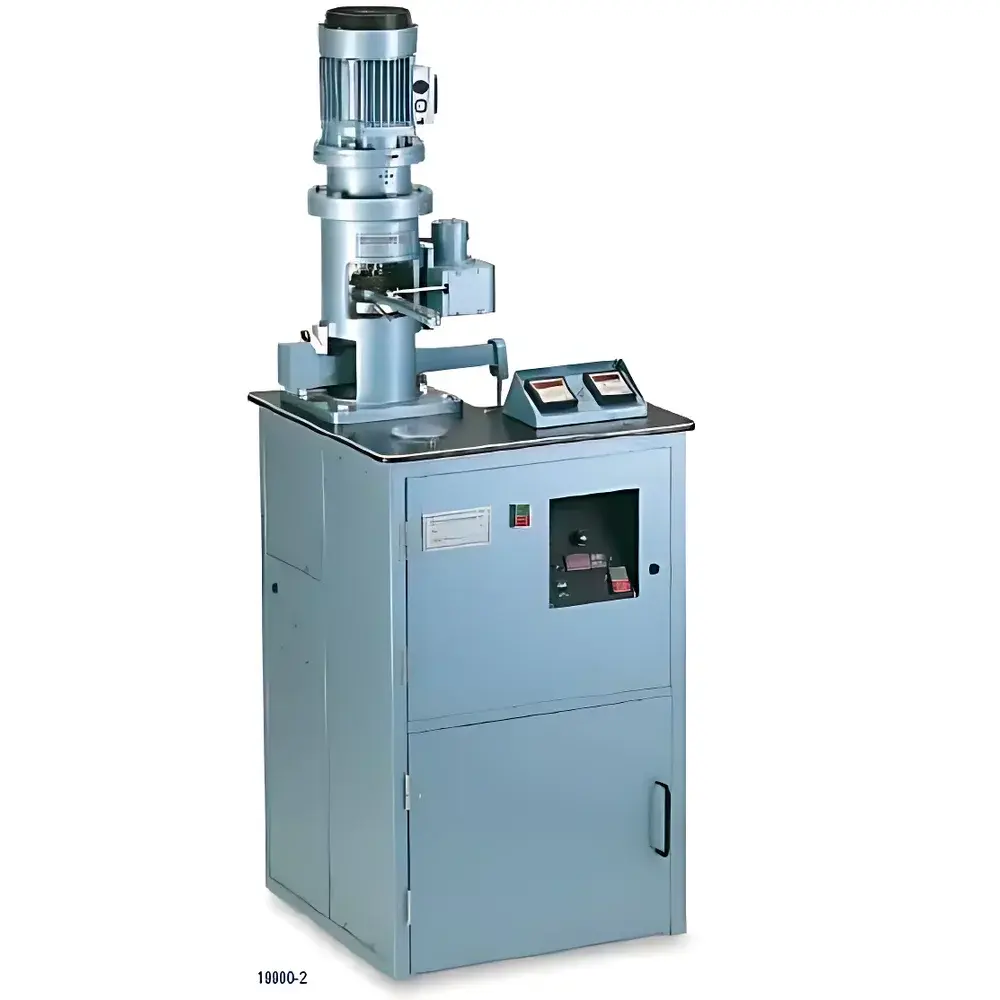
SETA 19900-2 Four-Ball Lubricant Tester
| Brand | SETA |
|---|---|
| Origin | United Kingdom |
| Model | 19900-2 |
| Speed Range | 720–1900 rpm |
| Load Range | 40–800 kgf |
| Timing Resolution | 0.1 s to 9999 hr |
| Power Supply | 220/240 V, 50/60 Hz |
| Power Consumption | 1.5 kW |
| Dimensions (W×D×H) | 169 × 63 × 62 cm |
| Weight | 150 kg |
Overview
The SETA 19900-2 Four-Ball Lubricant Tester is a precision-engineered tribological evaluation system designed for quantitative assessment of extreme pressure (EP) and anti-wear (AW) performance of lubricating oils and greases under controlled sliding contact conditions. Based on the standardized four-ball geometry—three stationary balls held in a triangular cup and one rotating upper ball—the instrument generates reproducible elastohydrodynamic and boundary lubrication regimes. It operates according to well-established tribological test principles defined by ASTM D2596 (EP wear), ASTM D2783 (EP load-carrying capacity), ISO 20623 (lubricant wear scar measurement), and CEC L-45-T-93 (gear oil testing), enabling direct correlation with industry acceptance criteria. The system is widely deployed in R&D laboratories, lubricant formulation centers, and QC/QA departments of petroleum refineries and additive manufacturers to validate performance claims, support regulatory submissions, and ensure batch-to-batch consistency.
Key Features
- Automated digital control of rotational speed (720–1900 rpm), applied load (40–800 kgf), and test duration (0.1 s to 9999 hr) via integrated microprocessor-based controller
- Real-time digital display of torque, load, elapsed time, and rotational speed—enabling immediate observation of frictional behavior and seizure onset
- Integrated safety interlock system with transparent polycarbonate guard that halts operation upon door opening, compliant with EN 61000-6-2 (EMC) and EN 61000-6-4 emission standards
- Modular mechanical architecture supporting optional accessories including Wear Loading Kit 19940-0 for ASTM D2266 (anti-wear) and D4172 (four-ball wear) protocols
- Rigid cast-iron base and precision-ground spindle assembly ensure minimal vibration and high repeatability across extended test cycles
- Thermally stable test chamber design minimizes ambient thermal drift during multi-hour EP tests, improving measurement fidelity of weld point determination
Sample Compatibility & Compliance
The SETA 19900-2 accommodates standard 12.7 mm (½ inch) diameter steel balls per ASTM E23 and ISO 376 specifications. It accepts liquid lubricants (mineral, synthetic, bio-based), grease formulations (NLGI #00 to #3), and additive concentrates without modification. All test methodologies implemented align with internationally recognized standards: ASTM D2596, D2783, D2266, D4172; IP 239, IP 300 Procedure A & B (observed); EN ISO 20623; ISO CD 11008; and CEC L-45-T-93. The instrument supports GLP-compliant documentation workflows when paired with validated data acquisition software, and its operational parameters are traceable to NPL (UK) and NIST-maintained reference materials.
Software & Data Management
While the base unit features standalone digital readouts, optional PC connectivity enables integration with SETA’s proprietary TestLog software (v3.2+). This application provides automated test sequencing, real-time torque vs. time plotting, wear scar diameter (WSD) calculation per ISO 20623 Annex A, and EP failure point identification using slope-detection algorithms. Data export is supported in CSV, PDF, and XML formats for inclusion in LIMS environments. Audit trails, user access levels, and electronic signature functionality comply with FDA 21 CFR Part 11 requirements when configured with appropriate IT validation protocols.
Applications
- Quantification of weld point and load-wear index (LWI) for gear oils and industrial lubricants
- Evaluation of anti-wear additive package efficacy under boundary lubrication conditions
- Comparative screening of biodegradable lubricants against conventional mineral oils
- Supporting OEM qualification of lubricants for automotive, wind turbine, and marine applications
- Root-cause analysis of field failures through correlation of lab-scale wear scar morphology with operational history
- Method development and cross-laboratory round-robin studies under ISO/IEC 17025-accredited quality systems
FAQ
What standards does the SETA 19900-2 directly support without hardware modification?
ASTM D2596, D2783, IP 239, IP 300 Procedure A & B (observed), EN ISO 20623, and ISO CD 11008.
Can the instrument perform ASTM D2266 or D4172 testing?
Yes—when equipped with the optional Wear Loading Kit 19940-0, which modifies the loading train to meet low-load anti-wear test requirements.
Is calibration traceable to national metrology institutes?
Load cells and rotational encoders are factory-calibrated against UKAS-accredited references; full calibration certificates with uncertainty budgets are available upon request.
What maintenance intervals are recommended for routine operation?
Lubrication of the main drive shaft and inspection of ball cup alignment are advised every 200 operational hours; annual verification of torque sensor linearity and load cell hysteresis is recommended.
Does the system support unattended overnight testing?
Yes—the 9999-hour timer, automatic shutdown on test completion or fault detection, and thermal cut-off protection enable secure long-duration EP testing.




