
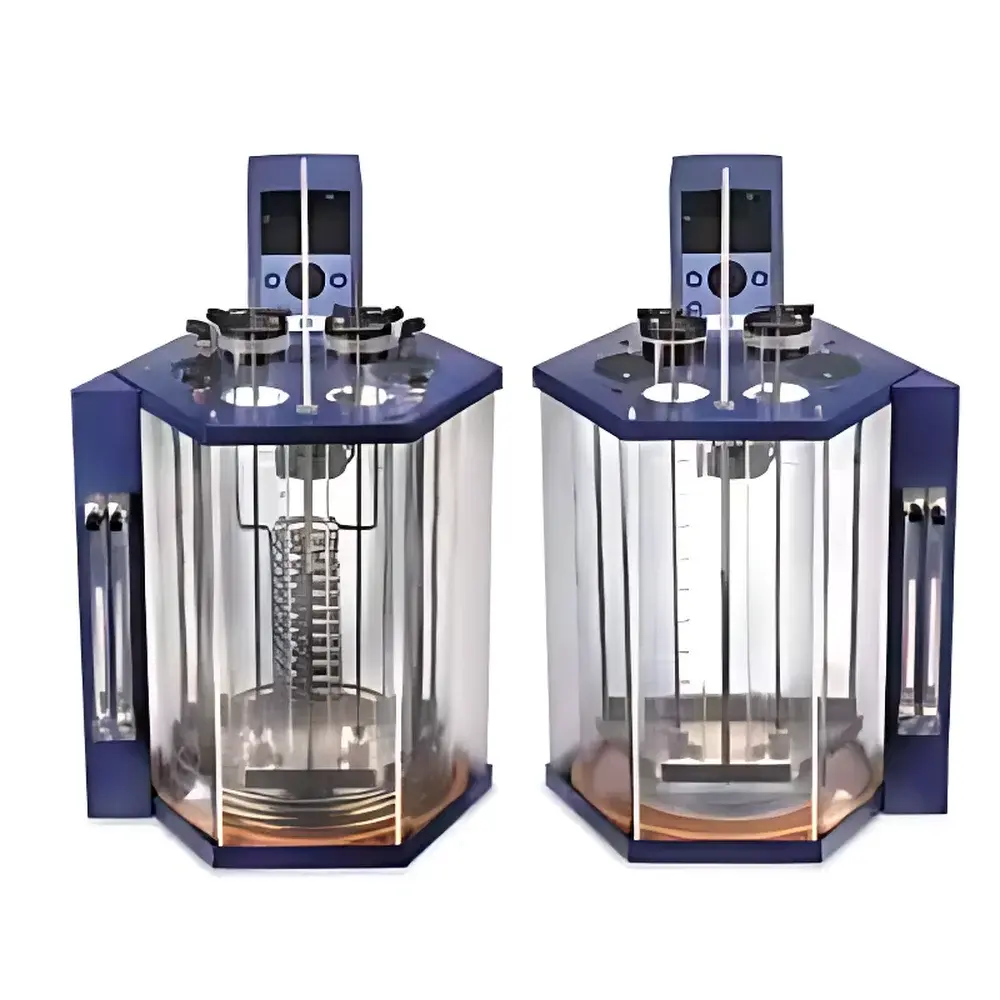
SETA Model 14020-8 Dual-Bath Lubricant Foam Tendency and Stability Tester
| Brand | SETA |
|---|---|
| Origin | United Kingdom |
| Model | 14020-8 |
| Bath Quantity | 2 |
| Cylinders per Bath | 2 (total 4 × 1000 mL) |
| Diffuser Material Options | Stainless Steel or Sintered Glass |
| Flowmeters | 2 per bath |
| Temperature Range | Ambient to 100 °C ±0.5 °C |
| Power Consumption | 3 kW |
| Dimensions (W×D×H) | 70 × 48 × 40 cm |
| Weight | 50 kg |
| Compliance | ASTM D892, ISO 6247, IP 146, BS 2000-146, GB/T 12579, NF T60-129, JIS K2518, FTM 791-3211 |
Overview
The SETA Model 14020-8 Dual-Bath Lubricant Foam Tendency and Stability Tester is a precision-engineered instrument designed for standardized evaluation of foaming behavior in industrial lubricants, hydraulic fluids, turbine oils, and gear oils. It operates on the principle of controlled air sparging into a heated oil sample within calibrated cylindrical vessels, followed by quantitative assessment of foam volume (tendency) and persistence (stability) under defined thermal and flow conditions. This methodology directly reflects real-world operational challenges in high-speed gearboxes, large-volume circulating systems, and splash-lubricated machinery—where excessive foam generation compromises film integrity, induces cavitation, accelerates oxidation, and promotes oil loss through venting. The dual-bath architecture enables concurrent testing at two independent temperatures—critical for simulating multi-zone equipment environments or conducting comparative thermal profiling per ASTM D892 Procedure A (24 °C), B (93.5 °C), and C (repeated heating cycles)—while maintaining strict adherence to temperature uniformity (±0.5 °C) and airflow reproducibility across all four test positions.
Key Features
- Dual independent temperature-controlled baths (each accommodating two 1000 mL graduated cylinders), allowing parallel foam tendency and stability determinations at differing thermal setpoints.
- Integrated dual-flowmeter control per bath ensures precise, repeatable air delivery (typically 94 ±5 mL/s per cylinder) as required by ASTM D892 and ISO 6247.
- Two selectable diffuser types—electropolished stainless steel or sintered glass—support method-specific validation and long-term resistance to hydrocarbon degradation.
- Pre-heating stations adjacent to each bath reduce thermal equilibration time and improve inter-run consistency, particularly during sequential high-temperature testing.
- Robust stainless-steel construction with insulated housing minimizes ambient heat loss and supports stable operation over extended duty cycles (e.g., 10-hour stability monitoring per ISO 6247 Annex A).
- Calibrated immersion thermometers (one per bath) provide direct, traceable temperature verification aligned with laboratory metrology protocols.
Sample Compatibility & Compliance
The SETA 14020-8 accommodates standard 1000 mL borosilicate glass cylinders conforming to ASTM D892 Figure 1 geometry. It supports routine analysis of mineral-based, synthetic, and semi-synthetic lubricants—including those formulated with silicone antifoams, polyacrylate polymers, or silicone-free defoamers. All operational parameters—including bath temperature ramp rate, dwell time, air flow calibration intervals, and cylinder cleaning procedures—are fully documented to support GLP-compliant workflows. The system meets the mechanical and procedural requirements of ASTM D892 (2023 edition), ISO 6247:2022, IP 146:2018, and GB/T 12579–2021. When integrated with validated SOPs and operator training records, it satisfies audit readiness for ISO/IEC 17025-accredited laboratories and supports data integrity requirements under FDA 21 CFR Part 11 when paired with compliant electronic lab notebook (ELN) systems.
Software & Data Management
The SETA 14020-8 is a benchtop manual instrument without embedded digital controls or proprietary software. Temperature monitoring, airflow verification, foam height reading, and timing are performed using external calibrated instruments (e.g., certified digital thermometers, rotameter calibrators, stopwatch with ±0.1 s resolution) and recorded manually or via LIMS-integrated entry forms. This design prioritizes method transparency, reduces firmware-related validation burden, and aligns with legacy QC environments where regulatory submissions require full traceability of human-performed steps. Laboratories may integrate the instrument into broader digital quality systems by assigning unique equipment IDs, linking test records to batch numbers and analyst credentials, and applying electronic signatures during review/approval per ALCOA+ principles.
Applications
- Quality control release testing of new lubricant batches against OEM specifications (e.g., GEK 32568, Rolls-Royce RRES 90001).
- Formulation development of antifoam additives and base stock compatibility screening.
- Troubleshooting field failures linked to foaming—correlating lab-measured foam stability with in-service oil analysis (e.g., MPC, FTIR oxidation index, elemental wear metals).
- Supporting technical service reports for refinery customers requiring ASTM D892 certification documentation.
- Teaching laboratories demonstrating interfacial phenomena, surfactant migration kinetics, and thermal degradation effects on foam collapse mechanisms.
FAQ
Does the SETA 14020-8 include automated data logging or PC connectivity?
No. It is a manually operated, analog instrument designed for direct observation and operator-recorded measurements in accordance with standardized test methods.
Can the unit be used for testing greases or non-fluid lubricants?
No. ASTM D892 and related standards apply exclusively to liquid lubricants with kinematic viscosity ≤ 900 mm²/s at 40 °C. Greases require separate test methods (e.g., ASTM D1263).
What maintenance is required for the sintered glass diffusers?
Sintered diffusers must be cleaned after each use with solvent (e.g., naphtha or toluene), followed by oven drying at 110 °C for 1 hour; pore blockage must be verified visually or via airflow calibration before reuse.
Is third-party calibration certification available for the built-in thermometers?
Yes—SETA provides optional NIST-traceable calibration certificates for the supplied immersion thermometers upon request, valid for 12 months from date of issue.
How is temperature uniformity verified across both baths?
Per ASTM D892 Section 7.2, uniformity is confirmed using a secondary calibrated thermometer inserted at three radial positions and two depths per bath, with maximum deviation not exceeding ±0.5 °C.




