
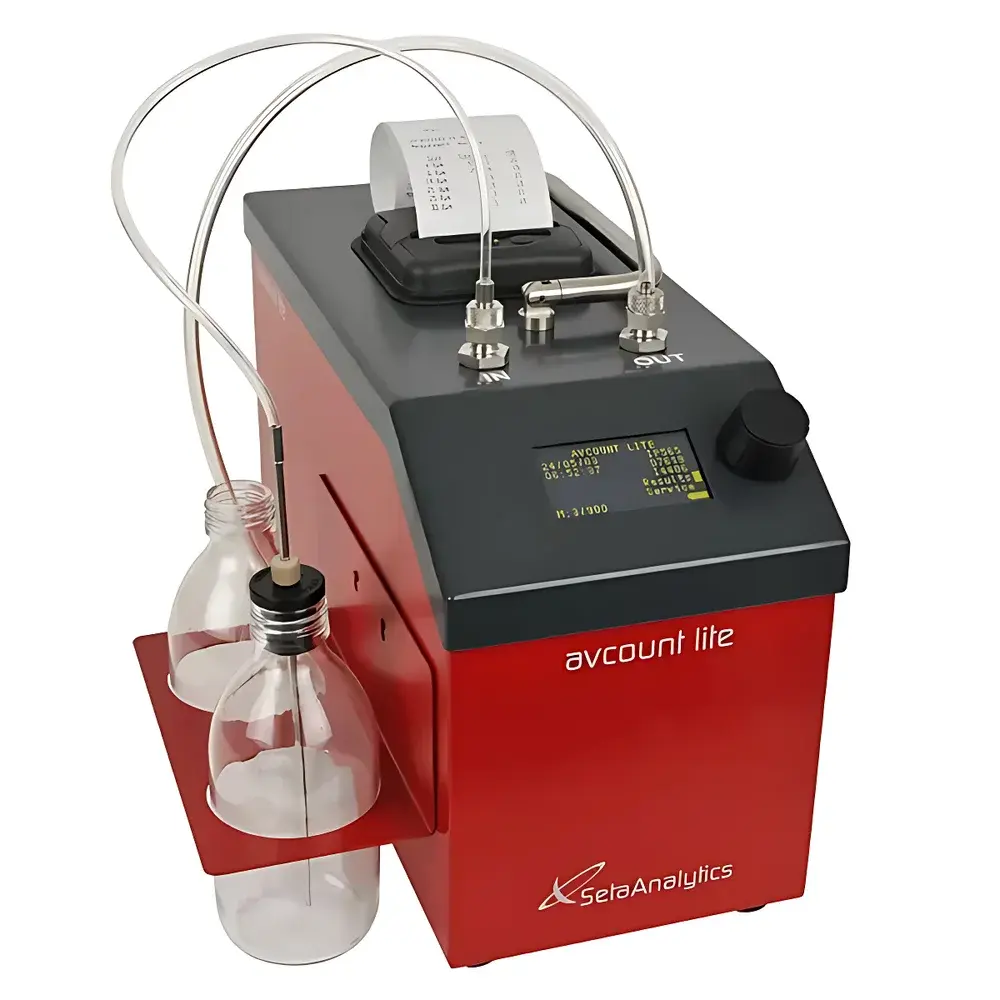
SETA AvCount Lite Portable Optical Particle Counter
| Brand | SETA |
|---|---|
| Origin | United Kingdom |
| Model | SA1800-2 |
| Instrument Type | Optical Particle Counter |
| Compliant Standards | ASTM D975, ASTM D6786, ASTM D7619, IP 565, IP 630, NB/SH/T 0868, JIS B 9932:2012, JIS B 9933:2021, JIS B 9934:2012, GB/T 5930 |
| Measurement Principle | Light Obscuration (LO) |
| Sample Throughput | ≤3 min per test |
| Display | Integrated graphical interface with trend visualization |
| Data Interface | USB port for export |
| Onboard Functions | Built-in thermal printer, three pre-programmed test methods, PC-configurable via Partikel software |
Overview
The SETA AvCount Lite Portable Optical Particle Counter (Model SA1800-2) is a compact, field-deployable instrument engineered for rapid, standardized particle contamination analysis in liquid hydrocarbon-based fluids. It operates on the light obscuration (LO) principle—where particles suspended in a flowing sample stream interrupt a collimated light beam, generating pulse signals proportional to particle cross-sectional area. These signals are classified into user-defined size channels (e.g., ≥4 µm, ≥6 µm, ≥14 µm, ≥21 µm, ≥38 µm, ≥70 µm) to generate ISO 4406:2021-coded cleanliness reports and cumulative particle counts per milliliter. Designed specifically for light-to-medium distillate fuels—including aviation turbine fuel (Jet A-1, JP-5), kerosene, biodiesel blends (B5–B20), low-viscosity lubricants, and hydraulic oils—the AvCount Lite delivers metrologically traceable results aligned with globally recognized specifications for fluid cleanliness assurance.
Key Features
- Portable, battery-operated architecture with integrated rechargeable power system—enabling on-site testing at refueling points, storage tanks, or mobile maintenance units without external AC supply.
- Optical sensing module calibrated per ISO 21501-4 and verified against NIST-traceable latex sphere standards; detection threshold optimized for 4 µm(c) and above in fluids with kinematic viscosity ≤15 mm²/s at 40 °C.
- Three embedded test protocols compliant with ASTM D7619 (for aviation fuels), IP 565 (for diesel and gas oil), and NB/SH/T 0868 (Chinese national standard for biodiesel)—all executable in ≤180 seconds with automated dilution compensation where applicable.
- Onboard thermal printer provides immediate hard-copy output of ISO 4406 codes, raw particle counts per size bin, pass/fail status relative to target cleanliness classes (e.g., ISO 16/13/10), and timestamped metadata.
- Graphical LCD display supports real-time histogram visualization, time-series trend overlays across sequential tests, and intuitive navigation via membrane keypad.
- USB 2.0 interface enables secure data export to Windows-based PCs; exported files include CSV-formatted particle count matrices, method parameters, operator ID, and environmental metadata (ambient temperature, pressure).
Sample Compatibility & Compliance
The AvCount Lite accepts both bottle-mode (offline) and inline (flow-through) sampling configurations. For offline use, it accommodates standard 100 mL or 250 mL glass or polymer sample bottles with compatible inlet tubing (ID 3.2 mm). Inline operation requires connection to a pressurized fluid loop via optional flow-control manifold (SETA accessory kit SA-FM-01), maintaining laminar flow at 20–30 mL/min. All measurement procedures adhere to the statistical sampling requirements defined in ISO 4021 and ASTM D5127 for representative contamination assessment. Regulatory alignment includes full support for ISO 4406:2021 reporting, compliance documentation for ISO 9001 and API RP 1529 audits, and compatibility with laboratory quality management systems operating under GLP or GMP frameworks. While not FDA 21 CFR Part 11–certified out-of-the-box, audit trails generated via Partikel software meet ALCOA+ data integrity criteria when deployed with controlled user access and electronic signature workflows.
Software & Data Management
The instrument is fully programmable using SETA’s Partikel desktop software (v3.2+), a Windows-native application supporting method development, calibration validation, report templating, and database archiving. Partikel enables creation of custom size bin definitions, threshold adjustment for optical gain stability, and integration with LIMS via ODBC-compliant export. Each test record stores instrument serial number, firmware revision, calibration certificate ID, operator login, and environmental logs—ensuring full traceability per ISO/IEC 17025 Clause 7.7. Data encryption (AES-128) and role-based access control (administrator/operator/viewer) are available within enterprise deployments. Export formats include PDF (print-ready reports), CSV (raw channel counts), and XML (structured metadata for ERP ingestion).
Applications
- Aviation fuel quality assurance at airport hydrant systems and fuel farms—verifying compliance with DEF STAN 91-91 and NATO F-34 before aircraft acceptance.
- Routine monitoring of biodiesel production batches per EN 14214 and ASTM D6751 to detect catalyst residue, glycerin carryover, or tank corrosion particulates.
- Hydraulic system health diagnostics in wind turbine gearboxes and aerospace actuation circuits—identifying wear debris signatures indicative of bearing or servo-valve degradation.
- Field verification of filter performance during commissioning of coalescer-separator assemblies in marine fuel treatment skids (IMO MARPOL Annex VI Annex 10).
- QC release testing of synthetic ester-based transformer oils per IEC 60296, where sub-10 µm particle load correlates with dielectric strength decay.
FAQ
What fluid viscosity range is supported by the AvCount Lite?
The instrument is validated for fluids with kinematic viscosity between 1.0 and 15.0 mm²/s at 40 °C. Viscosities exceeding 15 mm²/s require pre-dilution with certified clean solvent (e.g., ISO Grade 1 white oil) and application of dilution correction factors embedded in the ASTM D7619 protocol.
Can the AvCount Lite be used for water-based emulsions or coolant fluids?
No. The optical sensor is calibrated exclusively for hydrocarbon solvents and non-aqueous media. Water droplets cause refractive index mismatch and signal distortion; dedicated instruments with dual-wavelength or laser-induced breakdown detection are required for aqueous systems.
Is calibration certification included with the instrument?
Yes. Each unit ships with a UKAS-accredited calibration certificate (Ref: SETA-CAL-SA1800-XXXXX) valid for 12 months, covering linearity, size threshold accuracy, and counting efficiency per ISO 21501-4 Annex B.
How is sample volume accuracy ensured during testing?
An integrated positive-displacement piston pump with sapphire-plated plunger and ceramic check valves maintains volumetric precision ±1.5% over 10 mL–100 mL dispense ranges. Flow rate is continuously monitored via Hall-effect sensor feedback and adjusted in real time to compensate for backpressure fluctuations.
Does the device support remote firmware updates?
Firmware updates are performed locally via USB using SETA’s signed update package (SA1800-UPD-v4.1.0.bin); no cloud connectivity or internet dependency is implemented to preserve network security in critical infrastructure environments.



