
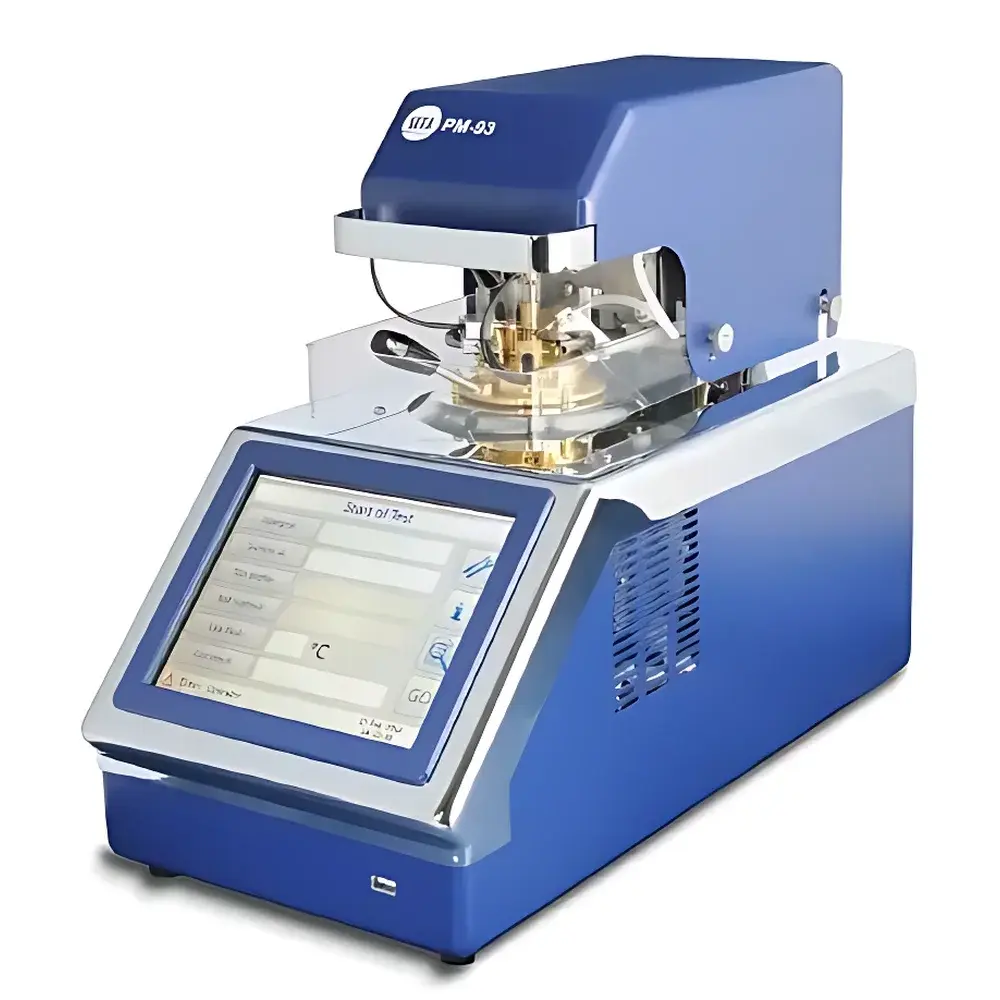
SETA Model 35000-0 Automated Closed-Cup Flash Point Tester
| Brand | SETA |
|---|---|
| Origin | United Kingdom |
| Model | 35000-0 |
| Test Method | Closed-Cup (Pensky-Martens) |
| Temperature Range | +5 °C to 400 °C |
| Temperature Resolution | ±0.1 °C |
| Heating Rates | 1.0, 1.3, 3.0, 5.5 °C/min (standard) |
| Stirring Speed | 105 or 250 rpm |
| Ignition Options | Electric spark or gas flame (user-selectable in menu) |
| Atmospheric Pressure Correction | Integrated digital barometer with automatic flash point compensation |
| Display | 8.4-inch color touchscreen (Chinese UI) |
| Data Storage | ≥2000 test records, 30 programmable methods |
| Connectivity | Ethernet and RS-232 |
| Dimensions | 38.5 × 24 × 50 cm |
| Weight | 25 kg |
Overview
The SETA Model 35000-0 Automated Closed-Cup Flash Point Tester is an ASTM D93– and GB/T 261–compliant instrument engineered for precise, repeatable determination of the closed-cup flash point of petroleum products, lubricants, solvents, and related hydrocarbon-based liquids. It operates on the Pensky-Martens closed-cup principle: a sample is heated under controlled conditions while a standardized ignition source is periodically introduced into the vapor space above the liquid surface; the lowest temperature at which momentary ignition (flash) occurs is recorded as the flash point. This thermodynamic endpoint reflects the volatility and fire hazard potential of the material under defined atmospheric conditions—making it a critical parameter for safety classification (e.g., OSHA, GHS), transportation regulation (UN TDG, IMDG Code), and refinery quality control.
Key Features
- Full compliance with 12 international standards including ASTM D93, ASTM E502, ISO 15267, EN ISO 2719, IP 34, JIS K2265, DIN 51758, NF M07-019, FTM 791.1102, EPA 1010 A, and GB/T 261—ensuring regulatory acceptance across global markets.
- Programmable heating profiles with five selectable ramp rates (1.0, 1.3, 3.0, 5.5 °C/min standard; rapid mode >10 °C/min), enabling method-specific thermal protocols without hardware modification.
- Dual ignition capability—electric spark and gas flame—switchable via touchscreen interface; no mechanical reconfiguration or accessory swapping required.
- Integrated digital barometer provides real-time atmospheric pressure measurement and automatically corrects flash point values per ASTM D93 Annex A1 and ISO 2719 Clause 8.2, eliminating manual correction errors.
- Fixed-position flash probe, Pt100 temperature sensor, and magnetic stirrer are mechanically co-aligned within a single robust assembly—eliminating alignment drift and operator-dependent setup variability.
- 8.4-inch high-resolution color touchscreen with intuitive Chinese-language interface supports creation, storage, and recall of up to 30 user-defined test methods and archives over 2000 result entries with timestamp, method ID, ambient pressure, and final flash point.
- Standard Ethernet and RS-232 interfaces enable seamless integration with laboratory information management systems (LIMS), electronic notebooks, or networked printers—supporting audit-ready data export in CSV or PDF format.
Sample Compatibility & Compliance
The SETA 35000-0 is validated for use with crude oils, distillates (e.g., diesel, kerosene), residual fuels, base oils, hydraulic fluids, brake fluids, and non-aqueous solvent blends. It excludes water-miscible or highly volatile materials (e.g., acetone, ethanol below 20% v/v) that may yield non-reproducible vapor-phase behavior under closed-cup conditions. All test procedures adhere to Good Laboratory Practice (GLP) requirements for instrument calibration traceability (NIST-traceable reference standards), operational verification (daily blank and check standard runs), and data integrity (time-stamped, immutable result logs). The system meets FDA 21 CFR Part 11 readiness when deployed with validated LIMS software supporting electronic signatures and audit trails.
Software & Data Management
Onboard firmware implements a deterministic state-machine architecture for unattended operation—each test sequence follows strict phase transitions (fill → equilibrate → ramp → scan → ignite → confirm → cool → report). Data files include raw temperature/time curves, ignition event timestamps, pressure-corrected flash point, and pass/fail flags against method-defined tolerances. Exported datasets retain full metadata (operator ID, method version, calibration certificate ID, environmental conditions) and conform to ASTM E1382–22 guidelines for analytical data interchange. Optional firmware upgrades support enhanced cybersecurity features (TLS 1.2 encryption for remote diagnostics) and extended audit log retention (≥18 months).
Applications
- Refinery QC laboratories verifying flash point compliance prior to product release (e.g., ASTM D975 for diesel fuel).
- Independent testing labs performing third-party certification for UN Class 3 flammable liquid classification.
- R&D departments evaluating formulation stability during solvent blending or additive development.
- Regulatory agencies conducting surveillance testing of commercial fuels and lubricants per national petroleum standards.
- Marine and aviation fuel testing facilities ensuring conformity with IMO MARPOL Annex VI and IATA DGR flash point thresholds.
FAQ
Does the SETA 35000-0 require external calibration equipment?
No—temperature calibration is performed in situ using certified reference oils traceable to NIST SRM 2357; the system supports multi-point verification across its full range (±0.1 °C accuracy confirmed at 50 °C, 100 °C, and 300 °C).
Can test results be exported directly to Excel or LIMS without manual transcription?
Yes—via Ethernet or RS-232, the instrument transmits structured ASCII data packets compatible with common LIMS APIs; CSV exports include all raw and corrected values plus method parameters.
Is atmospheric pressure correction applied in real time during the test?
Yes—the internal barometer samples pressure every 30 seconds; flash point calculation uses the average pressure value over the final 5-minute ramp interval, per ISO 2719:2016 Clause 8.2.
What maintenance is required for long-term reliability?
Annual verification of stirrer torque, ignition electrode wear, and cup seal integrity is recommended; no routine consumables beyond standard cleaning solvents and calibration oils.
Does the unit meet explosion-proof requirements for hazardous area installation?
The SETA 35000-0 is rated for general laboratory use (IEC 61010-1); it is not certified for Zone 1/2 hazardous locations—installation must comply with local electrical safety codes and ventilation standards for flammable vapor handling.




