
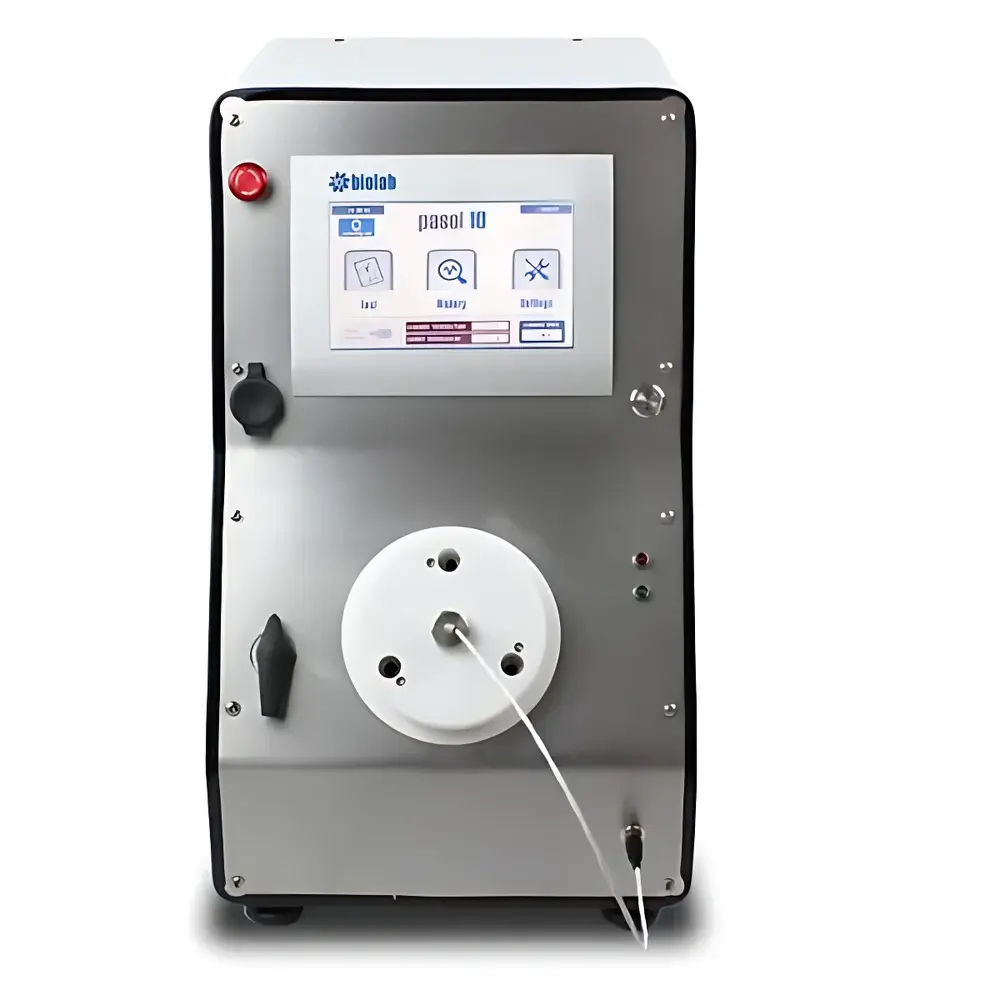
Biolab Pasol Oxidation Stability Analyzer
| Brand | Biolab |
|---|---|
| Model | Pasol |
| Test Methods | ASTM D2272 (RPVOT), ASTM D4742 (TFOUT), ASTM D942, ASTM D2112, IP 229, SH/T 0193 |
| Temperature Range | Up to 200 °C (metal bath heating) |
| Safety Features | Overtemperature & overpressure lockout, automatic venting of hazardous gases, insulated stainless-steel test chamber |
| Automation | Auto-oxygen pressurization, real-time pressure/temperature monitoring, endpoint detection, report generation (JPEG + parameter-rich PDF), USB/Ethernet connectivity (up to 12 units) |
| Software | Windows-based touchscreen interface with method library, audit-ready data logging, and GLP-compliant reporting |
Overview
The Biolab Pasol Oxidation Stability Analyzer is an engineered solution for quantitative assessment of oxidative degradation resistance in petroleum-based lubricants, hydraulic fluids, turbine oils, and greases. It operates on established accelerated oxidation principles defined by internationally recognized standards—including the Rotating Pressure Vessel Oxidation Test (RPVOT, ASTM D2272), Thin-Film Oxygen Uptake Test (TFOUT, ASTM D4742), and grease-specific protocols (ASTM D942, IP 229, SH/T 0193). By subjecting samples to controlled elevated temperature (up to 200 °C), high-purity oxygen pressure, and mechanical agitation—via magnetically coupled inner cylinder rotation—the instrument accelerates oxidation kinetics, enabling prediction of service life, remaining useful life (RUL), and early detection of antioxidant depletion. This predictive capability supports proactive maintenance strategies in power generation, aviation, marine propulsion, and industrial machinery sectors where oil oxidation directly correlates with sludge formation, acid number rise, viscosity change, and bearing wear.
Key Features
- Integrated metal-block heating system delivering precise, uniform temperature control up to 200 °C with ±0.1 °C stability—critical for reproducible RPVOT and TFOUT execution.
- Real-time dual-parameter monitoring: simultaneous acquisition and graphical display of sample temperature and internal oxygen pressure throughout the test cycle.
- Automated gas handling: pre-test oxygen pressure calculation based on ambient conditions and target test parameters; fully automated pressurization, purge, and vent sequences compliant with ASTM safety requirements.
- Touchscreen Windows-based control unit with intuitive navigation, method library management, and on-device creation or modification of test protocols per standard specifications.
- Dual USB ports (front and rear) plus Ethernet interface supporting networked operation—enabling centralized monitoring and synchronized data collection across up to 12 analyzers in a single lab environment.
- Comprehensive safety architecture: redundant overtemperature cutoff, pressure interlock, passive thermal shielding of the stainless-steel reaction chamber, and programmable hazardous gas evacuation.
- Full-cycle data autonomy: automatic JPEG curve export, timestamped parameter logs, and PDF reports containing method ID, operator ID, calibration status, raw curves, and pass/fail annotations against specified endpoints.
Sample Compatibility & Compliance
The Pasol analyzer accommodates standard RPVOT vessels (60 mL), TFOUT thin-film pans, and grease test cells per ASTM D942. Its design ensures full compatibility with mineral, synthetic, and semi-synthetic base oils, as well as lithium-, calcium-, and polyurea-thickened greases. All operational firmware and software modules are structured to enforce strict adherence to method-defined ramp rates, dwell times, pressure thresholds, and termination criteria. The system supports audit readiness under GLP and GMP frameworks: electronic records include user authentication, immutable timestamps, version-controlled method files, and full traceability from sample loading to final report generation—aligning with FDA 21 CFR Part 11 data integrity expectations for regulated laboratories.
Software & Data Management
The embedded Windows OS runs proprietary analytical software engineered for petroleum testing workflows. It provides role-based access control, customizable report templates (including multi-language support), and native export to CSV, PDF, and JPEG formats. All test data—including pressure vs. time and temperature vs. time curves—are stored locally with SHA-256 checksum validation. Network deployment enables integration with LIMS via standardized ODBC or RESTful API endpoints. Audit trails log every user action (e.g., method edit, calibration entry, report approval), satisfying ISO/IEC 17025 clause 7.5.2 for record retention and traceability.
Applications
- Predictive maintenance of turbine and compressor oils in electric utilities and offshore platforms.
- Quality release testing of new lubricant batches against OEM specifications (e.g., GEK 32568, Siemens TLV 9013).
- Oxidation inhibitor screening during formulation development of synthetic esters and PAOs.
- Remaining life assessment of in-service oils in critical hydraulics systems (e.g., wind turbine pitch controls).
- Regulatory compliance verification for military-grade lubricants (MIL-PRF-23699, MIL-PRF-83133).
- Research into antioxidant synergism and degradation pathway analysis using comparative RPVOT/TFOUT datasets.
FAQ
Which ASTM methods does the Pasol analyzer natively support?
ASTM D2272 (RPVOT), D4742 (TFOUT), D942, D2112, IP 229, and SH/T 0193—all implemented with method-specific default parameters and editable tolerances.
Is the system compatible with laboratory information management systems (LIMS)?
Yes—via configurable ODBC drivers and HTTP-based API endpoints supporting structured data exchange in JSON or XML format.
Does the instrument meet regulatory requirements for electronic records?
Yes—software enforces 21 CFR Part 11 compliance through electronic signatures, audit trail logging, and data immutability controls.
Can test methods be customized beyond standard protocols?
Yes—users may define non-standard temperature ramps, pressure setpoints, rotation speeds, and termination logic while retaining full traceability.
What cooling options are available for high-throughput labs?
An optional external rapid-cooling module (liquid N₂ or chilled glycol interface) reduces post-test cooldown time by >60% versus passive dissipation.





