
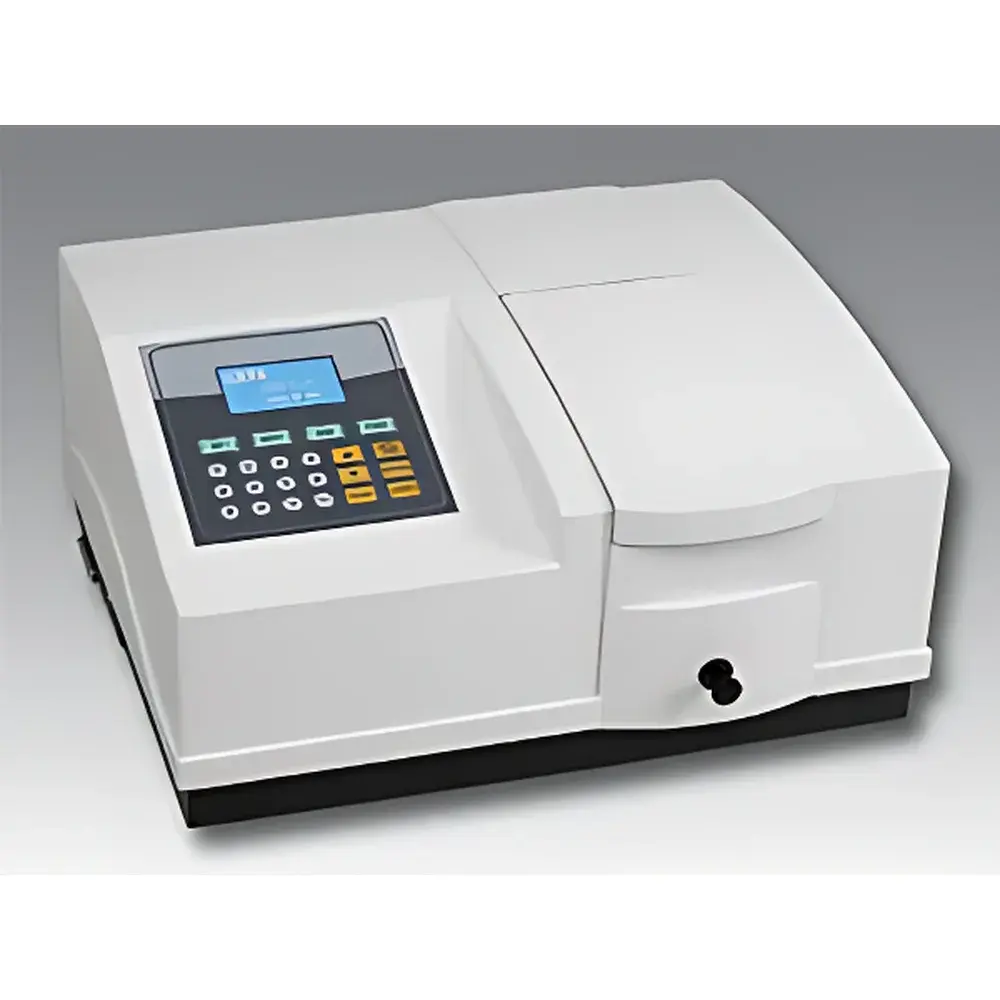
Shanghai SOPTOP 723PC Single-Beam UV-Vis Spectrophotometer
| Brand | SOPTOP |
|---|---|
| Origin | Shanghai, China |
| Model | 723PC |
| Optical System | Single-beam |
| Detector | Photodiode Array |
| Wavelength Range | 325–1100 nm (0.1 nm step) |
| Spectral Bandwidth | 2 nm |
| Wavelength Accuracy | ±1.0 nm (auto-calibrated at startup) |
| Wavelength Repeatability | ±0.5 nm |
| Stray Light | ≤0.2% T (at 360 nm) |
| Photometric Accuracy | ±0.5% T |
| Photometric Repeatability | ±0.2% T |
| Baseline Drift | ±0.002 A/h |
| Baseline Linearity | ±0.004 A |
| Absorbance Range | –0.5 to 3.000 A |
| Transmittance Range | –1.0 to 200.0% T |
| Display | 128 × 64 dot-matrix LCD |
| Dimensions | 455 × 430 × 220 mm |
| Software | UV-Solution 2.0 workstation (scan, kinetics, quantitative analysis, standard curve fitting) |
Overview
The Shanghai SOPTOP 723PC is a single-beam ultraviolet-visible (UV-Vis) spectrophotometer engineered for precision quantitative analysis in the visible and near-UV spectral region (325–1100 nm). It operates on the principle of Beer–Lambert law-based absorbance measurement, where sample concentration is determined from light attenuation at characteristic wavelengths. Designed for routine laboratory environments—including academic teaching labs, QC/QA departments in food and pharmaceutical manufacturing, environmental monitoring facilities, and industrial R&D centers—the instrument delivers high reproducibility and operational stability without requiring complex optical alignment or dual-beam referencing. Its fixed 2 nm spectral bandwidth ensures adequate resolution for most colorimetric assays while maintaining signal-to-noise ratio across the full wavelength range. The photodiode array detector enables rapid data acquisition and eliminates mechanical scanning delays associated with traditional monochromator-based systems.
Key Features
- Automatic wavelength scanning and positioning with 0.1 nm incremental resolution, enabling precise peak identification and method transferability.
- Integrated dark-current correction and real-time baseline compensation algorithms to minimize thermal drift and detector nonlinearity effects.
- Onboard calibration routines including automatic wavelength verification and zero-absorbance reference adjustment—fully compliant with ISO 9001 laboratory practice guidelines.
- 128 × 64 pixel backlit LCD display with intuitive menu navigation; supports both English and Chinese language interfaces (configurable via firmware).
- Up to 12-point first-order linear or zero-intercept calibration curves with automatic goodness-of-fit calculation (R² reporting) and residual error visualization.
- Internal memory stores up to 50 user-defined calibration curves and 200 individual measurement records, each timestamped via integrated real-time clock (RTC) module.
- USB 2.0 interface compatible with Windows-based UV-Solution 2.0 software for advanced spectral scanning, kinetic profiling, multi-wavelength quantitation, and GLP-compliant report generation.
Sample Compatibility & Compliance
The 723PC accommodates standard 10 mm pathlength cuvettes (glass, quartz, or plastic), supporting liquid, suspension, and diluted solid-phase extracts. It meets essential performance criteria outlined in ASTM E275 (Standard Practices for Describing and Measuring Performance of UV-Vis Spectrophotometers) and aligns with key sections of ISO/IEC 17025:2017 for analytical instrument validation. While not certified for regulated GMP environments out-of-the-box, its traceable wavelength accuracy (±1.0 nm), low stray light (<0.2% T), and documented photometric repeatability (±0.2% T) provide foundational evidence for internal method validation under FDA 21 CFR Part 11–aligned data integrity frameworks when paired with UV-Solution 2.0 audit-trail logging.
Software & Data Management
UV-Solution 2.0 is a dedicated Windows application that extends the 723PC’s functionality beyond basic absorbance reading. It supports full spectral scans (325–1100 nm), time-resolved kinetics (up to 100 points/sec), multi-component analysis using additive absorbance models, and customizable report templates exportable as PDF or CSV. All instrument commands, parameter changes, and measurement events are logged with timestamps, operator ID fields, and digital signatures—enabling retrospective review per GLP requirements. Raw spectral data files (.spc format) retain metadata including lamp hours, detector gain settings, and calibration history.
Applications
- Quantitative determination of transition metal ions (e.g., Fe²⁺/Fe³⁺, Cu²⁺, Cr⁶⁺) in wastewater using standardized colorimetric reagents (e.g., 1,10-phenanthroline, diphenylcarbazide).
- Enzyme activity assays (e.g., NADH/NADPH oxidation at 340 nm) and protein concentration estimation via Bradford or BCA methods (595 nm or 562 nm).
- Quality control of dyes, pigments, and food colorants in beverage and confectionery production lines.
- Educational use in undergraduate chemistry laboratories for teaching spectroscopic principles, calibration curve construction, and statistical evaluation of analytical uncertainty.
- Phytochemical screening in agricultural research (e.g., chlorophyll a/b quantification at 645/663 nm; anthocyanin index at 530/657 nm).
FAQ
Is the 723PC compliant with FDA 21 CFR Part 11?
The hardware itself does not include electronic signature or role-based access controls; however, UV-Solution 2.0 supports audit-trail logging and user authentication when deployed on validated Windows systems—making it suitable for Part 11 implementation within controlled IT environments.
Can quartz cuvettes be used below 350 nm?
Yes—while the specified lower limit is 325 nm, optimal performance below 350 nm requires fused silica or synthetic quartz cuvettes to avoid absorption artifacts from standard optical glass.
What is the warm-up time required before measurement?
A minimum 15-minute stabilization period is recommended after power-on to ensure thermal equilibrium of the deuterium/tungsten lamp assembly and detector electronics.
Does the instrument support external printer output?
Direct parallel or USB printer connectivity is not built-in, but reports generated in UV-Solution 2.0 can be exported and printed via standard Windows drivers.
How often should wavelength calibration be performed?
SOPTOP recommends performing wavelength verification using holmium oxide or didymium filters at least once per month—or prior to critical measurements—as part of routine instrument qualification (IQ/OQ).
Related Products





