
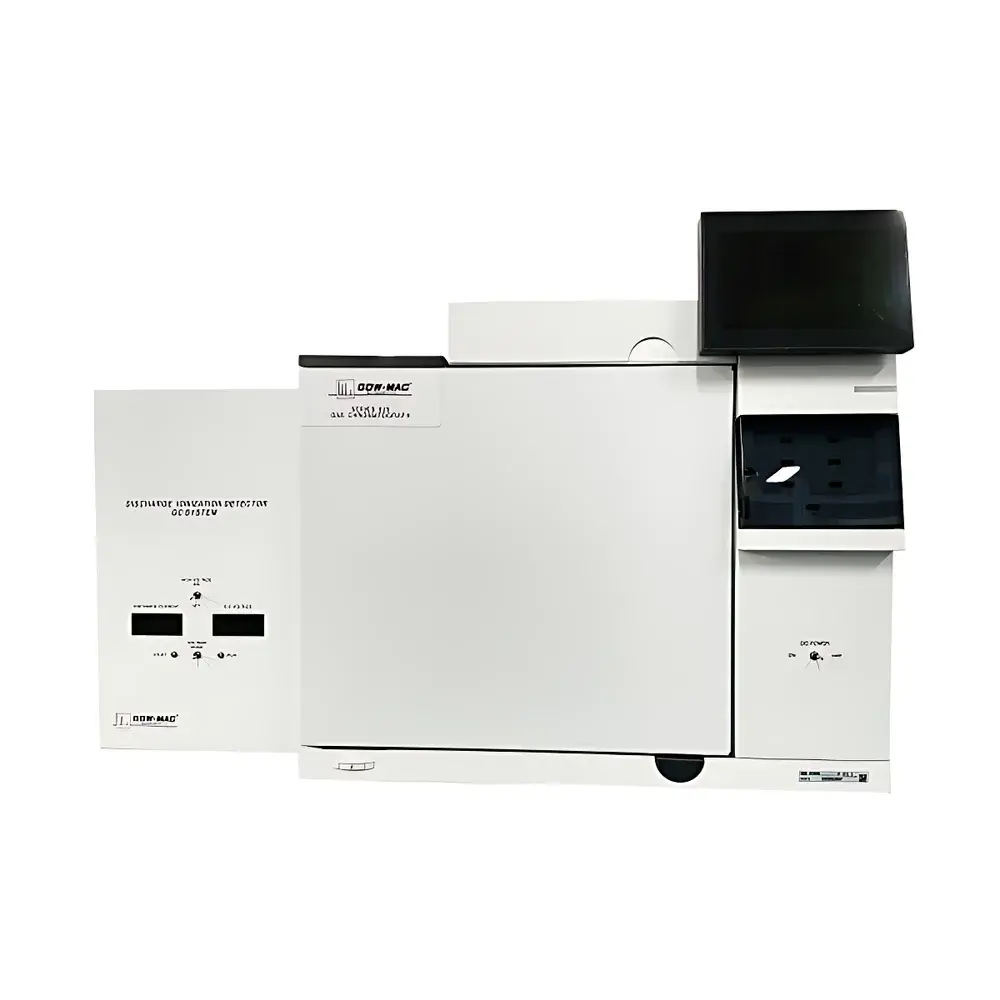
GOW-MAC GM 826 Series Gas Chromatograph
| Brand | GOW-MAC |
|---|---|
| Origin | USA |
| Model | GM 826 Series |
| Instrument Type | Laboratory Gas Chromatograph |
| Application Scope | General-Purpose |
| Detector Capacity | Up to Four Detectors (including one TCD) |
| Column Compatibility | Two 105 m × 0.53 mm Capillary Columns |
| Valve Automation | Supports up to 8 Automated Valves in a Single Method |
| Heating Zones | 6 Independent Zones (2 Inlets, 2 Detectors, 2 Auxiliary) |
| EPC Modules | Up to 6 Modules Controlling 16 EPC Channels |
| Sample Sequence Capacity | Up to 550 Samples |
| Communication Interfaces | Ethernet, RS-232/RS-485, Dual Analog Outputs (1 mV / 1 V / 10 V), Remote Start/Stop, Barcode Reader Option |
| Pressure & Temperature Compensation | Atmospheric Pressure and Ambient Temperature Compensation Integrated |
| Flow Path Material | Corrosion-Resistant Optional Flow Path |
| Touchscreen Interface | Integrated Color TFT Display with Intuitive GUI |
Overview
The GOW-MAC GM 826 Series Gas Chromatograph is a high-integrity, modular laboratory gas chromatograph engineered for precision, long-term stability, and method flexibility in regulated and research environments. Designed and manufactured in the United States since 1935, this instrument implements classical packed and capillary column separation principles based on differential partitioning of analytes between a mobile gas phase (carrier gas) and a stationary phase coated on the inner wall of the column. Its architecture supports both qualitative identification and quantitative analysis across diverse chemical matrices—including volatile organic compounds (VOCs), residual solvents, hydrocarbon fractions, environmental pollutants, and industrial process gases. Unlike entry-level GC systems, the GM 826 integrates full electronic pressure and flow control (EPC) with real-time atmospheric pressure and ambient temperature compensation—ensuring retention time reproducibility and peak area precision under variable lab conditions. The system’s robust mechanical design, thermally isolated valve heating zones, and corrosion-resistant optional flow path accommodate aggressive sample types without compromising baseline stability or detector sensitivity.
Key Features
- Modular detector configuration supporting up to four simultaneous detectors—including thermal conductivity detection (TCD) as standard—with independent temperature control and signal conditioning.
- Six independently programmable heating zones: two inlet ports, two detector compartments, and two auxiliary zones—each with dedicated PID control and thermal insulation from the main oven.
- Up to six EPC modules installed internally, enabling precise regulation of up to 16 pressure/flow channels across multiple columns, valves, and detectors.
- Integrated 7-inch color TFT touchscreen interface with intuitive graphical workflow navigation—supporting method editing, sequence management, diagnostic logging, and real-time parameter monitoring.
- Automated column backflush capability for extended column life and reduced maintenance intervals in complex matrix analysis.
- Onboard event control infrastructure: four internal 24 V DC valve drivers, two external 24 V low-power relays, and two 48 V switching outputs for synchronization with external equipment (e.g., autosamplers, reactors, or fraction collectors).
- Pre-programmable instrument startup (e.g., “Method Start Time”) with automatic deviation logging—enabling unattended overnight operation and GLP-compliant audit trails.
Sample Compatibility & Compliance
The GM 826 accommodates a broad range of sample introduction techniques including split/splitless injection, on-column injection, and gas-tight syringe or valve-based sampling. It supports both packed columns (up to 6 mm ID) and wide-bore capillary columns (up to 105 m × 0.53 mm ID), making it suitable for legacy method transfer and modern high-resolution applications. Optional corrosion-resistant flow path materials (e.g., SilcoNert®-treated stainless steel or fused silica-lined tubing) extend compatibility to halogenated, sulfur-containing, or acidic compounds. The system meets fundamental requirements for ISO/IEC 17025-accredited laboratories and supports compliance with USP , ASTM D3606/D5501/D6729, and EPA Methods 8015/8240/8260 when configured with appropriate detectors and validation protocols. All firmware and software logs maintain timestamped records required for FDA 21 CFR Part 11–aligned environments when paired with validated third-party LIMS or CDS platforms.
Software & Data Management
While the GM 826 operates autonomously via its embedded controller and touchscreen interface, it is fully compatible with industry-standard chromatography data systems (CDS) through native Ethernet and RS-232/RS-485 interfaces. Binary-encoded valve selection commands, analog output signals (1 mV, 1 V, 10 V), and remote start/stop triggers enable seamless integration into automated analytical workflows. Up to 10 user-defined methods can be stored onboard; all method parameters—including ramp rates, hold times, detector voltages, and EPC setpoints—are retained with checksum verification. System diagnostics—including leak detection routines, temperature sensor validation, and pressure transducer self-tests—are accessible via the GUI and exportable as CSV-formatted reports. Audit trail functionality captures operator actions, method changes, and run deviations—providing traceability essential for GMP/GLP audits.
Applications
The GM 826 serves as a foundational platform for routine and advanced gas-phase separations across pharmaceutical QC (residual solvent testing per ICH Q3C), petrochemical analysis (hydrocarbon typing, PIONA distribution), environmental monitoring (BTEX, chlorinated VOCs in soil/water headspace), food safety (ethanol fermentation profiling, flavor volatiles), and industrial hygiene (workplace air contaminant screening). Its multi-valve, multi-column architecture enables heart-cutting, column-switching, and multidimensional GC (MDGC) configurations—ideal for resolving co-eluting peaks in complex mixtures. Laboratories performing method development benefit from its flexible EPC tuning, customizable temperature programming, and deterministic event sequencing—reducing method optimization cycles and improving inter-laboratory transferability.
FAQ
Does the GM 826 support regulatory-compliant data integrity?
Yes—when integrated with validated third-party CDS software and operated under documented SOPs, the GM 826 provides the hardware-level controls (audit trail logging, electronic signatures via external authentication, and tamper-evident method storage) required for FDA 21 CFR Part 11 and EU Annex 11 alignment.
Can the instrument operate unattended for extended sequences?
Yes—the system supports up to 550-sample sequences with scheduled startup, automatic method recall, and real-time fault detection that pauses runs upon pressure/temperature deviation outside user-defined thresholds.
Is column backflushing supported natively?
Yes—backflush functionality is implemented at the firmware level and controllable via the touchscreen or remote command interface, eliminating the need for manual valve reconfiguration during method execution.
What carrier gases are compatible with the EPC system?
Helium, hydrogen, nitrogen, and argon are fully supported; EPC modules auto-compensate for gas-specific compressibility and viscosity characteristics using built-in gas property tables.
How is temperature uniformity maintained across independent zones?
Each zone employs a dedicated platinum RTD sensor and digital PID algorithm with ±0.1 °C stability over 8-hour periods; thermal isolation between oven and valve/detector zones minimizes cross-talk during rapid temperature transitions.




