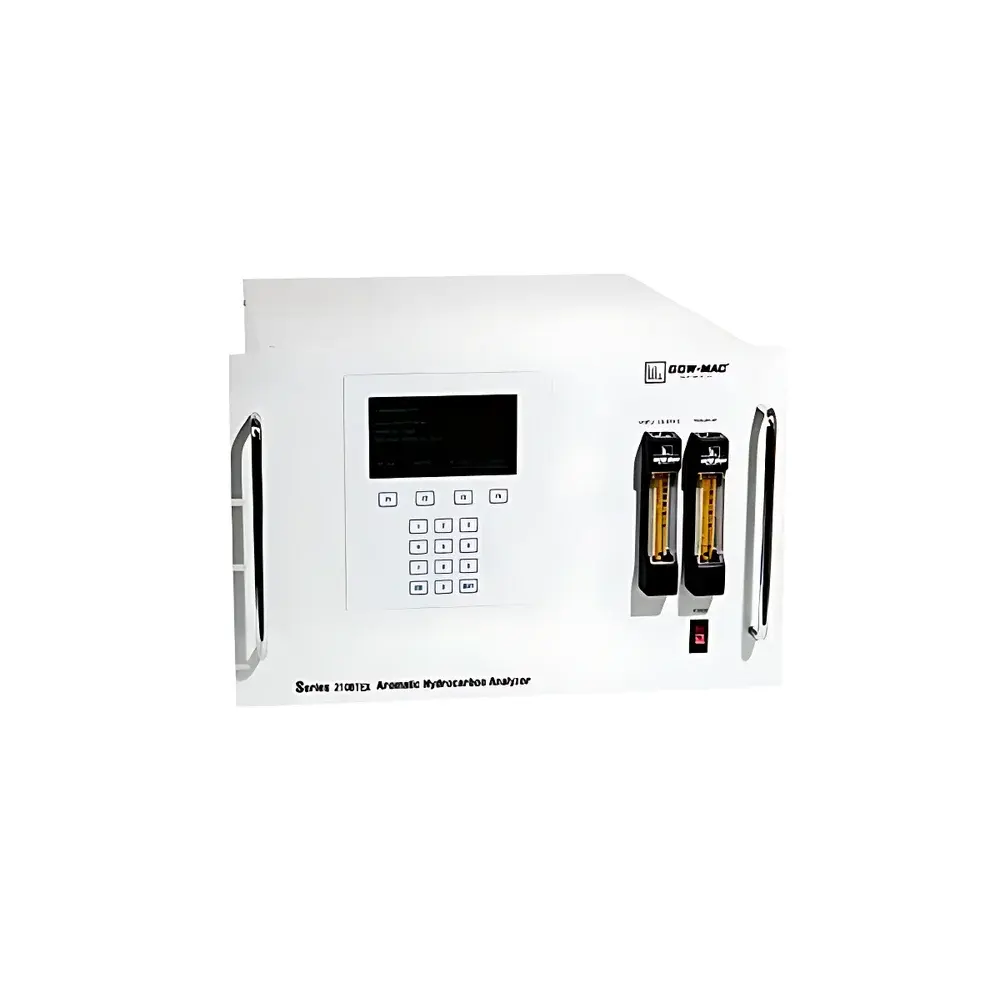
GOW-MAC 210 BTEX Online Gas Chromatograph for Trace Aromatic Hydrocarbon Analysis
| Brand | GOW-MAC |
|---|---|
| Origin | USA |
| Model | GOW-MAC 210 BTEX |
| Detection Limit | <5 ppb |
| Linear Range | 5 ppb to 5 ppm |
| Carrier Gas Flow Rate | ≈7 cc/min |
| Carrier Gas Pressure | 5–10 psig |
| Sample/Calibration Gas Pressure | 5 psig (max 20 psig) |
| Operating Temperature | 5–40 °C |
| Power Requirement | 400 W |
| Dimensions (W×H×D) | 42.9 × 31.1 × 58.4 cm |
| Weight | 23 kg (net), 28 kg (shipping) |
| Gas Fitting | 1/8" Swagelok |
| Mounting | EIA 19" rack (7U) or benchtop |
| Analog Outputs | six 4–20 mA channels |
| Input Trigger | TTL or dry contact |
| Display | 16×2 character LED backlight |
| User Interface | membrane keypad (non-contact, numeric) |
Overview
The GOW-MAC 210 BTEX Online Gas Chromatograph is a dedicated, industrial-grade analytical system engineered for continuous, unattended quantification of benzene, toluene, ethylbenzene, and xylenes (BTEX) in gaseous matrices at trace concentration levels. Based on proven gas chromatographic separation principles—employing a temperature-programmable column oven, precision-controlled carrier gas flow, and a highly selective detector—the instrument delivers robust performance in demanding process environments. Its design adheres to fundamental chromatographic integrity: reproducible sample introduction via fixed-volume loop injection, thermally stable column elution, and calibrated signal detection optimized for aromatic hydrocarbons. The system operates fully autonomously following initial configuration, requiring no operator intervention during routine analysis cycles—making it suitable for integration into continuous emission monitoring systems (CEMS), beverage CO₂ purity assurance protocols, and industrial gas quality control loops.
Key Features
- Modular architecture enabling “plug-and-play” replacement of critical subsystems—including detector modules, column oven assemblies, and valve manifolds—with minimal tools and ≤10 minutes per maintenance action.
- Automated dual-solenoid sample introduction system: one valve selects between calibration gas and process sample; the second is a fixed-volume sampling loop valve with upstream solenoid isolation to minimize calibration gas consumption during idle periods.
- Carrier gas flow regulated by high-stability mass flow controller (≈7 cc/min); compatible with cylinder sources, bulk gas vessels, or portable hydrogen generators—provided ambient temperature near gas supply remains within ±3 °C.
- Front-panel integrated flow meters for real-time visual verification of carrier, sample, and calibration gas flows.
- Factory-configured detector temperature (adjustable via software), programmable column oven ramp profiles, and embedded thermal management ensuring retention time stability across ambient fluctuations (5–40 °C operating range).
- Industrial I/O interface: six isolated 4–20 mA analog outputs assignable to individual BTEX compound concentrations or diagnostic parameters; TTL/dry-contact trigger input for external synchronization.
Sample Compatibility & Compliance
The GOW-MAC 210 BTEX accepts gaseous samples at up to 20 psig inlet pressure, accommodating diverse feed sources including CO₂ production streams, carbonated beverage plant headspace, refinery off-gas, and landfill or biogas upgrading lines. Its validated linear dynamic range (5 ppb–5 ppm) meets ASTM D5504 and ISO 13877 requirements for trace aromatic hydrocarbon determination in compressed gases. While not pre-certified for regulatory reporting, the system’s architecture supports GLP/GMP-aligned operational practices: all method parameters are stored with timestamps, detector response factors can be revalidated using NIST-traceable standards, and output signals comply with ISA-50/IEC 60381 analog transmission standards. Optional audit trail logging and user-access controls may be implemented via third-party SCADA integration to satisfy FDA 21 CFR Part 11 data integrity expectations where required.
Software & Data Management
Operation is managed through an embedded microcontroller with non-volatile memory storing method files, calibration history, and alarm logs. The front-panel interface features a 16×2 character LED display with backlight and tactile membrane keypad—designed for glove-compatible, low-cognitive-load interaction. All chromatographic parameters (oven ramps, valve timing, detector bias) are adjustable via menu-driven navigation without external PC dependency. Raw analog outputs enable direct connection to DCS/PLC systems; digital communication (RS-232 or optional RS-485) permits remote firmware updates and extended diagnostics. Data archiving relies on external historian systems; the instrument itself retains only the most recent 30 calibration events and 100 consecutive analysis results for local troubleshooting.
Applications
- Real-time monitoring of BTEX impurities in food-grade CO₂ used in beverage carbonation—ensuring compliance with FDA 21 CFR §184.1100 and EFSA specifications for aromatic hydrocarbon limits.
- Continuous quality assurance in hydrogen or nitrogen purge streams where trace aromatics indicate upstream catalyst degradation or seal leakage.
- Environmental compliance monitoring of vented gases from petrochemical storage tanks or solvent recovery units, supporting EPA Method 18 and TO-17 workflows.
- Process optimization in syngas cleaning trains, where BTEX breakthrough signals adsorbent saturation in activated carbon beds.
- Validation of membrane separation efficiency in biogas upgrading facilities prior to grid injection.
FAQ
What detection technology does the GOW-MAC 210 BTEX employ?
It utilizes a flame ionization detector (FID), optimized for hydrocarbon sensitivity and long-term baseline stability in industrial settings.
Can the instrument operate unattended for extended periods?
Yes—designed for 24/7 operation with automated calibration scheduling, fault detection, and alarm-triggered shutdown protocols.
Is column maintenance required between analyses?
No routine column maintenance is needed; the fused-silica capillary column is rated for >1,000 injections under typical BTEX load conditions.
How is calibration gas introduced and managed?
Calibration gas is externally supplied at regulated pressure (5–20 psig); optional custom manifolds are available for multi-point standard delivery or zero-air dilution schemes.
Does the system support remote diagnostics or firmware updates?
Yes—via RS-232 serial interface; optional Ethernet gateway modules enable integration into enterprise-level asset management platforms.
Related Products