
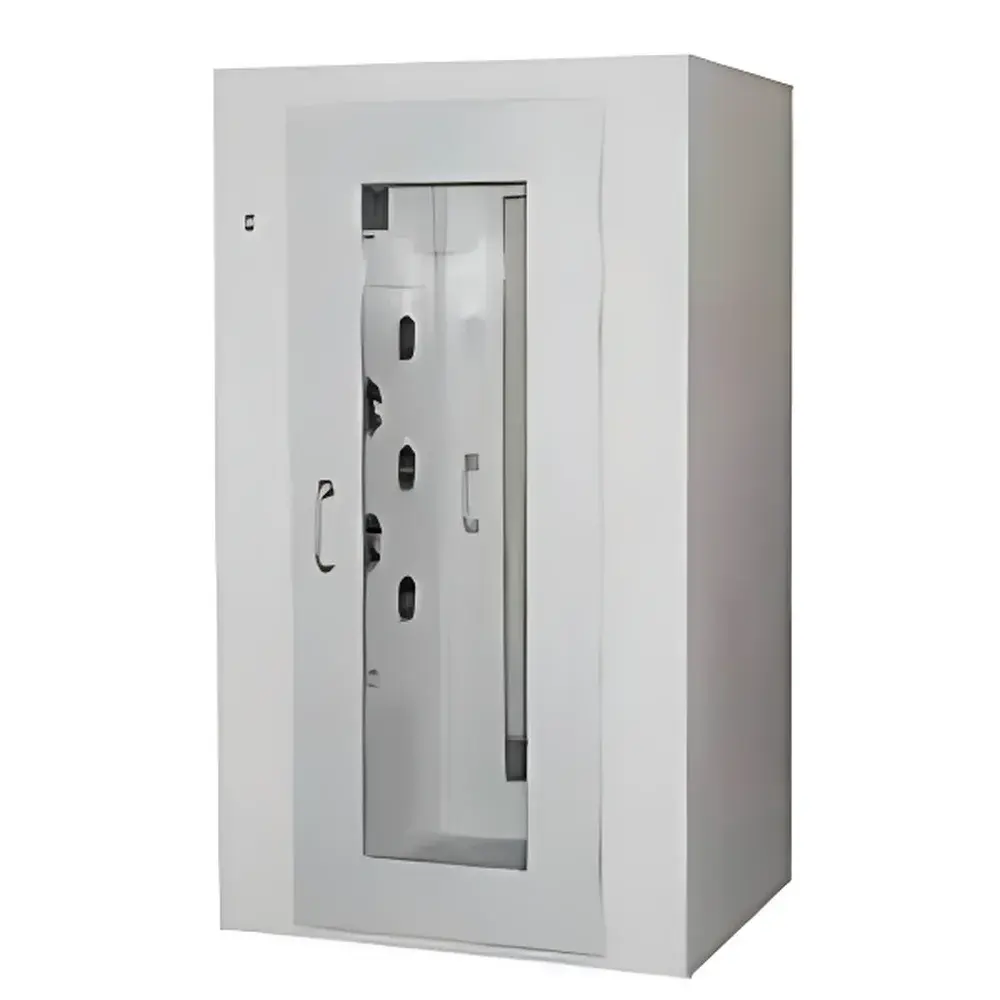
AnTai AAS-700AR Air Shower System
| Brand | AnTai |
|---|---|
| Origin | Jiangsu, China |
| Manufacturer Type | Authorized Distributor |
| Country of Origin | China |
| Model | AAS-700AR |
| Price | USD 7,150 (FOB Jiangsu) |
| Filter Efficiency | ≥99.99% @ 0.3 µm |
| Air Velocity at Nozzles | >20 m/s |
| Adjustable Shower Duration | 0–99 s |
| Exterior Casing | Powder-Coated Cold-Rolled Steel |
| Floor Pan | Stainless Steel with Polyurethane Foam Core |
| Internal Chamber Dimensions (W×D×H) | 770 × 900 × 1960 mm |
Overview
The AnTai AAS-700AR Air Shower System is an engineered personnel and material decontamination station designed for controlled environments requiring ISO Class 5–8 (Class 100–100,000) cleanroom integrity. Installed at the interface between non-classified and classified zones, it functions as a critical first-line barrier against particulate ingress—removing loose fibers, skin flakes, hair, and dust from operators’ garments and surface-mounted objects prior to entry. Its operation relies on high-velocity, HEPA-filtered laminar airflow directed through strategically positioned nozzles, generating turbulent shear forces that dislodge and evacuate contaminants into integrated recirculating filtration ducts. The system complies with fundamental cleanroom hygiene protocols outlined in ISO 14644-1 and supports facility adherence to GMP Annex 1 (2022), USP , and EU GMP Guide Part I requirements for aseptic processing support infrastructure.
Key Features
- High-efficiency particulate air (HEPA) filtration certified to ≥99.99% efficiency at 0.3 µm particle size—validated per EN 1822-1 and tested in accordance with IEST-RP-CC001.6.
- Uniform nozzle array delivering consistent air velocity exceeding 20 m/s across the entire shower zone—engineered to minimize dead zones and maximize particle removal efficacy.
- Programmable shower duration (0–99 seconds) with digital timer interface, supporting configurable SOP-driven cycles for different gowning protocols or material types.
- Rugged structural design: exterior housing fabricated from cold-rolled steel with electrostatic powder coating (RAL 7035) for corrosion resistance and ease of disinfection; floor pan constructed from 304 stainless steel bonded to closed-cell polyurethane foam core—providing mechanical stability, thermal insulation, and non-porous surface integrity.
- Integrated interlocked door system preventing simultaneous opening of entry and exit doors—ensuring containment integrity during operation and eliminating cross-contamination pathways.
- Modular scalability: the AAS-700AR platform supports extended-length configurations (AAS-700AR-2L through -6L), enabling seamless integration into linear gowning corridors without compromising airflow uniformity or pressure cascade control.
Sample Compatibility & Compliance
The AAS-700AR accommodates standard cleanroom apparel (e.g., bouffant caps, coveralls, shoe covers, face masks) and small-to-medium sized equipment carts, trays, and component carriers (max. width 770 mm, depth 900 mm, height 1960 mm). It is not intended for sterilization or microbial reduction—its function is strictly physical particulate removal. Installation requires verification of static pressure differential (≥15 Pa) between adjacent zones and confirmation of room air balance per ISO 14644-3 Annex B. Documentation includes factory-issued filter test reports, airflow mapping summary, and electrical safety certification (GB 4706.1 / IEC 60335-1 compliant).
Software & Data Management
The AAS-700AR operates via embedded microcontroller logic with local push-button interface—no external PC or software dependency. All operational parameters (duration, cycle count, door status, filter run-time hours) are logged internally with timestamping and retained for ≥12 months. Optional RS-485 Modbus RTU output enables integration into building management systems (BMS) or centralized cleanroom monitoring platforms for audit-ready recordkeeping. Event logs meet ALCOA+ principles and support 21 CFR Part 11-compliant electronic records when paired with validated third-party data acquisition software.
Applications
- Pharmaceutical manufacturing: pre-entry decontamination for Grade C/D aseptic filling suites and API handling areas.
- Medical device assembly: personnel air showering prior to Class 10,000 cleanrooms used for implant-grade packaging and final inspection.
- Microelectronics fabrication: operator preparation before entering photolithography or wafer probe stations where sub-micron particle control is essential.
- Biotechnology R&D labs: safeguarding biosafety level 2 (BSL-2) containment zones from external environmental particulates.
- Food-grade processing facilities: maintaining hygienic zoning per ISO 22000 and FSSC 22000 requirements for low-moisture product packaging lines.
FAQ
What filter class is installed in the AAS-700AR?
HEPA H14 filters meeting EN 1822-1 specification (≥99.995% @ 0.3 µm) are standard; ULPA options (U15/U16) are available upon request.
Can the unit be integrated into a facility’s pressure cascade system?
Yes—the AAS-700AR is designed to maintain nominal negative pressure relative to the cleanroom and positive pressure relative to the anteroom, supporting validated pressure differentials per ISO 14644-3.
Is routine filter replacement documented and traceable?
Each filter carries a unique serial number and test certificate; replacement intervals are tracked via internal log and align with ISO 14644-3 recommended maintenance frequency (typically every 6–12 months depending on ambient particle load).
Does the system support IQ/OQ validation documentation?
AnTai provides template protocols (IQ/OQ/ PQ) aligned with ASTM E2500 and GAMP 5, including test acceptance criteria, instrumentation calibration references, and signature-ready execution checklists.
What electrical supply and exhaust requirements apply?
Standard configuration requires 220 V AC ±10%, 50 Hz, 16 A; no external exhaust ducting is needed—air is fully recirculated after filtration. Optional ducted exhaust mode is available for solvent-laden or heat-sensitive applications.




