
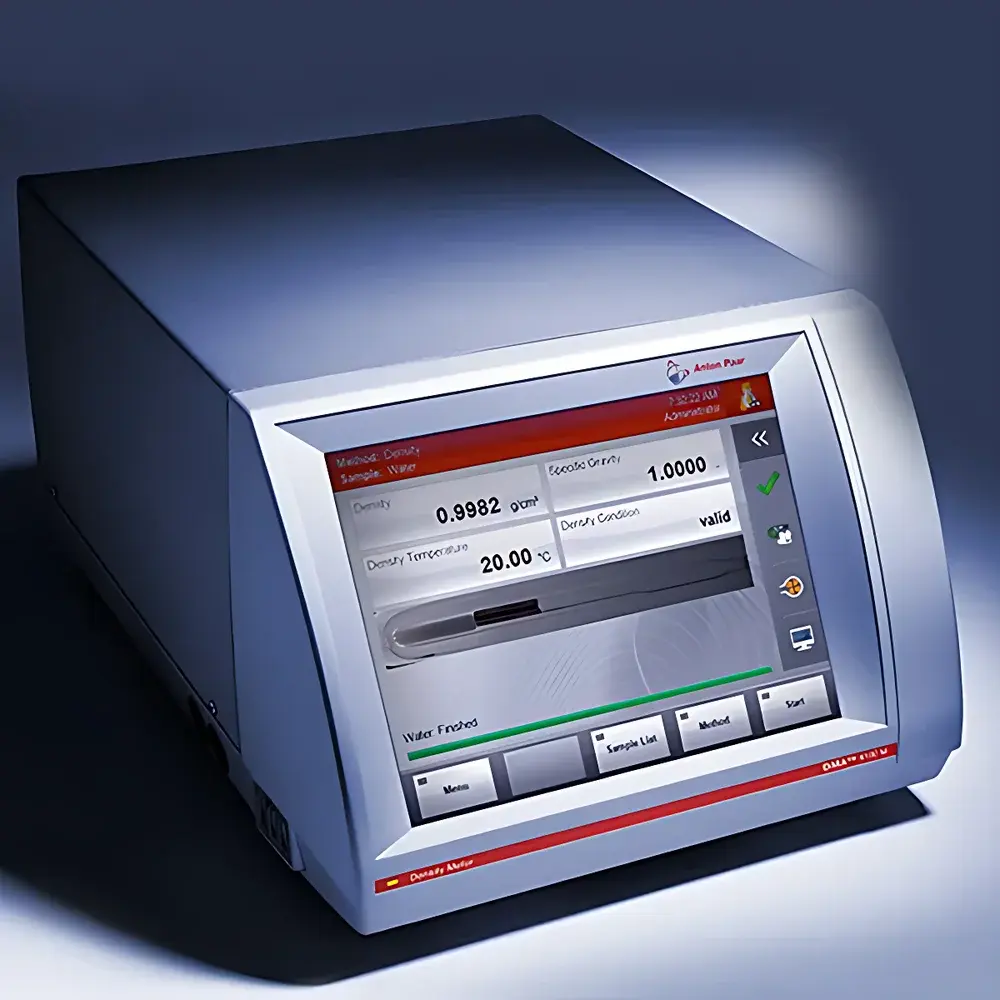
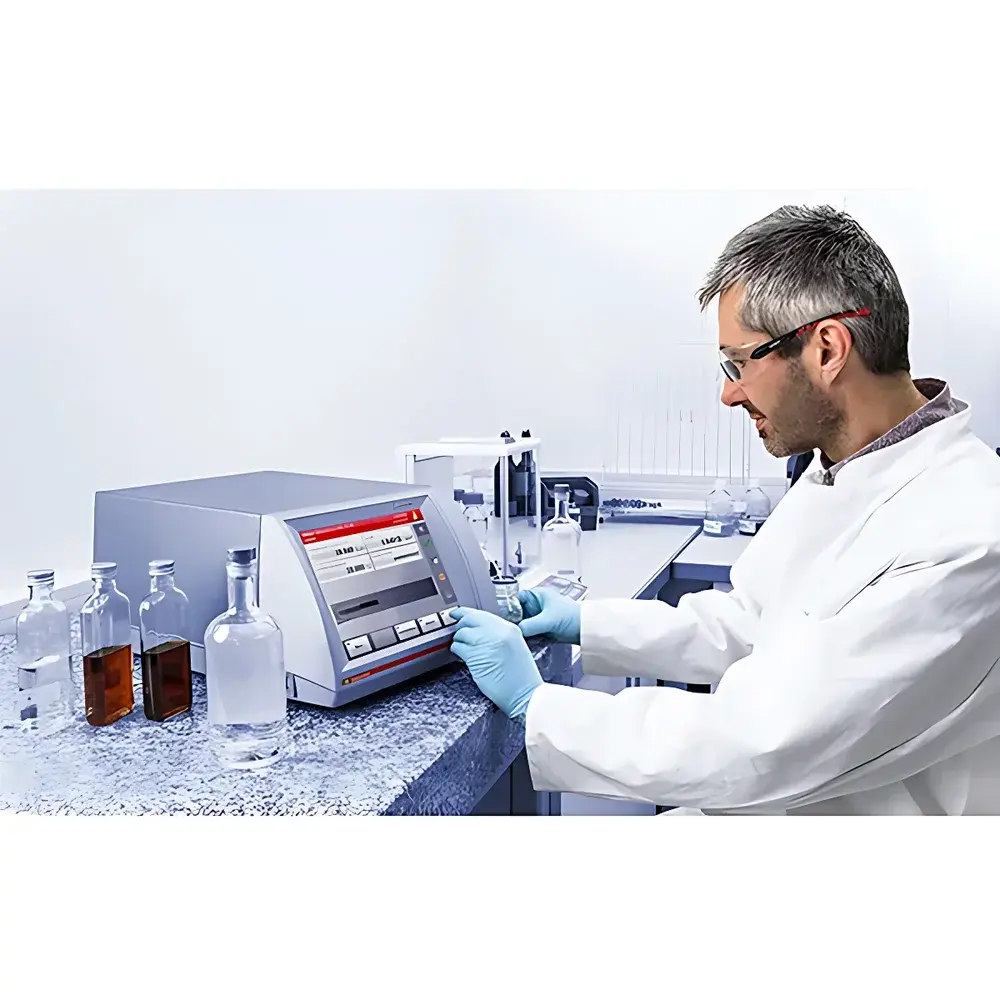
Anton Paar DMA 4100 M Oscillating U-Tube Density Meter
| Brand | Anton Paar |
|---|---|
| Origin | Austria |
| Model | DMA 4100 M |
| Instrument Type | Laboratory Benchtop Oscillating Tube Densitometer |
| Sample Type | Liquid |
| Density Range | 0 g/cm³ to 3 g/cm³ |
| Density Accuracy | ±0.0001 g/cm³ |
| Temperature Range | 0 °C to 100 °C |
| Temperature Accuracy | ±0.03 °C |
| Density Resolution | 0.0001 g/cm³ |
| Minimum Sample Volume | 1 mL |
| Measurement Time (after thermal equilibration) | 30 s |
| Repeatability (σ) | 0.00001 g/cm³ |
| Reproducibility (σ) | 0.00005 g/cm³ |
| Operating Pressure | up to 10 bar |
| Display | 10.4" TFT PCAP Touchscreen (640 × 480 px) |
| Interfaces | 4× USB, RS-232, CAN, VGA, Ethernet |
| Data Storage | 1000 measurements (circular buffer optional) |
| Wetted Materials | PTFE, borosilicate glass |
| Dimensions (L×W×H) | 495 × 330 × 230 mm |
| Weight | 22.5 kg |
Overview
The Anton Paar DMA 4100 M is a high-precision laboratory benchtop oscillating U-tube density meter engineered for metrological-grade liquid density determination in regulated and routine quality control environments. It operates on the fundamental physical principle of measuring the resonant frequency of a precisely manufactured borosilicate glass U-tube filled with sample—where density is inversely proportional to the square of the oscillation period. This method, standardized in ISO 12058-1 and ASTM D4052, delivers traceable, temperature-compensated results with minimal operator dependency. The instrument integrates patented Pulsed Excitation Method (AT 516420 B1, AT 517082 B1), which enhances signal stability by actively suppressing transient damping effects during tube excitation. Unlike conventional continuous-excitation systems, this approach enables superior viscosity compensation—up to two times more effective—thereby minimizing systematic bias in moderately viscous samples such as syrups, glycols, or pharmaceutical formulations without requiring external calibration adjustments.
Key Features
- Patented Pulsed Excitation Method for enhanced oscillation stability and accelerated viscosity correction
- U-View™ real-time imaging system: integrated high-resolution camera captures and stores full-field images of the U-tube fill process, enabling post-measurement verification of meniscus position, bubble presence, and sample homogeneity
- FillingCheck™ algorithmic monitoring: automatically detects air bubbles, particulates, and incomplete filling via dynamic analysis of oscillation decay profiles; generates timestamped warnings stored with measurement data
- Environmental resilience: active ambient pressure, humidity, and temperature compensation ensures measurement integrity across variable lab conditions—no recalibration required for diurnal fluctuations or HVAC cycling
- 10.4″ PCAP capacitive touchscreen interface: glove-compatible, customizable display layout, adjustable font scaling, and intuitive workflow navigation compliant with IEC 61000-4-2 ESD immunity standards
- Robust mechanical design: IP20-rated enclosure with shock-damped base, leak-tight wetted path (PTFE seals + borosilicate glass cell), and vibration-isolated sensor housing
Sample Compatibility & Compliance
The DMA 4100 M is validated for use with a broad spectrum of liquids—including volatile organics, aqueous solutions, suspensions, and low-surface-tension solvents—within its 0–3 g/cm³ density range and 0–100 °C temperature window. All wetted components are chemically inert (PTFE, borosilicate glass), supporting compliance with USP , EP 2.2.5, and FDA 21 CFR Part 11 when configured with audit-trail-enabled software (e.g., Anton Paar’s mPDS or LabX). The instrument meets ISO/IEC 17025 requirements for accredited testing laboratories and supports GLP/GMP documentation workflows through configurable electronic signatures, user access levels, and immutable result archiving. Its measurement uncertainty budget is traceable to NIST SRM-certified reference materials, and repeatability (σ = 0.00001 g/cm³) conforms to ISO 5725-2 precision criteria.
Software & Data Management
Data acquisition and reporting are managed via Anton Paar’s modular software ecosystem. The embedded firmware supports direct export of raw oscillation parameters (period, damping, amplitude), compensated density, temperature, and image metadata in CSV, XML, or PDF formats. Optional LabX software provides centralized instrument control, multi-user permission management, electronic batch records, and integration with LIMS via ODBC or REST API. Built-in conversion tables include alcohol-by-volume (ABV), °Brix, API gravity, acidity/alkalinity, and 150 user-definable polynomial or lookup-table functions—enabling direct output of application-specific values without post-processing. All measurement events—including FillingCheck™ alerts and U-View™ snapshots—are time-stamped, digitally signed, and retained with full audit trail per 21 CFR Part 11 Annex 11 requirements.
Applications
The DMA 4100 M serves as a primary density standard in industries where compositional accuracy dictates regulatory acceptance or process yield. In pharmaceutical manufacturing, it verifies excipient concentration in liquid dosage forms and monitors ethanol content in tinctures per USP . In petrochemical QA/QC, it determines API gravity and distillation cut points in accordance with ASTM D1298 and D287. Beverage producers rely on its ABV and extract tables for beer, wine, and spirits compliance with TTB and EU Regulation (EU) No 1308/2013. Food labs apply it for sugar syrup consistency, dairy product standardization, and edible oil purity assessment per AOAC 985.12. Environmental testing labs use it for density-based speciation of aqueous contaminants, while academic research groups deploy it in thermophysical property studies requiring long-term drift stability and inter-laboratory comparability.
FAQ
What is the minimum sample volume required for a valid measurement?
A minimum of 1 mL is sufficient to fully fill the U-tube sensor and achieve thermal equilibrium under standard operating conditions.
Does the instrument require daily recalibration with reference fluids?
No—its patented environmental compensation and stable quartz oscillator eliminate the need for routine recalibration; verification using certified density standards is recommended per ISO/IEC 17025 at defined intervals (e.g., before critical batches or weekly).
Can the DMA 4100 M measure samples containing suspended particles?
Yes, provided particles are non-settling and do not obstruct the U-tube capillary; FillingCheck™ will flag sedimentation or clogging events in real time.
Is remote operation and data export supported?
Yes—via Ethernet or USB, the instrument supports SCPI command set for automated integration into PLC-controlled workflows and allows scheduled data push to network drives or cloud repositories.
How does the Pulsed Excitation Method improve viscosity handling compared to legacy oscillating tube instruments?
By decoupling excitation from damping analysis, it isolates the true resonant frequency from viscous drag artifacts—reducing viscosity-induced error by up to 50% relative to continuous-drive systems, as verified in interlaboratory round-robin studies per ISO 12058-2.
Related Products



