
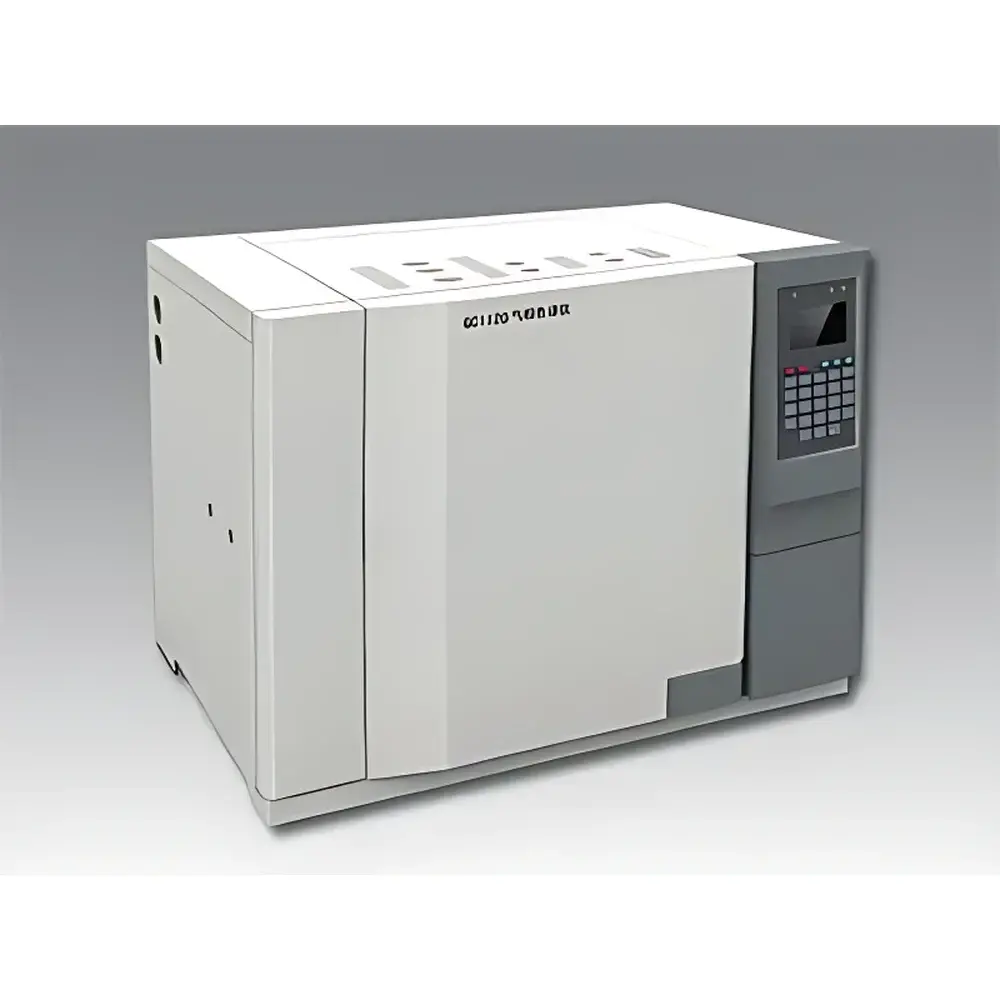
Soptop GC1120 Gas Chromatograph
| Brand | Soptop |
|---|---|
| Origin | Shanghai, China |
| Model | GC1120 |
| Instrument Type | Laboratory Gas Chromatograph |
| Application Scope | General-Purpose |
| Oven Temperature Range | 7 °C above ambient to 400 °C |
| Oven Ramp Rate | 0.1–40 °C/min |
| Cooling Rate | ~10 min from 300 °C to 50 °C |
| Carrier Gas Flow Range | 0–1200 mL/min |
| Carrier Gas Pressure Range | 0–900 kPa |
| Injector Maximum Temperature | 400 °C |
| Injector Pressure Setting Range | 0–900 kPa |
| Injector Total Flow Setting Range | 0–1200 mL/min |
| Temperature Program | 8-stage ramping |
| Isothermal Hold Time | 0–655 min |
| FID Sensitivity | ≤8×10⁻¹² g/s (C₁₆) |
| TCD Sensitivity | ≥5000 mV·mL/mg (C₁₆) |
| ECD Detection Limit | ≤1×10⁻¹³ g/mL (γ-BHC) |
| FPD Detection Limit | ≤1×10⁻¹¹ g/s (P), ≤1×10⁻¹⁰ g/s (S) |
| NPD Detection Limit | ≤5×10⁻¹² g/s (N), ≤5×10⁻¹³ g/s (P) |
| PID Detection Limit | ≤1 ppb (benzene) |
| Maximum PID Operating Temperature | 350 °C |
Overview
The Soptop GC1120 Gas Chromatograph is a general-purpose, laboratory-grade analytical instrument engineered for precision separation and quantitative analysis of volatile and semi-volatile organic compounds. Based on classical gas chromatographic principles—where analytes are partitioned between a mobile phase (inert carrier gas) and a stationary phase (capillary or packed column)—the GC1120 delivers robust performance across routine QC, environmental monitoring, food safety testing, and academic research applications. Its modular architecture supports dual-oven temperature control (column oven + auxiliary zones), programmable 8-stage temperature ramps with sub-0.1 °C resolution, and real-time thermal profiling for method development and validation. Designed for operational transparency and regulatory readiness, the system meets foundational requirements for GLP-compliant workflows and aligns with ISO/IEC 17025 method validation frameworks.
Key Features
- High-stability temperature control system with ±0.1 °C accuracy across column oven (7 °C above ambient to 400 °C), injector (up to 400 °C), and detector zones; supports isothermal holds up to 655 minutes and ramp rates from 0.1 to 40 °C/min in 0.1 °C increments.
- Digital carrier gas flow monitoring module (optional) displays real-time values for main carrier flow and split/splitless flows—up to four independent channels—with automatic logging for audit-ready method documentation.
- Modular inlet configuration supporting up to three simultaneously installed units: packed-column, split/splitless, cold-on-column, and programmable temperature vaporizer (PTV) inlets—enabling flexible sample introduction strategies for diverse matrices.
- Multi-detector compatibility: accommodates up to three detectors concurrently—including Flame Ionization (FID), Thermal Conductivity (TCD), Electron Capture (ECD), Flame Photometric (FPD), Nitrogen-Phosphorus (NPD), and Photoionization (PID)—with plug-and-play hardware expansion post-purchase.
- Integrated data acquisition system with USB interface enables direct PC connectivity using a single cable; supports dual-channel analog input (expandable) with baseline correction, peak integration, and customizable report generation.
- Intuitive 7-inch TFT LCD interface with Chinese/English menu navigation displays real-time oven temperature, ramp curves, detector baselines, and flow/pressure parameters—reducing operator dependency on external software during method setup.
Sample Compatibility & Compliance
The GC1120 is validated for analysis of hydrocarbons, pesticides, residual solvents, flavor compounds, petrochemical fractions, and environmental pollutants (e.g., PAHs, PCBs, VOCs). Its wide operating range and detector sensitivity profiles meet typical requirements outlined in ASTM D3606 (gasoline aromatics), EPA Method 8021B (organophosphorus pesticides), USP (residual solvents), and ISO 11843-2 (detection capability estimation). While not pre-certified for 21 CFR Part 11, the system supports audit-trail-capable data handling when paired with compliant third-party chromatography data systems (CDS) and user-defined electronic signature protocols.
Software & Data Management
Data acquisition and processing are handled via Soptop’s proprietary GC Navigator software (Windows-based), offering full instrument control, real-time signal visualization, automated calibration curve generation, and five built-in quantitation algorithms (external standard, internal standard, standard addition, normalization, and area percent). Raw data files (.DAT) retain metadata including method parameters, instrument configuration logs, and detector response histories—ensuring traceability. Export formats include CSV, PDF, and XML for LIMS integration. For regulated environments, users may configure manual audit trails, user access levels, and electronic signature prompts in alignment with GMP/GLP documentation standards.
Applications
- Environmental labs: Quantification of chlorinated hydrocarbons (e.g., γ-HCH) by ECD; organophosphate insecticides (e.g., parathion-methyl) via FPD or NPD; BTEX compounds using FID.
- Pharmaceutical QA/QC: Residual solvent profiling per ICH Q3C guidelines using headspace-GC/FID configurations.
- Food and beverage testing: Pesticide multiresidue analysis in fruits/vegetables; fatty acid methyl ester (FAME) profiling in edible oils using TCD or FID.
- Academic research: Reaction monitoring of catalytic processes; polymer additive screening; forensic toxicology screening for volatile substances.
- Industrial hygiene: Workplace air monitoring for VOC exposure limits (e.g., benzene, toluene) using PID or FID with thermal desorption units.
FAQ
Is the GC1120 compatible with third-party chromatography data systems (CDS)?
Yes—the instrument outputs analog signals and supports RS232/USB communication protocols; integration with major CDS platforms (e.g., Chromeleon, OpenLab CDS) is achievable via custom driver configuration or analog-to-digital conversion modules.
What is the maximum allowable column bleed temperature for standard capillary columns?
The GC1120 oven supports stable operation up to 400 °C; however, column-specific upper temperature limits must be observed per manufacturer specifications (e.g., 325 °C for 5% phenyl polysiloxane phases).
Can the GC1120 perform unattended overnight analysis?
Yes—its programmable autosampler interface (optional) and robust thermal stability enable multi-run sequences with automatic method switching, making it suitable for high-throughput batch analysis.
Does the system support splitless injection for trace-level analysis?
Yes—when equipped with a毛细管 split/splitless inlet, the GC1120 delivers precise splitless transfer with adjustable purge times and optimized liner geometry for low-ng injections.
Are consumables such as septa, liners, and ferrules supplied by Soptop?
Soptop offers OEM-compatible consumables including graphite/Vespel septa, deactivated glass liners, and universal compression ferrules—designed for consistent retention time reproducibility and minimal active site formation.




