
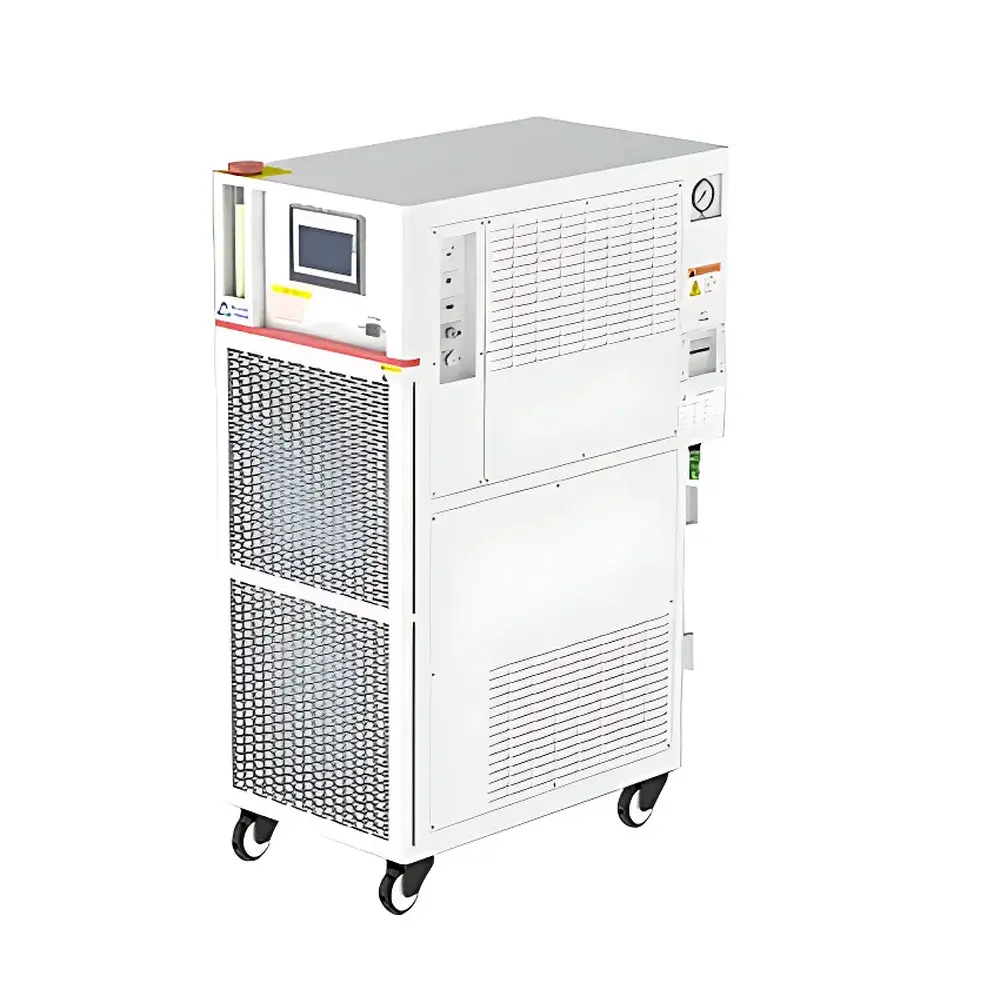
Tongzhou Weipu TC1000 Series High-Low Temperature Circulating Chiller
| Brand | Tongzhou Weipu |
|---|---|
| Origin | Tianjin, China |
| Manufacturer Type | OEM Manufacturer |
| Country of Origin | China |
| Model | TC1000 Series |
| Temperature Range | –10 °C to +200 °C |
| Display | 7-inch LCD touchscreen interface |
| Control Modes | Internal/external temperature control, 100-step programmable ramp-soak profiles |
| Communication Interfaces | Ethernet (Modbus TCP), RS485 (Modbus RTU), USB data logging, dry-contact alarm & status outputs |
| Pump Flow Rate | Up to 75 L/min @ 2.5 bar |
| Heating Power | Up to 15 kW |
| Refrigeration Capacity | Up to 15 kW @ –10 °C, 12 kW @ +20 °C, 9 kW @ +40 °C, 5.5 kW @ +100 °C, 2.5 kW @ +200 °C |
| Cooling Method | Air-cooled (F) or water-cooled (W) configurations |
| Enclosure Options | Standard, explosion-proof (ATEX-compliant upon request), split-system, stainless-steel cabinet |
| Fluid Compatibility | Synthetic heat-transfer fluids (e.g., AUSI-05, AUSI-10) rated for –80 °C to +250 °C |
| Hose Interface | Stainless-steel braided flex lines with custom-length insulation (rubber/plastic or aerogel-enhanced) |
| PID Algorithm | Multi-dimensional adaptive PID with dynamic load compensation |
Overview
The Tongzhou Weipu TC1000 Series High-Low Temperature Circulating Chiller is an engineered thermal management platform designed for precise, stable, and repeatable temperature control across demanding laboratory and pilot-scale industrial applications. Utilizing a dual-circuit refrigeration-heating architecture with independent compressor and electric heating systems, the TC1000 achieves seamless transition between cooling and heating modes without thermal lag or overshoot. Its operational range spans from –10 °C to +200 °C—optimized for chemical synthesis, polymerization kinetics, catalyst testing, reaction calorimetry, and material aging studies where thermal stability and transient response are critical. Unlike single-function chillers or ovens, the TC1000 integrates high-efficiency scroll compressors, low-thermal-mass heating elements, and a high-flow, pressure-stable circulation pump to maintain ±0.3 °C temperature uniformity under dynamic load conditions. All models comply with IEC 61000-6-3 (EMC) and IEC 61000-6-2 (immunity) standards, and optional ATEX-certified variants meet Directive 2014/34/EU for use in Zone 1 hazardous environments.
Key Features
- 7-inch capacitive touchscreen HMI with real-time graphical display of setpoint, actual temperature, flow rate, pressure, and system status
- 100-segment programmable temperature profile with ramp/soak logic, event-triggered actions, and password-protected parameter locking
- Multi-interface connectivity: Modbus TCP over Ethernet for SCADA integration; RS485 Modbus RTU for PLC interfacing; USB 2.0 for CSV-formatted audit trail export
- Dual-sensor input support: internal PT100 immersion probe + external user-supplied PT100 (via dedicated 4-wire input) for jacket or reactor wall monitoring
- Adaptive multi-dimensional PID algorithm with auto-tuning capability—compensates for fluid viscosity changes, heat exchanger fouling, and ambient fluctuations
- Robust mechanical design: stainless-steel fluid reservoir and circulation loop; reinforced aluminum alloy frame; IP54-rated enclosure (standard); optional 316L stainless cabinet
- Configurable cooling architecture: air-cooled (F-series) for space-constrained labs; water-cooled (W-series) for high-ambient or continuous-duty operation
Sample Compatibility & Compliance
The TC1000 series is compatible with a broad spectrum of thermally sensitive samples and process equipment—including glass-jacketed reactors (1–50 L), calorimeters, spectroscopic cells, extruders, and environmental test chambers. It supports fluid media certified per ASTM D6722 (synthetic heat-transfer fluids) and meets ISO 8502-2 requirements for non-corrosive thermal transfer. When operated with AUSI-05 or AUSI-10 synthetic oils, the system maintains thermal stability across extended cycles at elevated temperatures without degradation or vapor lock. All electrical components adhere to UL 61010-1 and CE EN 61010-1 safety directives. For regulated environments, optional firmware enables 21 CFR Part 11-compliant electronic signatures, full audit trail generation (user, timestamp, parameter change), and role-based access control—supporting GLP/GMP validation protocols.
Software & Data Management
Embedded firmware includes a built-in data logger recording up to 30 days of continuous timestamped values (temperature, flow, pressure, power consumption) at user-selectable intervals (1 s to 60 min). Exported USB logs are CSV-compatible and import-ready into MATLAB, Python (pandas), or LIMS platforms. Optional PC software (TC-Control Suite) provides remote monitoring via Ethernet, real-time trend visualization, alarm email/SMS notifications (via SMTP or GSM gateway), and automated report generation (PDF/Excel) compliant with ISO/IEC 17025 documentation requirements. Historical data retention supports root-cause analysis during OOS investigations and facilitates PQ/UQ documentation for equipment qualification.
Applications
- Controlled-rate heating/cooling in exothermic/endothermic reaction optimization (e.g., Grignard, hydrogenation, nitration)
- Thermal cycling tests for battery electrolyte stability, elastomer hysteresis, and composite resin cure profiling
- Temperature-dependent rheological characterization using coupled rheometer-chiller setups
- Calibration of IR sensors, thermocouples, and RTD reference standards across extended ranges
- Stabilization of laser diodes, CCD detectors, and NMR probe preamplifiers requiring sub-ambient thermal anchoring
- Pilot-scale crystallization process development with precise supersaturation control
FAQ
What is the minimum recommended heat-transfer fluid for operation at –10 °C?
AUSI-05 synthetic fluid (pour point –90 °C, flash point 128 °C) is validated for continuous use down to –80 °C and is the default recommendation for sub-zero TC1000 operation.
Can the TC1000 be integrated into a distributed control system (DCS)?
Yes—Modbus TCP implementation allows native integration with Emerson DeltaV, Honeywell Experion, and Siemens PCS7 via standard Ethernet infrastructure without protocol gateways.
Is validation documentation available for GxP environments?
Factory-provided IQ/OQ templates, traceable calibration certificates (NIST-traceable PT100 and pressure transducers), and firmware validation reports are supplied upon request.
What maintenance intervals are specified for the refrigeration circuit?
Compressor oil and filter replacement is scheduled every 8,000 operating hours or 24 months—whichever occurs first—under normal lab-use conditions.
Are custom hose lengths and insulation types supported?
Yes—stainless-steel flex hoses with aerogel-rubber hybrid insulation are available in lengths from 200 cm to 500 cm, with custom thread adapters (M30×1.5, M38×1.5, G1, tri-clamp) fabricated per ASME B16.5 specifications.



