
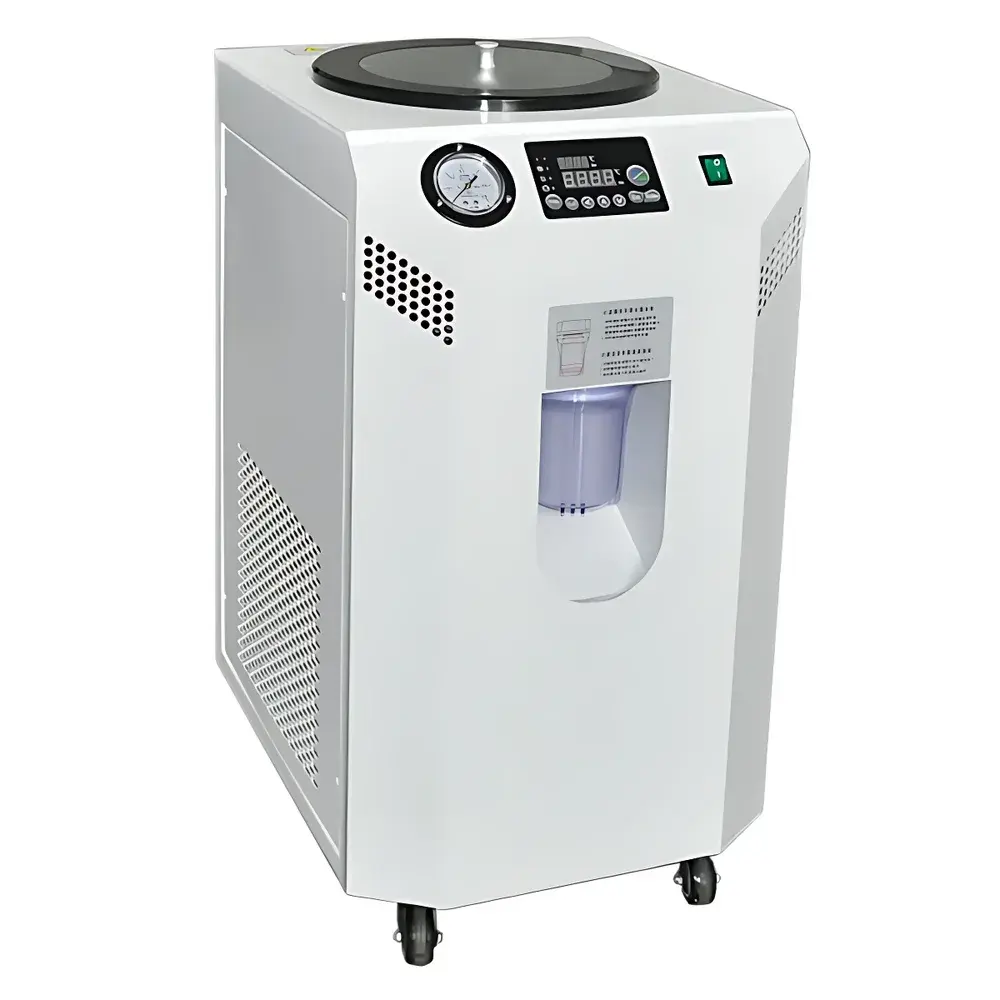
Tongzhou Weipu AC1600 Series Integrated Air-Cooled Circulating Chiller
| Brand | Tongzhou Weipu |
|---|---|
| Origin | Beijing, China |
| Manufacturer Type | Direct Manufacturer |
| Instrument Type | Integrated Circulating Chiller |
| Cooling Method | Air-Cooled |
| Temperature Control Range | 5–35 °C |
| Refrigeration Capacity | 600–5600 W |
| Temperature Stability | ±0.1 °C |
| Circulation Pump Pressure | 2.0 bar |
| Flow Rate | 10–58 L/min |
| Reservoir Volume | 8–60 L |
| Operating Mode | Closed-Loop Water Circulation |
Overview
The Tongzhou Weipu AC1600 Series Integrated Air-Cooled Circulating Chiller is an engineered thermal management solution designed for precise, stable, and continuous cooling of laboratory analytical instruments and process equipment. Based on vapor-compression refrigeration cycle architecture with optimized air-cooled condensation, the system delivers consistent temperature control across a wide operational envelope (5–35 °C) while maintaining high thermal reproducibility (±0.1 °C stability). Its integrated design eliminates external coolant loops and simplifies installation in space-constrained lab environments. The chiller operates as a closed-loop system, circulating deionized or purified water through connected instrumentation to absorb and dissipate heat generated during operation—critical for preserving optical alignment in spectrometers, stabilizing plasma sources in ICP-OES/ICP-MS systems, and ensuring thermal equilibrium in electron microscopy stages.
Key Features
- Stainless-steel open-top reservoir with transparent level indicator—enables visual inspection of water clarity and facilitates routine cleaning to prevent biofilm or particulate buildup.
- Integrated pre-filter housing with sight window—allows real-time assessment of filter condition; standard cartridge filters retain particles ≥5 µm and are field-replaceable without tools.
- Dual-sensor thermal protection: independent high-temperature cutoff and low-water-level detection circuits prevent dry-run pump failure and overheating of connected instruments.
- Air-cooled condenser with rear-mounted axial fans and vibration-dampened mounting—ensures efficient heat rejection without requiring chilled water infrastructure or external ventilation ducting.
- Corrosion-resistant fluid path: all wetted components—including pump head, impeller, valves, and internal tubing—are constructed from 316 stainless steel or fluoropolymer-lined materials.
- Configurable digital I/O interface: supports TTL-level start/stop commands via parallel port and provides isolated relay outputs for flow loss, overtemperature, and low-level alarms—compatible with PLC-based lab automation systems.
Sample Compatibility & Compliance
The AC1600 Series is compatible with a broad spectrum of heat-sensitive laboratory instrumentation requiring regulated coolant supply, including but not limited to atomic absorption spectrometers (AAS), inductively coupled plasma optical emission spectrometers (ICP-OES), scanning electron microscopes (SEM), glovebox inert-atmosphere systems, RF plasma etchers, direct-reading optical emission spectrometers (OES), and Kjeldahl digestion units. All models comply with IEC 61000-6-3 (EMC emissions) and IEC 61000-6-2 (immunity) standards. Optional resin filtration kits enable conductivity reduction to <1 µS/cm, supporting applications governed by ASTM D1193 Type II water specifications. For GxP-regulated environments, optional audit-trail-enabled firmware (with timestamped event logging and user-access controls) aligns with FDA 21 CFR Part 11 requirements when deployed with validated software interfaces.
Software & Data Management
While the base AC1600 operates via front-panel membrane keypad and LCD display, optional RS485 Modbus RTU or Ethernet TCP/IP communication modules enable integration into centralized lab monitoring platforms. Logged parameters—including setpoint, actual bath temperature, pump status, alarm history, and cumulative runtime—are exportable in CSV format. Firmware supports configurable alarm thresholds and hysteresis settings for temperature deviation, flow interruption, and reservoir level. Remote configuration and firmware updates are performed via secure authenticated sessions using TLS 1.2 encryption on network-connected variants. Data integrity is preserved through non-volatile EEPROM storage with write-cycle endurance exceeding 100,000 operations.
Applications
- Thermal stabilization of hollow cathode lamps and graphite furnace assemblies in AAS systems to minimize spectral drift.
- Cooling of ICP torch interfaces and RF generator coils in plasma spectrometry, where sustained 2.0 bar delivery pressure ensures uninterrupted nebulizer gas flow.
- Maintaining vacuum chamber wall temperatures in SEM systems to reduce thermal expansion-induced image distortion.
- Controlling exothermic reaction temperatures in automated Kjeldahl digesters operating under ISO 5983-2 protocols.
- Providing stable coolant supply to laser ablation cells and mass spectrometer ion optics in LA-ICP-MS configurations.
FAQ
What is the maximum allowable ambient temperature for continuous operation?
The unit is rated for continuous duty at ambient temperatures up to 35 °C, provided minimum clearance of 30 cm is maintained on all sides and rear for unobstructed airflow.
Can the chiller be used with ethylene glycol/water mixtures?
No—this model is specifically engineered for aqueous solutions only. Glycol-based coolants may compromise pump seal integrity and reduce heat transfer efficiency due to increased viscosity.
Is calibration certificate traceable to NIST available?
Yes—optional factory calibration with NIST-traceable temperature sensors (±0.05 °C uncertainty at 25 °C) is available upon order, including full documentation per ISO/IEC 17025 requirements.
How often should the pre-filter cartridge be replaced?
Under typical deionized water use, replacement is recommended every 3–6 months; frequency increases proportionally with total dissolved solids (TDS) concentration above 5 ppm.
Does the system support remote shutdown via LabVIEW or Python?
Yes—Modbus RTU register mapping and Python-compatible API libraries are supplied with communication module orders, enabling script-driven control and data acquisition workflows.



