
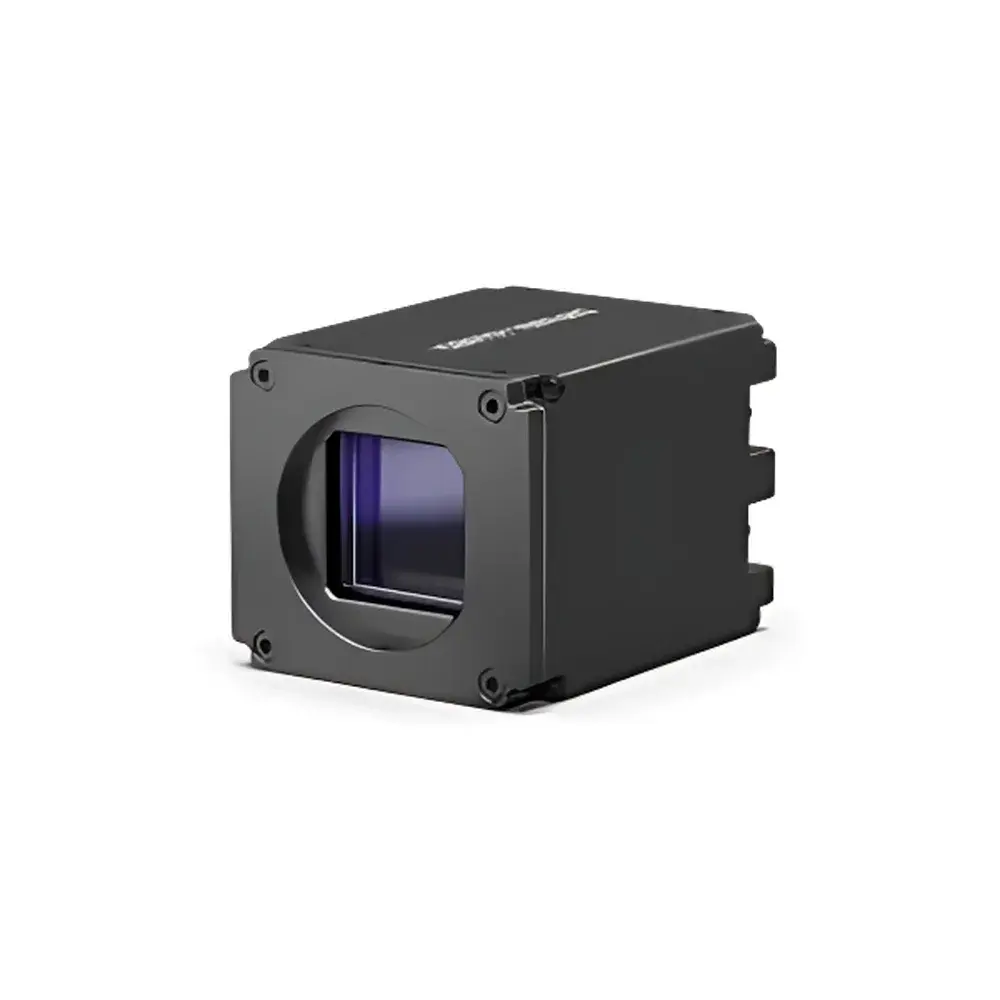
Tucsen Dhyana 4040BSI Back-Illuminated Scientific CMOS Camera
| Brand | Tucsen |
|---|---|
| Origin | Fujian, China |
| Manufacturer Type | Original Equipment Manufacturer (OEM) |
| Regional Classification | Domestic (China) |
| Model | Dhyana 4040BSI |
| Image Resolution | 4096 × 4096 |
| Pixel Size | 9 µm × 9 µm |
| Sensor Diagonal | 52.1 mm |
| Readout Speed | 16.5 fps @ CameraLink |
| Dynamic Range | 85 dB |
| Quantum Efficiency | 90% @ 550 nm |
Overview
The Tucsen Dhyana 4040BSI is a high-performance, back-illuminated scientific CMOS (sCMOS) camera engineered for demanding low-light imaging applications in astrophysics, space debris tracking, soft X-ray detection, and quantum optics. Built around the Gpixel GSENSE4040BSI sensor—a monolithic 4K × 4K BSI sCMOS device—the camera delivers exceptional photon collection efficiency across an extended spectral range (200–1100 nm), with peak quantum efficiency of 90% at 550 nm. Its 52.1 mm diagonal sensor enables wide-field, single-shot imaging without tiling or mosaicking—critical for time-resolved observations of transient astronomical events, orbital object characterization, and spatially coherent quantum interference experiments. Unlike legacy CCD architectures, the Dhyana 4040BSI combines high frame rates (16.5 fps full-frame via CameraLink), ultra-low read noise (≤2.3 e⁻ rms), and wide dynamic range (85 dB) to support both quantitative intensity mapping and high-fidelity temporal sampling under photon-starved conditions.
Key Features
- Monolithic 4096 × 4096 back-illuminated sCMOS sensor with 9 µm × 9 µm pixels and 36.9 mm × 36.9 mm active area
- Full-well capacity of 39 ke⁻ (typical), enabling robust linearity over >4 decades of signal intensity
- Deep-cooling architecture: air-cooled operation down to −45 °C below ambient; water-cooled variant reduces dark current to ≤0.1 e⁻/pixel/s
- Advanced pixel-level calibration: DSNU (Dark Signal Non-Uniformity) < 0.5 e⁻; PRNU (Photo Response Non-Uniformity) < 0.2%, ensuring traceable radiometric accuracy
- Flexible triggering and synchronization: hardware/software trigger inputs, programmable output signals (start-of-exposure, global reset, end-of-readout), SMA and CC1 I/O interfaces
- Precision timing: 1 µs timestamp resolution; optional GPS-synchronized timestamps with ±8 ns accuracy for multi-site correlation or orbital ephemeris alignment
- Multi-interface support: CameraLink Base (16.5 fps full-frame), USB 3.0 (9.7 fps), with dual 12-bit/16-bit digitization modes
Sample Compatibility & Compliance
The Dhyana 4040BSI is compatible with standard F-mount optical assemblies and supports user-defined mechanical interfaces for integration into vacuum-compatible beamlines, telescope focal planes, or synchrotron endstations. Its sealed, dust-resistant enclosure (IP52-rated) and operational range (−25 °C to +45 °C ambient, 0–95% non-condensing humidity) permit deployment in observatory domes, cleanroom-based quantum labs, and mobile tracking platforms. The camera adheres to electromagnetic compatibility (EMC) standards per IEC 61326-1 and meets RoHS 2015/863/EU directives. Firmware and SDK implementations support audit-trail logging and metadata embedding compliant with GLP and ISO/IEC 17025 documentation requirements for metrological traceability in research-grade imaging workflows.
Software & Data Management
The camera is fully supported by Tucsen’s Mosaic 1.6 acquisition suite, offering real-time histogram analysis, multi-region-of-interest (ROI) binning (2×2, 4×4), non-uniformity correction, and dark-frame subtraction. Third-party interoperability includes native drivers for MaxIm DL, LabVIEW (NI-IMAQdx), MATLAB Image Acquisition Toolbox, and Python (via PyTUCSEN). A comprehensive C/C++/C# SDK provides low-level register access, asynchronous frame buffering, and memory-mapped I/O for custom pipeline development. All acquired frames embed EXIF-compliant metadata—including exposure time, temperature, gain, timestamp, and sensor calibration coefficients—enabling reproducible post-processing and FAIR (Findable, Accessible, Interoperable, Reusable) data management practices.
Applications
- Astrophysical imaging: Wide-field survey astronomy, exoplanet transit photometry, and stellar interferometry where large FoV and high QE are essential
- Space situational awareness: Real-time detection and centroiding of LEO/MEO debris objects using ground-based optical tracking telescopes
- Soft X-ray microscopy: Direct detection of 0.1–2.0 keV photons via scintillator-coupled configurations or thin-metal-filtered direct illumination
- Quantum optics: Single-photon correlation measurements (e.g., HBT, Hanbury Brown–Twiss), entanglement verification, and spatial mode analysis in multimode fiber or free-space setups
- Time-resolved spectroscopy: Synchronization with pulsed lasers or RF-gated sources for pump-probe imaging with microsecond-scale temporal resolution
FAQ
What cooling options are available, and how do they affect dark current performance?
The Dhyana 4040BSI offers air-cooling (dark current ≤0.2 e⁻/pixel/s) and water-cooling (≤0.1 e⁻/pixel/s) configurations. Both achieve up to 45 °C delta-T below ambient, with thermal stability maintained within ±0.1 °C over 1-hour acquisitions.
Is the camera suitable for vacuum environments?
The standard unit is not vacuum-rated; however, Tucsen provides custom vacuum-compatible variants with CF-flanged housings and outgassing-certified materials upon request.
Does the SDK support real-time frame processing on GPU?
Yes—the C++ SDK includes CUDA-accelerated modules for on-the-fly flat-field correction, centroid fitting, and photon counting histogramming, compatible with NVIDIA GPUs supporting Compute Capability 6.0+.
How is radiometric calibration validated across the sensor?
Each unit undergoes NIST-traceable uniformity testing using integrating sphere illumination at multiple wavelengths (400–900 nm); calibration files (DSNU/PRNU maps, gain tables) are delivered with serialized firmware and embedded in every FITS/ TIFF header.
Can the camera operate in global shutter mode?
No—it employs a highly optimized rolling shutter with synchronized global reset capability, minimizing skew artifacts for exposures ≥100 µs; sub-millisecond timing jitter is compensated via hardware trigger alignment and timestamp interpolation.




