
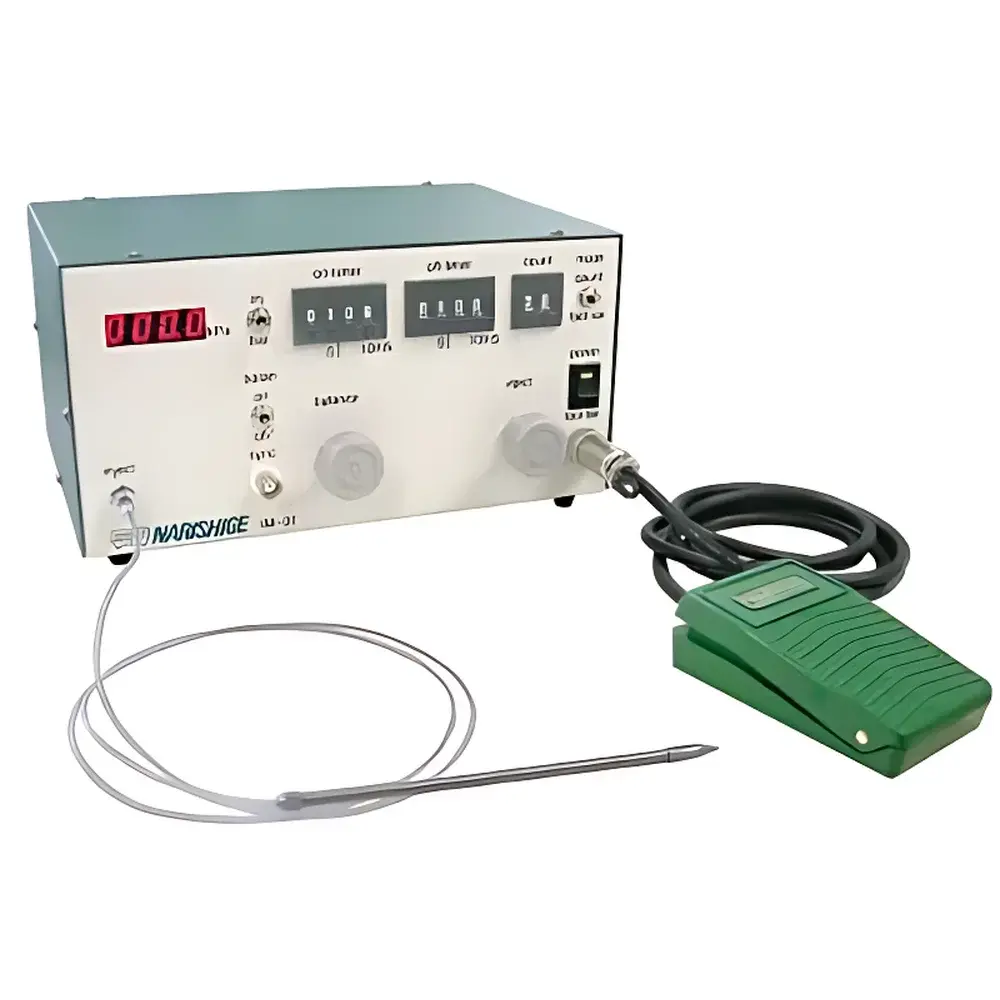
Narishige IM-31 Microinjector
| Brand | Narishige |
|---|---|
| Origin | Japan |
| Model | IM-31 |
| Operating Modes | Count Mode (Pressure/Time/Count), Footswitch Mode (Pressure Only) |
| Pressure Range | 50–500 kPa |
| Time Setting Range | 10 ms – 99.99 s |
| Count Setting Range | 1–99 |
| Interval Setting Range | 10 ms – 99.99 s |
| Input Voltage | AC 100–240 V (±5%), 50/60 Hz |
| Dimensions | 240 × 215 × 130 mm |
| Weight | 4 kg |
| TTL Input | Negative logic compatible |
| Compatibility | Modular integration with Narishige micromanipulators (e.g., MMO-4, MDO-84) via adapter kits |
| Accessories | HI-7 syringe holder, tubing connectors, footswitch, silicone O-rings, power cord |
Overview
The Narishige IM-31 is a precision pneumatic microinjector engineered for reproducible, low-disturbance fluid delivery in demanding life science applications—including intracellular injection, embryo microinjection, CRISPR/Cas9 delivery, and patch-clamp-assisted loading of dyes or tracers. It operates on a regulated compressed-air principle, converting digitally set pressure into controlled volumetric displacement within glass capillaries or pulled needles. Unlike solenoid-driven or stepper-motor-based injectors, the IM-31 employs a high-stability diaphragm valve actuated by calibrated pneumatic pressure—ensuring minimal mechanical vibration and zero electromagnetic interference (EMI), critical for concurrent electrophysiological recording. Its dual-mode architecture (Count Mode and Footswitch Mode) supports both deterministic multi-pulse protocols and real-time manual triggering, enabling experimental flexibility without hardware reconfiguration.
Key Features
- Pneumatic actuation with adjustable pressure range (50–500 kPa), delivering consistent impulse force across varying needle resistances and solution viscosities.
- Two operational modes: Count Mode allows precise programming of injection count (1–99), pulse duration (10 ms–99.99 s), and inter-pulse interval (10 ms–99.99 s); Footswitch Mode enables immediate manual control with pressure-only activation via included foot pedal.
- TTL-compatible external trigger input (negative logic) permits synchronization with third-party equipment such as fluorescence imaging systems, electrophysiology amplifiers, or programmable stimulators—supporting automated, time-locked experimental workflows.
- Modular mechanical interface designed for seamless integration with Narishige micromanipulators (MMO-4, MDO-84, etc.) using standardized adapter plates, enabling rapid assembly of complete microinjection rigs on inverted or upright microscopes.
- Low-vibration, EMI-free operation ideal for combined patch-clamp/microinjection experiments; no motor noise or thermal drift affects membrane potential stability during long-duration recordings.
- Ergonomic front-panel layout with tactile rotary encoder and LED display ensures intuitive parameter navigation under microscope viewing conditions; non-slip rubber feet and anti-loosening screws enhance positional stability during extended manipulation sessions.
Sample Compatibility & Compliance
The IM-31 is compatible with standard borosilicate or quartz capillaries (1.0–1.5 mm OD), pulled to tip diameters ranging from sub-micron to ~5 µm. It accommodates common injection solutions including aqueous buffers, plasmid DNA, siRNA, fluorescent dyes (e.g., Alexa Fluor conjugates), and viscous cytoplasmic components (e.g., dextran-FITC). The device complies with IEC 61010-1:2010 for laboratory electrical equipment safety and meets CE marking requirements for EMC (EN 61326-1) and low voltage (2014/35/EU). While not classified as a medical device, its design aligns with GLP principles for traceable parameter logging when used in preclinical research settings; audit-ready operation is achievable when paired with Narishige’s optional data acquisition modules supporting timestamped event logging.
Software & Data Management
The IM-31 operates as a standalone instrument without proprietary software dependency—parameters are configured directly via front-panel controls. However, its TTL input supports bidirectional synchronization with external platforms: LabVIEW, MATLAB, or Python-based acquisition systems can initiate injections, log timestamps, and correlate injection events with physiological or imaging data streams. When integrated into larger Narishige ecosystems (e.g., with the ASI MP-285 manipulator controller), injection logs—including pressure value, pulse count, and duration—can be embedded into system-wide experiment metadata files. All firmware updates are delivered via USB flash drive; no cloud connectivity or remote access functionality is implemented, preserving data sovereignty and network isolation in secure lab environments.
Applications
- Single-cell transfection and genome editing in zebrafish, mouse, or Xenopus embryos.
- Targeted dye loading in neuronal cultures for calcium imaging or morphological reconstruction.
- Co-injection of CRISPR ribonucleoprotein complexes with fluorescent reporters for real-time editing validation.
- Intracytoplasmic sperm injection (ICSI) training and assisted reproductive technology (ART) protocol development.
- Microfluidic chip priming and localized reagent deposition in organ-on-chip assays.
- Electrophysiology-supported intracellular filling during whole-cell patch clamp recordings.
FAQ
Can the IM-31 be used with oil-immersion objectives?
Yes—the device generates no EMI and exhibits negligible mechanical resonance, making it compatible with high-NA oil-immersion setups where vibration sensitivity is critical.
Is calibration required before each use?
No routine recalibration is needed; factory-set pressure transduction remains stable over time. Users may verify output consistency using gravimetric or optical flow measurement methods per ISO 8655-5 guidelines.
What is the maximum recommended viscosity for injected solutions?
Solutions up to 10 mPa·s (e.g., 10% dextran in PBS) are routinely delivered; higher viscosities require proportional pressure increase and empirical optimization of pulse duration.
Does the IM-31 support multi-channel parallel injection?
Not natively—but when paired with Narishige’s dual-manipulator systems (e.g., MMO-4 + MN-401) and synchronized TTL triggers, two independent IM-31 units can operate in parallel with sub-millisecond timing alignment.
How is maintenance performed?
The unit requires only periodic inspection of O-rings and tubing connections; the pneumatic valve assembly is sealed and non-user-serviceable—Narishige-certified service centers perform internal diagnostics and recalibration if performance deviation exceeds ±2% of full-scale pressure reading.



