
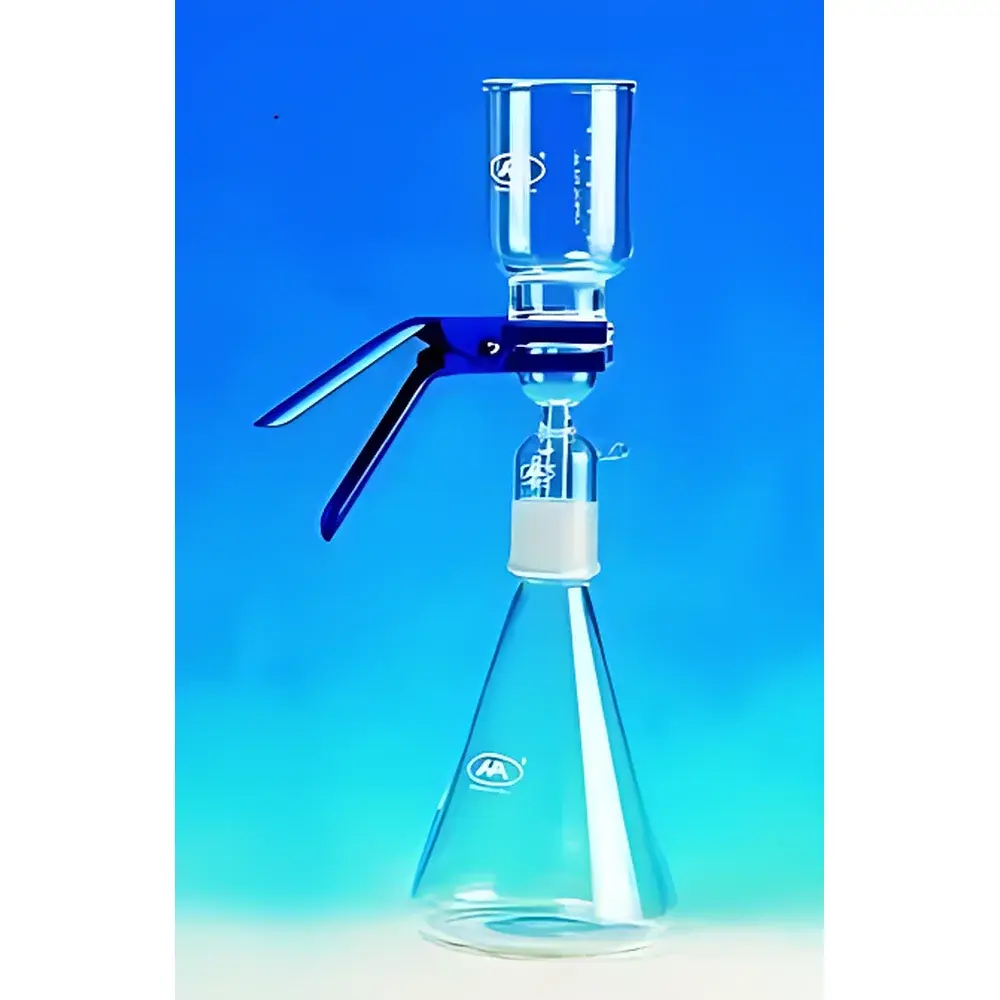
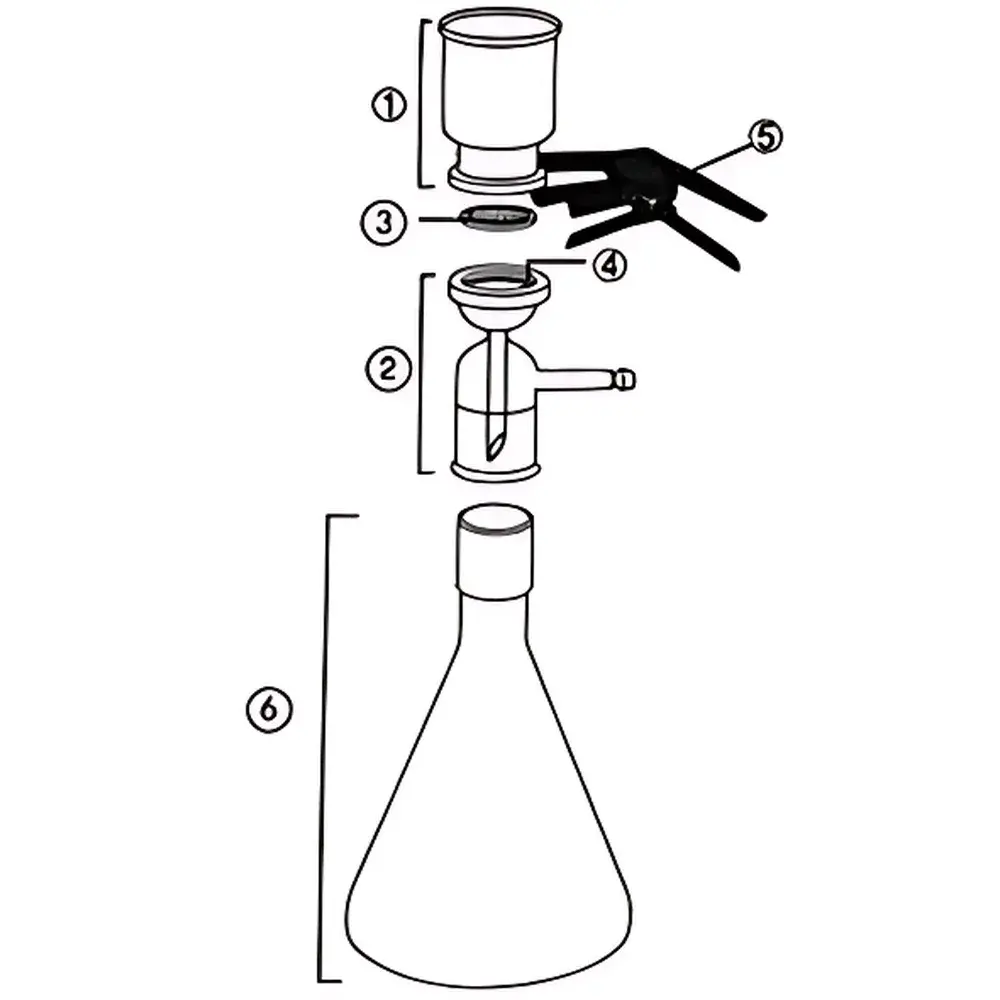
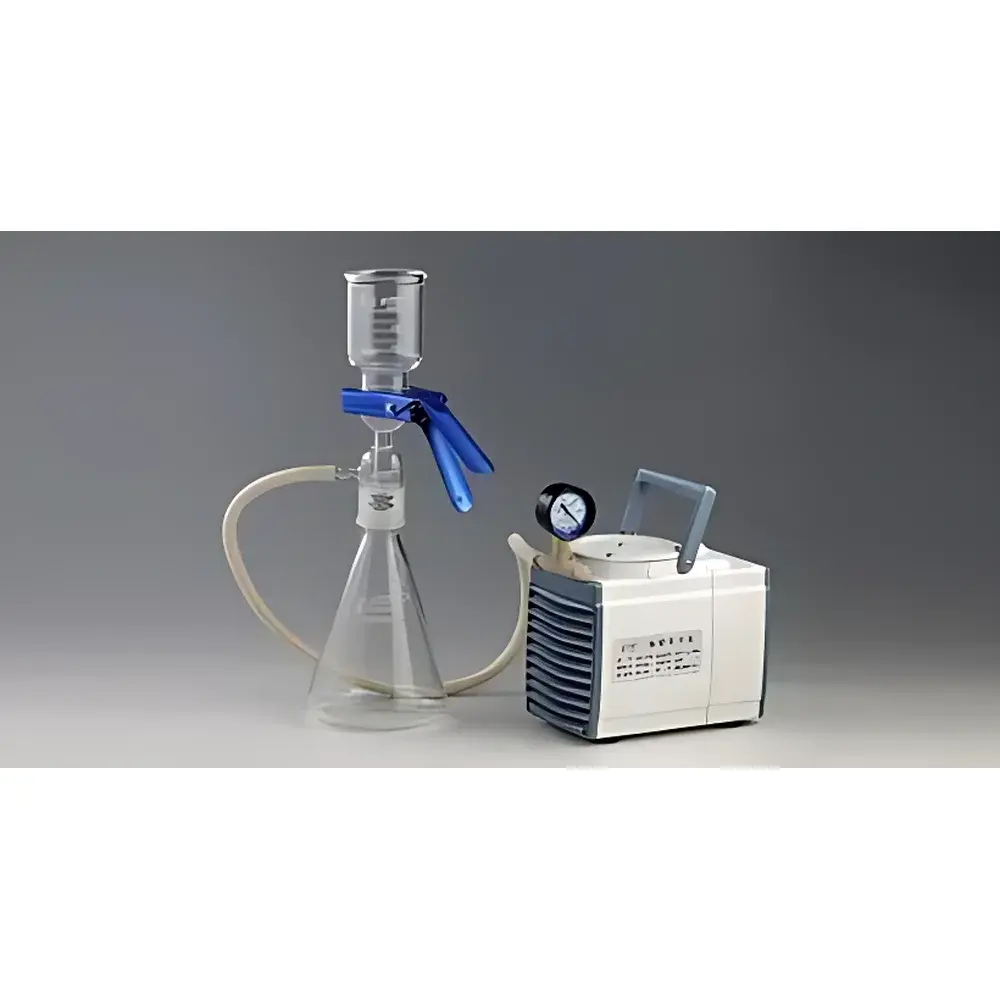
Jiayuan 2L Solvent Filtration System for HPLC Mobile Phase Preparation
| Brand | Jiayuan |
|---|---|
| Origin | Beijing, China |
| Manufacturer Type | Authorized Distributor |
| Product Origin | Domestic (China) |
| Model | 2L |
| Price Range | USD 140–1,400 |
| Filter Cup Capacity | 500 mL |
| Receiving Bottle Capacity | 2000 mL |
| Filter Head Diameter | 60 mm |
| Filter Head Pore Size | 10 µm |
| Filter Head Material | High-Borosilicate Glass |
| Filter Membrane Compatibility | Ø60 mm or Ø58 mm |
| Connection Type | Standard Tapered Ground-Glass Joint (ISO 273/24) |
| PTFE Frit | Removable |
| Clamp Material | Anodized Aluminum Alloy |
| Sterilization Compatibility | Autoclavable at 121°C, 20 min |
Overview
The Jiayuan 2L Solvent Filtration System is a precision-engineered laboratory filtration assembly designed for the rigorous demands of analytical sample preparation—particularly in high-performance liquid chromatography (HPLC), ultra-high-performance liquid chromatography (UHPLC), and trace-level contaminant analysis. Built upon the Couette-type vacuum-driven filtration principle, this system enables rapid, particle-free clarification of aqueous, organic, and aggressive solvent systems—including acetonitrile, methanol, tetrahydrofuran, and dilute acids or bases—without leaching, adsorption, or pressure-induced membrane deformation. Its primary functional role extends beyond particulate removal: by facilitating controlled vacuum application across a high-integrity glass manifold, the system concurrently reduces dissolved gas content in mobile phases—a critical step to prevent bubble formation, pump cavitation, and baseline instability in chromatographic workflows. The unit complies with fundamental design expectations outlined in ASTM D1193 (Type I–IV reagent water specifications) and supports GLP-aligned documentation when integrated with validated lab procedures.
Key Features
- High-borosilicate glass construction (DIN/ISO-compliant borosilicate 3.3) ensures thermal stability up to 500°C, chemical inertness toward strong acids (e.g., 6 M HCl), bases (e.g., 1 M NaOH), and halogenated solvents, and optical clarity for real-time process monitoring.
- Standardized ground-glass joints (ISO 273/24 taper, 60 mm outer diameter) guarantee leak-tight sealing under vacuum (≤10 mbar) and enable repeatable, tool-free assembly/disassembly without gasket degradation.
- Removable PTFE frit (10 µm pore size) provides uniform flow distribution, eliminates glass frit clogging, and allows full compatibility with aggressive media where ceramic or sintered metal frits would corrode or contaminate.
- Anodized aluminum alloy clamp delivers ≥25 N clamping force with zero plastic deformation after ≥10,000 cycles; surface hardness exceeds 300 HV, preventing thread stripping during repeated sterilization cycles.
- Autoclavable configuration: entire filter head, cup, and bottle assemblies withstand standard steam sterilization (121°C, 20 min, 1.1 bar gauge) per ISO 17665-1, supporting aseptic applications in cell culture media preparation and pharmaceutical QC environments.
Sample Compatibility & Compliance
The system accommodates filtration of low- to medium-viscosity liquids (0.3–5 cP) across pH 0–14 and temperatures from −20°C to +120°C (short-term). It is routinely deployed for HPLC mobile phase degassing and particulate removal (≥0.22 µm or 0.45 µm membrane insertion), environmental water extract cleanup (EPA Method 505/525), and pre-filtration of buffers for SEC-MALS or DLS measurements. All wetted components meet USP Class VI biocompatibility requirements. While not certified to ISO 13485 or FDA 21 CFR Part 11 out-of-the-box, the system’s mechanical traceability (joint numbering, batch-marked glassware) supports integration into 21 CFR Part 11–compliant workflows when paired with electronic logbooks and audit-trail-enabled vacuum controllers.
Software & Data Management
This is a manually operated, hardware-only filtration platform—no embedded electronics, firmware, or proprietary software. Vacuum source control (e.g., diaphragm pump, water aspirator) remains external and user-configured. However, the standardized geometry and dimensional repeatability (±0.15 mm joint tolerance, ±1% volume calibration per ISO 4787) allow seamless integration into LIMS-managed workflows: receiving bottle graduation marks conform to ISO 1042 volumetric accuracy class B; filter head dimensions align with common membrane supplier footprints (e.g., Pall Acrodisc, Merck Millipore Millex), enabling automated inventory tagging and SOP referencing.
Applications
- HPLC/UHPLC mobile phase preparation and inline degassing prior to column equilibration
- Filtration of cell culture supernatants and protein solutions prior to size-exclusion chromatography
- Cleanup of environmental extracts (soil leachates, wastewater digests) before GC-MS or ICP-MS analysis
- Pre-filtration of nanoparticle dispersions for dynamic light scattering (DLS) or zeta potential measurement
- Preparation of sterile-filtered assay buffers in GLP-compliant bioanalytical laboratories
FAQ
Can this system be used with 0.22 µm PVDF membranes for sterile filtration?
Yes—Ø60 mm or Ø58 mm membranes are compatible; however, sterility assurance requires validation of the complete assembly (membrane, frit, glass surfaces) via microbial challenge testing per ISO 13408-1.
Is the ground-glass joint interchangeable with other manufacturers’ 60 mm systems?
Yes—the taper conforms to ISO 273/24, ensuring mechanical interchangeability with major suppliers (e.g., Schott, Kimble, DWK Life Sciences), though vacuum integrity must be verified per joint.
What vacuum level is recommended for optimal filtration rate without membrane collapse?
A stable vacuum of 200–400 mbar (absolute) is typical; higher differentials (>600 mbar) may deform thin-track membranes and reduce reproducibility.
Does the PTFE frit require periodic replacement?
Under normal use, the frit exhibits >5,000-cycle durability; replacement is advised only after visible etching, warping, or increased flow resistance inconsistent with new-membrane baselines.
Can the receiving bottle be calibrated for quantitative transfer?
Yes—each 2L bottle is individually calibrated to ISO 1042 Class B tolerances (±5 mL at 20°C), with permanent laser-etched graduations traceable to NIM (China National Institute of Metrology).



