
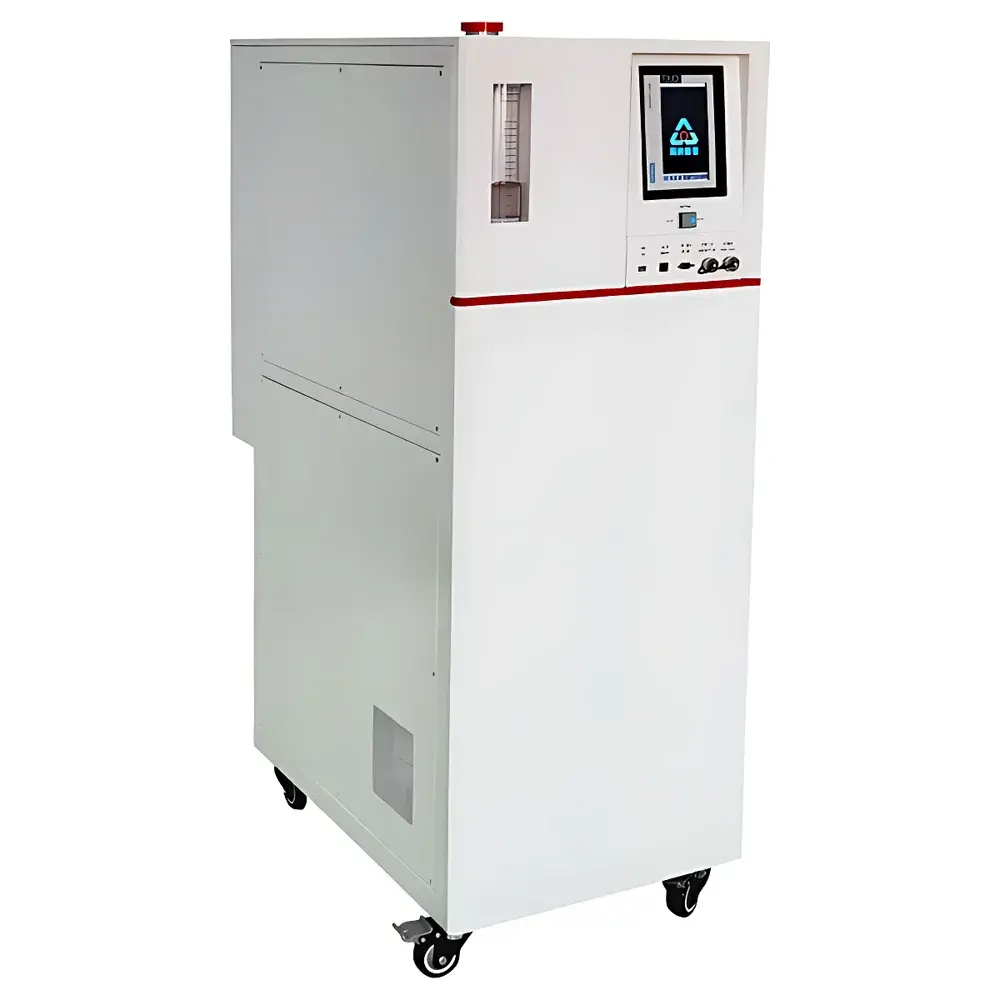
TC900 High-Low Temperature Dynamic Circulating Chiller
| Origin | Tianjin, China |
|---|---|
| Manufacturer Type | Authorized Distributor |
| Product Origin | Domestic (China) |
| Model | TC900 |
| Price Range | USD 7,000 – 14,000 |
| Temperature Range (Empty Load) | –120 °C to +250 °C |
| Cooling Method | Water-Cooled (Air-Cooled Optional) |
| Max. Flow Rate | 15 L/min |
| Max. Pressure | 1.5 bar |
| Heating Power | 3.0 kW |
| Refrigeration Capacity | 2.0 kW @ –40 °C (at cooling water 20 °C / ambient 25 °C) |
| Dimensions (W×D×H) | 550 × 950 × 1550 mm |
Overview
The TC900 High-Low Temperature Dynamic Circulating Chiller is an engineered thermal management system designed for precise, rapid, and stable temperature control across demanding laboratory and pilot-scale applications. Based on closed-loop circulation of synthetic heat-transfer fluid (e.g., silicone oil or low-temperature glycol blends), the unit employs a dual-stage cascade refrigeration architecture combined with high-efficiency electric heating elements to achieve continuous operation from –120 °C to +250 °C under no-load conditions. Its dynamic response capability—enabled by low internal fluid volume, optimized flow path design, and real-time thermal load compensation—makes it suitable for processes requiring tight thermal profiling, such as exothermic/endothermic reaction control, semiconductor device thermal cycling, calorimetric calibration, and accelerated material aging studies. The system operates without direct exposure of the heat-transfer medium to ambient air, minimizing oxidation and degradation over extended service life.
Key Features
- Multidimensional adaptive PID control algorithm with auto-tuning functionality, delivering ±0.1 °C temperature stability and < ±0.3 °C setpoint deviation under dynamic load conditions.
- Fully sealed circulation loop with inert gas purging interface (optional), preventing moisture ingress and thermal fluid contamination during low-temperature operation.
- Dual-isolation pump assembly featuring high-temperature and cryogenic shaft seals, rated for continuous operation across the full temperature span without leakage risk.
- Comprehensive safety architecture including over-temperature cut-off, low-level fluid alarm, pressure differential monitoring, refrigerant leak detection, and dry-run protection.
- Modular power configuration supporting both water-cooled (standard) and air-cooled (optional) condenser variants to accommodate facility constraints and ambient thermal management requirements.
Sample Compatibility & Compliance
The TC900 interfaces seamlessly with external equipment via standardized 1/2″–1″ NPT or ISO-KF ports, supporting integration with jacketed reactors, environmental test chambers, DSC/DMA sample stages, and wafer-level thermal probes. All wetted components—including tubing, pump head, and heat exchanger surfaces—are constructed from 316 stainless steel and fluoropolymer-lined fittings to ensure chemical compatibility with common solvents (e.g., THF, acetone, ethylene glycol) and non-corrosive heat-transfer fluids. The system complies with IEC 61000-6-2 (EMC immunity) and IEC 61000-6-4 (EMC emission) standards. Electrical safety conforms to IEC 61010-1 for laboratory equipment. While not certified for hazardous area use (ATEX/IECEx), optional intrinsically safe signal interfaces are available upon request for controlled environment integration.
Software & Data Management
The TC900 is equipped with an embedded industrial-grade controller featuring a 7-inch capacitive touchscreen HMI, programmable ramp/soak profiles (up to 32 segments), and real-time trend logging (≥30 days at 1-second resolution). RS485 (Modbus RTU) and Ethernet (TCP/IP) communication protocols enable integration into centralized SCADA or LIMS platforms. Optional PC software provides remote monitoring, CSV export of temperature/flow/power data, audit trail generation, and user access level management aligned with GLP/GMP documentation practices. Data integrity features include timestamped event logs, parameter change history, and electronic signature support compliant with FDA 21 CFR Part 11 requirements when deployed with validated software configuration.
Applications
- Low-temperature synthesis of organometallic compounds and cryo-catalysis below –80 °C.
- Thermal stress testing of polymer composites, battery electrolytes, and aerospace-grade adhesives under controlled thermal cycling (–100 °C ↔ +200 °C).
- Calibration of differential scanning calorimeters (DSC), thermogravimetric analyzers (TGA), and dynamic mechanical analyzers (DMA) requiring traceable thermal ramp fidelity.
- Environmental simulation for semiconductor packaging reliability assessment per JEDEC JESD22-A104 and MIL-STD-883 methods.
- Stabilization of optical benches, laser diode mounts, and interferometric measurement systems requiring sub-0.1 °C thermal drift suppression.
FAQ
What is the minimum achievable temperature with external load connected?
Under typical operating conditions (20 °C cooling water, 25 °C ambient), the TC900 maintains –100 °C at the outlet with a 1.5 kW thermal load; actual performance depends on heat exchanger efficiency and fluid flow resistance in the external circuit.
Can the TC900 be integrated with third-party PLCs or LabVIEW?
Yes—Modbus RTU over RS485 and TCP/IP socket communication are natively supported, with register mapping documentation provided for custom integration.
Is the unit suitable for use with flammable heat-transfer fluids?
No. Only non-flammable, thermally stable synthetic oils (e.g., Dow Corning PM-200, Marlotherm SH) or aqueous glycol mixtures meeting ASTM D6796 specifications are approved for use.
Does the system include validation documentation for GxP environments?
Factory-installed IQ/OQ documentation packages are available as an option; PQ execution requires site-specific installation and operational context verification.
What maintenance intervals are recommended for long-term reliability?
Refrigerant oil analysis and filter replacement every 12 months; heat-transfer fluid sampling and viscosity testing every 24 months; annual calibration of PT100 sensors against NIST-traceable references.



