
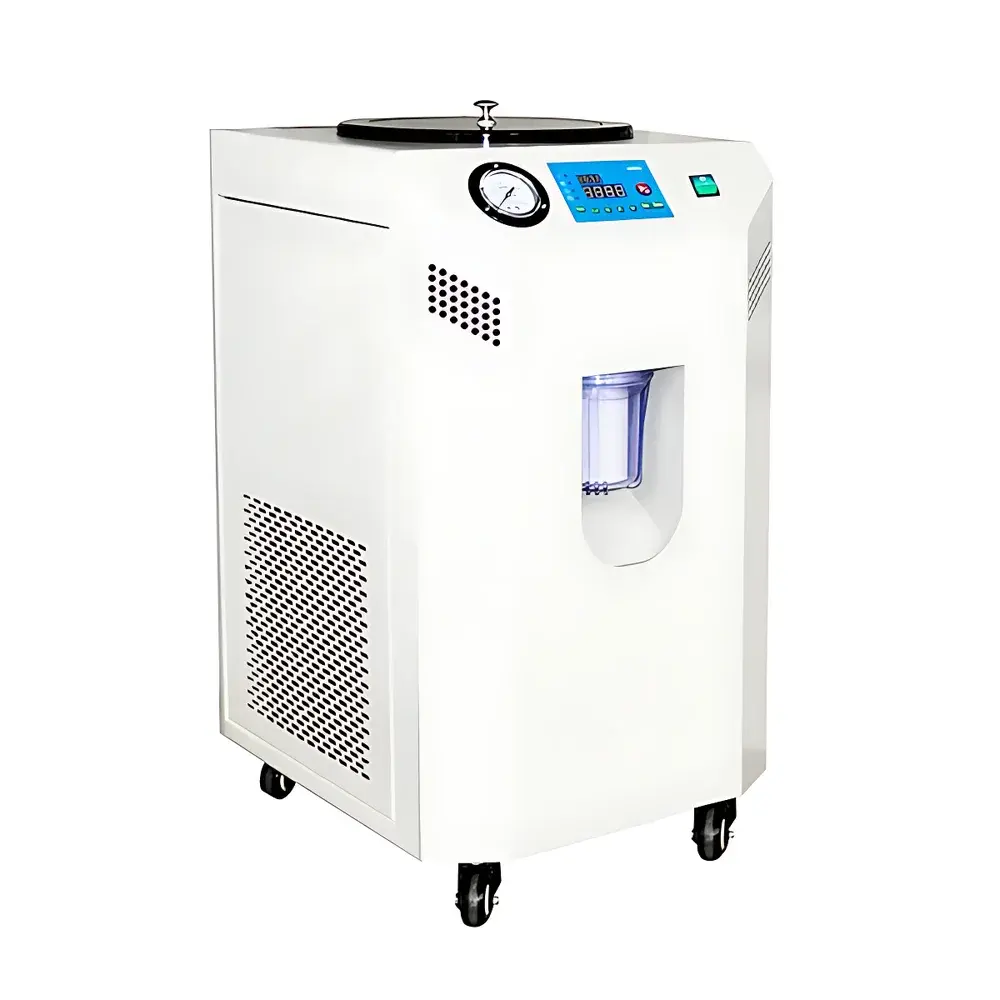
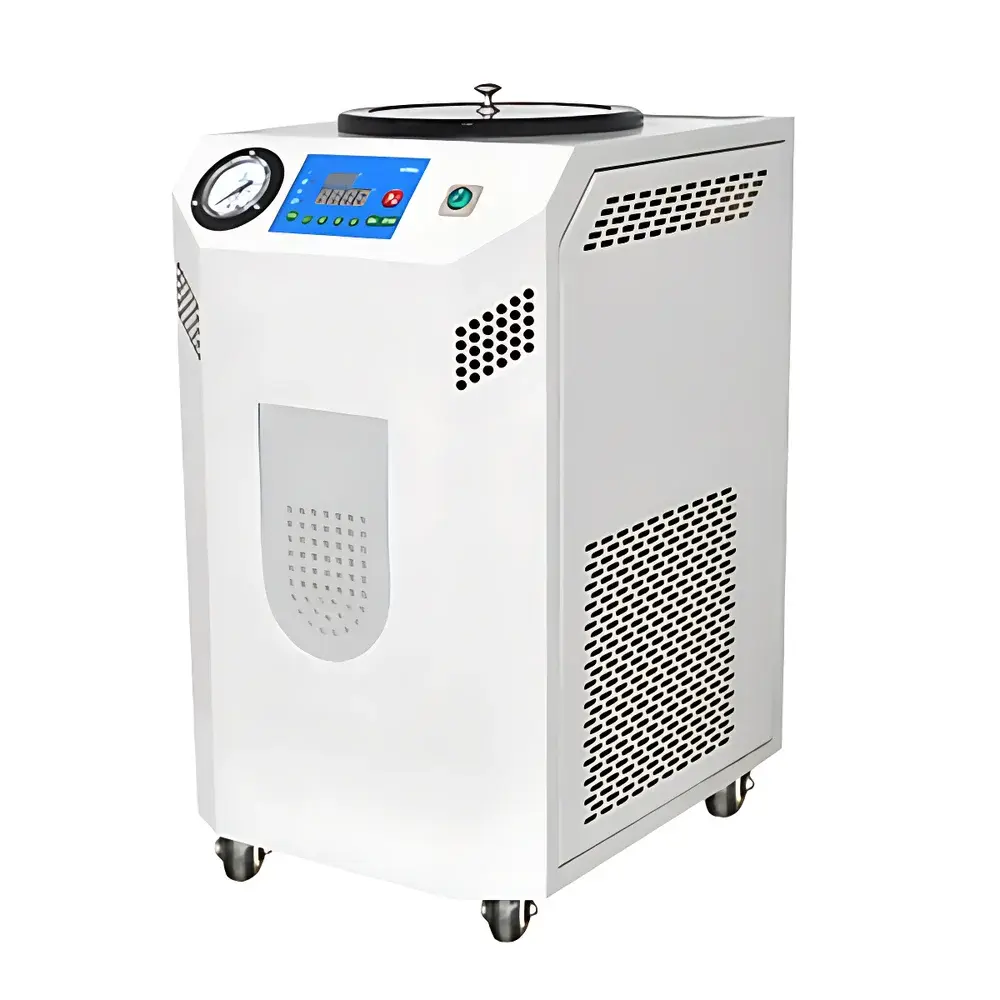
Tongzhou Weipu AC1200A Atomic Absorption Spectrophotometer Circulating Chiller
| Brand | Tongzhou Weipu |
|---|---|
| Origin | Beijing, China |
| Manufacturer Type | Direct Manufacturer |
| Product Category | Domestic |
| Model | AC1200A |
| Instrument Type | Integrated Circulating Chiller |
| Cooling Method | Air-Cooled |
| Temperature Control Range | 5–35 °C |
| Temperature Stability | ±1 °C |
| Refrigeration Capacity | 1200 W |
| Circulating Pump Head | 13 m (max) / 10 m (rated) |
| Circulating Flow Rate | 15 L/min (max) / 8 L/min (rated) |
| Reservoir Volume | 16 L |
| Working Mode | Air-Cooled Closed-Loop Circulation |
Overview
The Tongzhou Weipu AC1200A is an integrated, air-cooled circulating chiller engineered specifically for thermal management of high-precision analytical instruments requiring stable, low-noise coolant delivery. Designed around a robust vapor-compression refrigeration cycle with optimized heat exchange geometry, the AC1200A maintains precise temperature control (5–35 °C) with ±1 °C stability—critical for sustaining optical alignment, detector sensitivity, and plasma stability in atomic absorption spectrometry (AAS), inductively coupled plasma optical emission spectroscopy (ICP-OES), and related instrumentation. Its closed-loop architecture eliminates evaporative loss and minimizes contamination risk, while its stainless-steel reservoir and fluid path ensure compatibility with ultrapure water and low-conductivity coolants required by sensitive detectors and RF generators.
Key Features
- Stainless-steel open-top reservoir with transparent level indicator—enables real-time visual inspection of coolant clarity and facilitates rapid cleaning and maintenance.
- Integrated pre-filter housing with sight window—allows direct observation of filter saturation; standard 5-µm particulate filtration prevents clogging of instrument heat exchangers and microfluidic channels.
- Dual-stage pump system delivering up to 15 L/min at 10 m head—engineered for consistent flow across multi-branch cooling circuits common in ICP torches, AAS nebulizers, and SEM cold stages.
- Comprehensive protection suite: flow interruption detection, low-level reservoir alarm, over-temperature cutoff (both reservoir and outlet), and ambient overheat lockout—each with configurable dry-contact relay outputs (NO/NC) for integration into lab-wide safety interlocks.
- Air-cooled condenser with rear-mounted axial fans and optimized fin spacing—ensures effective heat rejection in standard laboratory environments without external water supply or drainage infrastructure.
- Modular electrical interface: standard RS-232 port for serial command control; optional parallel I/O board supports TTL-level start/stop triggers and discrete alarm signaling compatible with PLC-based lab automation systems.
Sample Compatibility & Compliance
The AC1200A is validated for continuous operation with deionized water, ASTM Type II water, and glycol/water mixtures (up to 30% v/v). Its all-stainless-steel wetted components (304 SS reservoir, pump housing, tubing, and fittings) comply with ISO 8502-9 for corrosion resistance and meet USP conductivity requirements when operated with purified water. The unit supports GLP/GMP workflows through configurable event logging (time-stamped temperature, flow, and fault events) and optional audit-trail-enabled firmware compliant with FDA 21 CFR Part 11 Annex 11 principles. It is routinely deployed in laboratories accredited to ISO/IEC 17025 and operates within ambient conditions specified in IEC 61000-6-3 (EMC emissions) and IEC 61010-1 (safety for laboratory equipment).
Software & Data Management
While the AC1200A operates as a standalone instrument with intuitive front-panel controls, its RS-232 interface enables bidirectional communication with host systems using ASCII-based SCPI-like commands. Lab managers may integrate it into centralized monitoring platforms via Modbus RTU (with optional protocol converter) or custom Python/LabVIEW drivers. Logged operational data—including setpoint history, actual temperature traces, pump runtime, and alarm timestamps—can be exported in CSV format for trending analysis. Firmware updates are performed via secure USB flash drive, with version rollback capability and cryptographic signature verification to maintain system integrity.
Applications
- Thermal stabilization of hollow cathode lamps and graphite furnace assemblies in flame and graphite furnace AAS systems.
- Cooling of ICP-OES and ICP-MS plasma torches, spray chambers, and RF matching networks to suppress thermal drift and improve signal-to-noise ratio.
- Heat extraction from SEM electron column cold traps, EDS detector Peltier elements, and beam blanker electronics.
- Temperature regulation for glovebox antechambers, plasma etch chamber chill plates, and high-frequency fusion furnaces used in geochemical sample preparation.
- Secondary cooling loop for automated Kjeldahl digestion units and UV-Vis spectrophotometer light sources requiring vibration-isolated thermal management.
FAQ
Can the AC1200A be used with organic solvent-based coolants?
No—this unit is designed exclusively for aqueous coolants (water, water/glycol). Organic solvents may degrade seals and compromise refrigerant system integrity.
Is remote monitoring supported out-of-the-box?
Yes—RS-232 communication is standard; Ethernet or Wi-Fi connectivity requires an external protocol gateway or third-party IoT adapter.
What is the maximum allowable ambient temperature for continuous operation?
40 °C at 60% relative humidity, per IEC 60068-2-14 thermocycling specifications.
Does the unit include a built-in water purification system?
It includes a mechanical pre-filter only; resin-based deionization modules are available as factory-installed options (e.g., AC1200A-RF variant).
How often should the pre-filter cartridge be replaced under typical lab use?
Every 6–12 months depending on water quality; visual inspection via the sight window is the primary replacement indicator.
Related Products



