
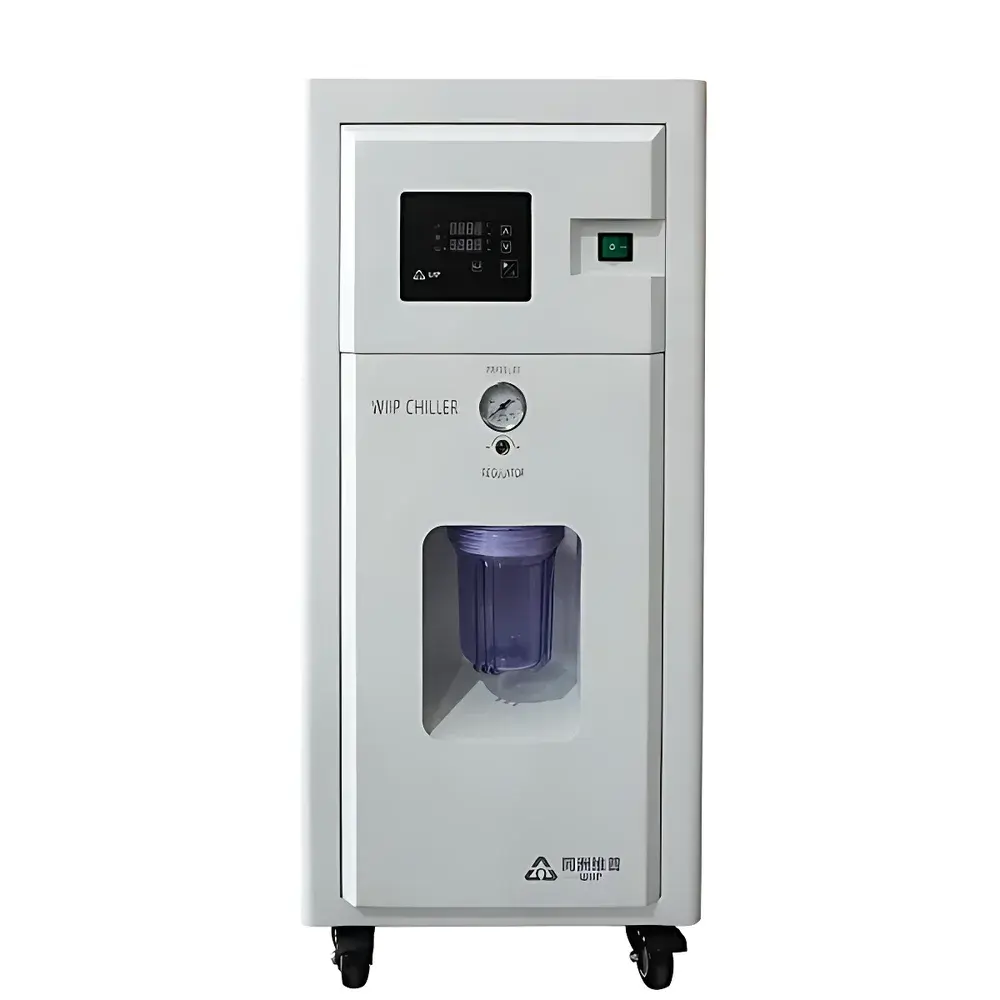
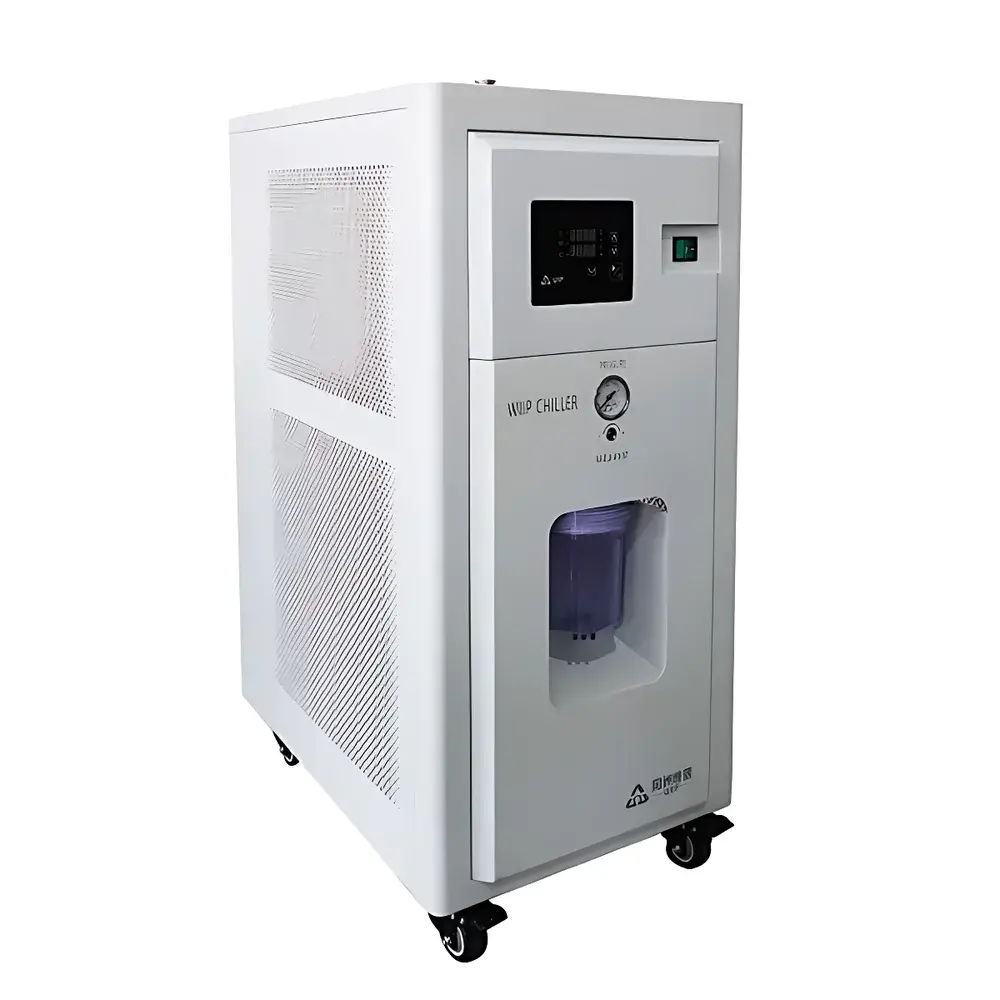
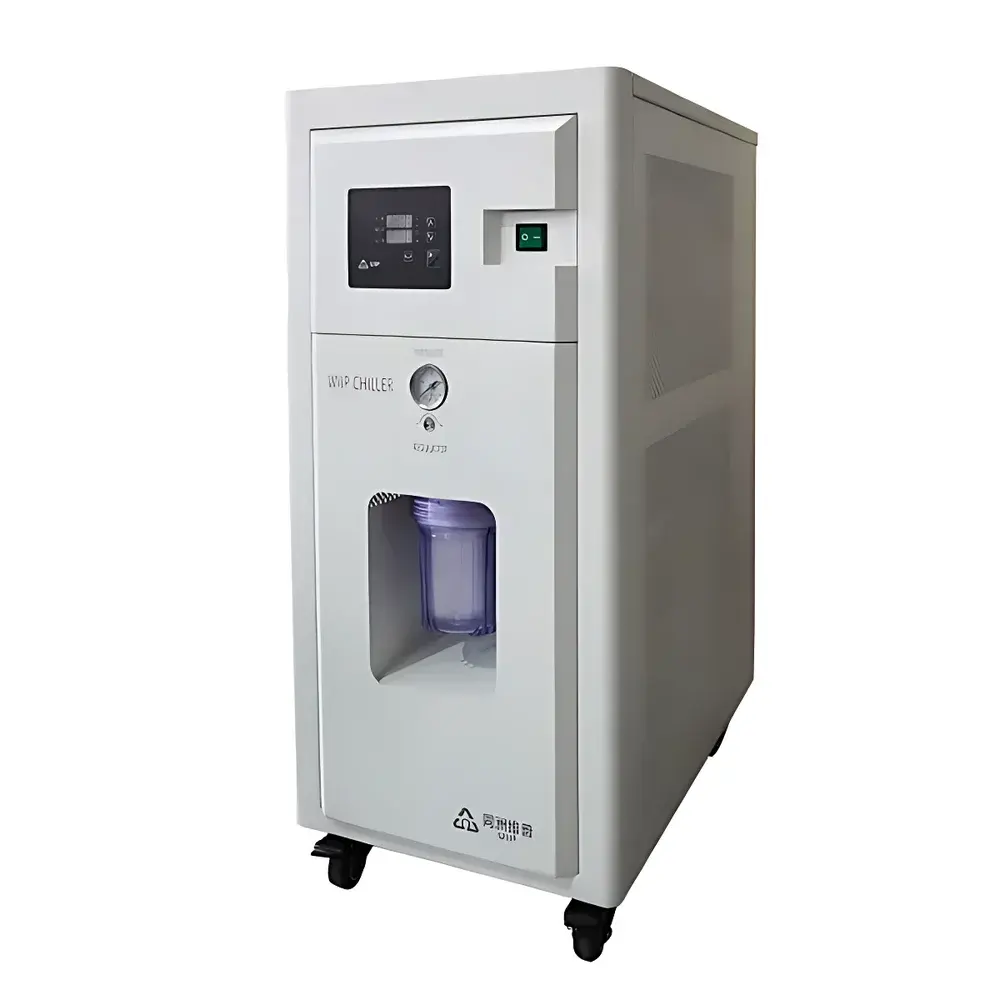
Tongzhou Weipu H1 Circulating Chiller for ICP-MS Systems
| Brand | Tongzhou Weipu |
|---|---|
| Origin | Beijing, China |
| Manufacturer Type | Direct Manufacturer |
| Product Category | Domestic |
| Model | H1 Circulating Chiller for ICP-MS |
| Instrument Type | Integrated Unit |
| Cooling Method | Water-Cooled |
| Temperature Control Range | −40 °C to 95 °C |
| Cooling Capacity | 900 W to 6400 W |
| Temperature Stability | ±0.1 °C to ±0.3 °C |
Overview
The Tongzhou Weipu H1 Circulating Chiller is an integrated, water-cooled temperature control system engineered specifically for high-precision analytical instrumentation requiring stable, continuous thermal management. Designed to serve as a dedicated cooling solution for inductively coupled plasma mass spectrometers (ICP-MS), the H1 operates on a closed-loop refrigeration cycle using environmentally compliant refrigerant (R-410A or equivalent, per regional regulatory compliance). Its core function is to maintain consistent coolant temperature and flow rate under dynamic thermal loads—critical for sustaining plasma stability, detector sensitivity, and long-term signal reproducibility in ICP-MS operation. Unlike generic chillers, the H1 integrates instrument-specific thermal interface logic, including pressure-regulated flow delivery, low-temperature alarm thresholds aligned with RF generator and ion optics operational limits, and real-time thermal load compensation to prevent condensation or thermal shock during extended analysis runs.
Key Features
- Integrated vertical architecture with footprint-optimized design (≤0.45 m²), suitable for placement beneath or adjacent to ICP-MS consoles without obstructing service access.
- Low-RPM, large-diameter axial fan assembly delivering ≤52 dBA acoustic emission at 1 m—engineered to minimize vibration transmission to sensitive mass spectrometer components.
- Dual-stage filtration system: particulate pre-filter (5 µm) + activated carbon + ion-exchange resin cartridge, ensuring coolant purity compliant with ASTM D1193 Type II water specifications for critical instrument cooling loops.
- Real-time monitoring suite: integrated sensors for coolant temperature, flow rate (±1% FS accuracy), pressure differential, refrigerant saturation temperature, and reservoir level—with configurable relay outputs for external interlock integration (e.g., ICP-MS shutdown on flow loss).
- CE-certified electrical architecture with universal voltage input (100–240 VAC, 50/60 Hz), enabling seamless deployment across global laboratory infrastructures without hardware modification.
- Refrigeration circuit optimized for transient thermal load response: achieves <30 s recovery time from 100% to 90% of setpoint after step-load increase typical of plasma ignition cycles.
Sample Compatibility & Compliance
The H1 chiller is validated for continuous-duty operation with ICP-MS platforms from Thermo Fisher Scientific (iCAP RQ/QQQ), Agilent (8900/7900), PerkinElmer (NexION series), and Shimadzu (ICPMS-2030), as well as auxiliary systems including RF generators, vacuum pumps, and collision/reaction cell assemblies. It meets ISO 13849-1 (PL e) for safety-related control functions and conforms to EN 61000-6-3 (EMC emission) and EN 61000-6-2 (immunity) standards. All fluid-contact materials—including stainless steel reservoir, EPDM gaskets, and fluoropolymer-coated heat exchangers—are certified non-leaching per USP and compatible with deionized water/glycol mixtures (up to 30% v/v) used in low-temperature ICP-MS applications.
Software & Data Management
The H1 features embedded firmware supporting Modbus RTU/TCP protocol for bidirectional communication with laboratory information management systems (LIMS) and instrument host controllers. Local HMI includes password-protected parameter configuration, event logging (≥10,000 entries with timestamp and severity tagging), and audit-trail-enabled calibration history storage. When deployed in regulated environments (e.g., GLP/GMP-compliant trace metal labs), the system supports 21 CFR Part 11-compliant electronic signatures via optional USB-authenticated login module and encrypted log export (CSV/CSV-GZ). Remote diagnostics and firmware updates are performed over secure TLS 1.2 connections, with all data transmissions meeting NIST SP 800-53 Rev. 4 encryption requirements.
Applications
- Stabilizing plasma torch and interface cone temperatures in ICP-MS to reduce polyatomic interference drift and improve long-term precision (RSD <1.5% over 8 h).
- Maintaining constant thermal environment for quadrupole mass filters and electron multipliers to minimize gain drift and background noise elevation.
- Cooling high-power RF generators (≥2.0 kW) operating at 27.12 MHz or 40.68 MHz frequencies, preventing frequency detuning due to thermal expansion.
- Supporting tandem ICP-MS/MS configurations where reaction cell cooling must remain decoupled from main plasma cooling loops.
- Providing auxiliary cooling for cryo-trapped vacuum manifolds and cooled spray chambers in ultra-trace elemental analysis workflows.
FAQ
What is the minimum coolant flow rate required for compatibility with Thermo Fisher iCAP RQ?
The H1 delivers adjustable flow rates from 1.2 to 8.0 L/min with pressure regulation; Thermo Fisher iCAP RQ requires ≥2.5 L/min at ≤2.5 bar backpressure—fully supported across its operating range.
Does the H1 support glycol-water mixtures for sub-zero operation?
Yes—certified for use with up to 30% propylene glycol/water solutions, maintaining full cooling capacity down to −40 °C while preserving corrosion resistance and thermal conductivity.
How is calibration traceability maintained for temperature sensors?
Each unit ships with NIST-traceable calibration certificate (per ISO/IEC 17025) for both reservoir and outlet temperature sensors, with annual recalibration intervals defined in the user manual.
Can the H1 be integrated into a centralized lab cooling network?
No—the H1 is a dedicated point-of-use chiller; it does not support primary-secondary loop interfacing or hydraulic balancing valves required for central plant integration.
Is remote firmware update capability available without local IT administrator access?
Firmware updates require authenticated USB key or TLS-secured network upload with dual-factor authentication—no unattended remote execution is permitted per cybersecurity policy.



