
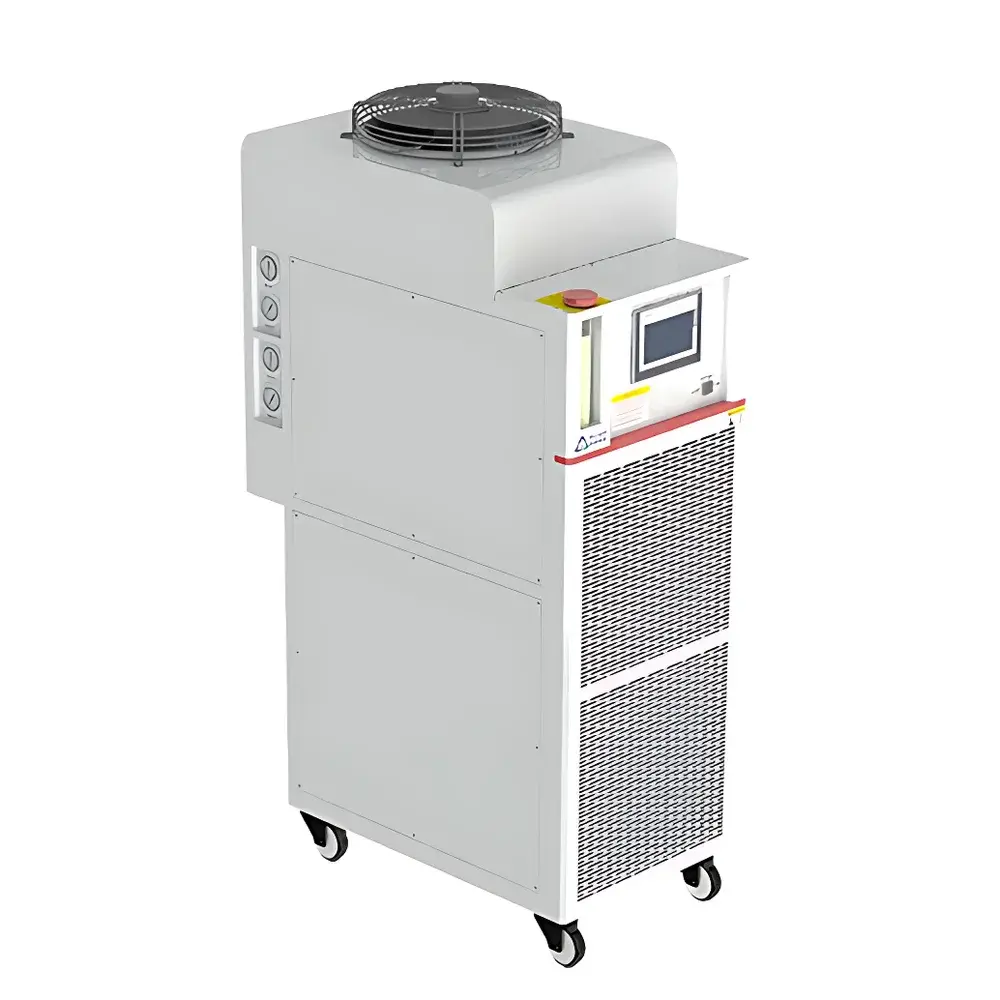
Tongzhou Weipu TC2000 Series High-Low Temperature Circulator
| Brand | Tongzhou Weipu |
|---|---|
| Origin | Tianjin, China |
| Manufacturer Type | Direct Manufacturer |
| Model | TC2000 |
| Temperature Range | –25 °C to +200 °C |
| Pump Flow Rate | 20–75 L/min (2.0–2.5 bar) |
| Heating Power | 2.5–15.0 kW |
| Refrigeration Power | 1.2–15.0 kW (@ –20 °C to +200 °C) |
| Control Interface | 7″ TFT LCD touchscreen with PLC-based logic |
| Communication | Ethernet (Modbus TCP), RS485 (Modbus RTU), USB data logging, external PT100 input |
| Programmable Steps | Up to 100-step ramp-soak profiles |
| Cooling Method | Air-cooled (F) or water-cooled (W) variants |
| Enclosure Options | Standard, explosion-proof, split-system, stainless-steel cabinet, OEM-integrated configurations |
| Fluid Compatibility | Synthetic heat transfer fluids (e.g., AU-280, AUSI-05, AUSI-10) rated for –90 °C to +250 °C |
| Hose Interface | Stainless steel braided hoses with customizable M30×1.5/M38×1.5 fittings, aerogel+rubber insulation options |
| Compliance | Designed per IEC 61000-6-2/6-4 (EMC), UL/CSA recognition-ready, GLP/GMP-compatible data traceability architecture |
Overview
The Tongzhou Weipu TC2000 Series High-Low Temperature Circulator is an engineered thermal management system designed for precise, dynamic temperature control across demanding laboratory and pilot-scale process applications. Operating on a closed-loop refrigeration-heating cycle, the TC2000 integrates a dual-stage compression refrigeration circuit with high-efficiency electric resistance heating elements, enabling seamless transition between cooling and heating modes without fluid exchange or manual intervention. Its core function is to maintain stable, programmable bath temperatures — from –25 °C to +200 °C — within external reaction vessels, jacketed reactors, calorimeters, or material testing fixtures. Unlike basic chillers or heaters, the TC2000 employs a multi-dimensional PID algorithm with adaptive gain scheduling, allowing rapid thermal response (<60 s to settle within ±0.3 °C of setpoint under load) and long-term stability (<±0.1 °C over 24 h at steady state). The system’s architecture supports both internal bath control and external process temperature feedback via user-supplied PT100 sensors, making it suitable for exothermic reaction monitoring, polymer curing validation, and accelerated aging studies where thermal fidelity directly impacts kinetic reproducibility.
Key Features
- Wide operational range: –25 °C to +200 °C continuous duty, with optional fluid compatibility extending down to –90 °C using AUSI-05 synthetic media
- Modular thermal output: Refrigeration power up to 15.0 kW and heating power up to 15.0 kW, scalable across 12 standard models (TC2025H20 to TC2150H20)
- Dual cooling configuration: Air-cooled (F) and water-cooled (W) variants accommodate facility constraints; water-cooled models reduce ambient heat rejection by >40%
- Intelligent control platform: 7-inch industrial-grade TFT touchscreen with embedded PLC logic, supporting up to 100-segment temperature programs with ramp rates from 0.1 to 10 °C/min
- Robust fluid handling: Stainless-steel braided circulation hoses with custom-length options (200–500 cm), rated for –100 °C to +350 °C service when paired with aerogel-rubber composite insulation
- Compliance-ready interfaces: Modbus TCP (Ethernet) and Modbus RTU (RS485) enable integration into SCADA, MES, or LIMS environments; USB port supports CSV-formatted audit logs compliant with FDA 21 CFR Part 11 requirements
- Configurable safety architecture: Dry-contact alarm outputs for high/low temperature, flow loss, and compressor fault; optional ATEX-certified explosion-proof variants available for Class I Div 1 hazardous locations
Sample Compatibility & Compliance
The TC2000 circulator is compatible with a broad spectrum of heat transfer media, including silicone oils, glycol-water mixtures, and synthetic hydrocarbon-based fluids (e.g., AU-280, AUSI-05, AUSI-10), each selected based on required flash point (>100 °C), pour point (≤–90 °C), and thermal stability (>250 °C). All models conform to IEC 61000-6-2 (immunity) and IEC 61000-6-4 (emissions) standards for laboratory electromagnetic environments. Electrical safety design aligns with IEC 61010-1 for measurement, control, and laboratory equipment. For regulated pharmaceutical or biotech use, the TC2000 supports 21 CFR Part 11-compliant electronic records through time-stamped, user-authenticated data export and configurable audit trails. Optional IQ/OQ documentation packages are available to support GMP validation per ASTM E2500 and ISO 13485 frameworks.
Software & Data Management
The integrated control firmware provides native support for protocol-based communication without third-party drivers. Modbus TCP mapping includes real-time registers for bath temperature, setpoint, pump speed, compressor status, heater duty cycle, and alarm flags — enabling direct polling by LabVIEW, Python (pymodbus), or DeltaV DCS systems. USB data logging captures timestamped temperature, pressure, and power consumption at user-defined intervals (1 s to 60 min), generating ISO 8601-compliant .csv files with SHA-256 hash verification. Remote monitoring is supported via static IP or DHCP configuration; no cloud dependency or vendor-hosted infrastructure is required. Firmware updates are performed offline via USB stick, preserving network air-gap integrity in secure lab environments.
Applications
- Chemical synthesis: Exothermic Grignard reactions, nitration, hydrogenation — where precise jacket temperature control prevents runaway conditions
- Materials science: Thermal cycling of composites, DSC calibration verification, rheological testing of thermoplastics across glass transition ranges
- Pharmaceutical development: Dissolution apparatus temperature regulation (USP ), lyophilizer shelf pre-cooling, stability chamber qualification
- Automotive R&D: Battery thermal management simulation, coolant loop testing under dynamic load profiles
- Academic research: Cryogenic spectroscopy sample cooling, high-temperature catalysis screening, phase-change material characterization
FAQ
What is the minimum recommended heat transfer fluid for –25 °C operation?
AUSI-05 synthetic fluid (pour point –90 °C, flash point 128 °C) is validated for continuous use down to –25 °C and is supplied with full SDS and thermal stability reports.
Can the TC2000 interface with a distributed control system (DCS) in a pilot plant?
Yes — Modbus TCP over Ethernet enables native integration with Emerson DeltaV, Honeywell Experion, and Siemens PCS7 without gateway hardware.
Is external PT100 sensor compensation supported during heating cycles?
Yes — the system accepts two independent PT100 inputs: one for internal bath sensing and one for external process feedback, with selectable control mode (internal vs. external) per program step.
What certifications are included with standard delivery?
CE marking, RoHS compliance, and factory calibration certificates (NIST-traceable reference thermometer) are provided; UL/cUL listing requires optional certification package.
How is maintenance access structured for compressor service?
Front-access service panels allow full compressor, condenser coil, and refrigerant circuit inspection without disassembling the main chassis; scheduled maintenance intervals are defined in the operator manual (Section 7.2).



