
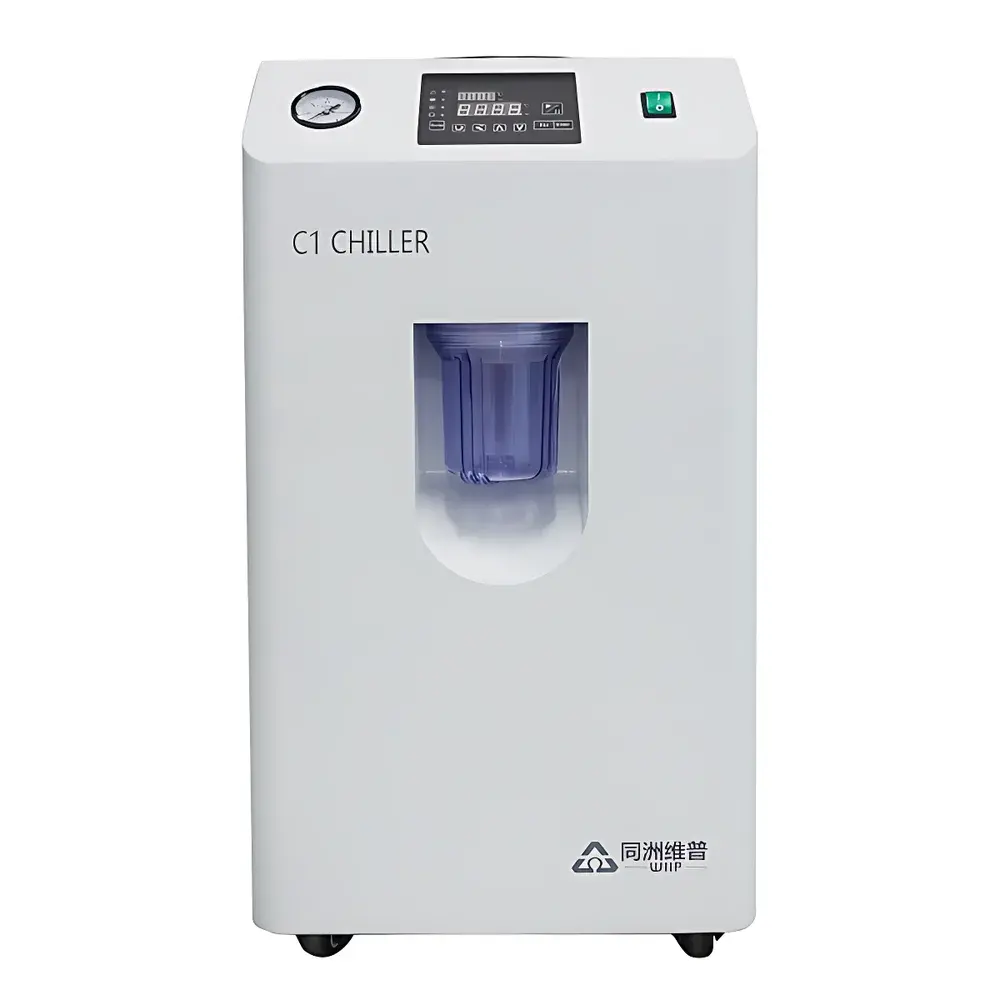
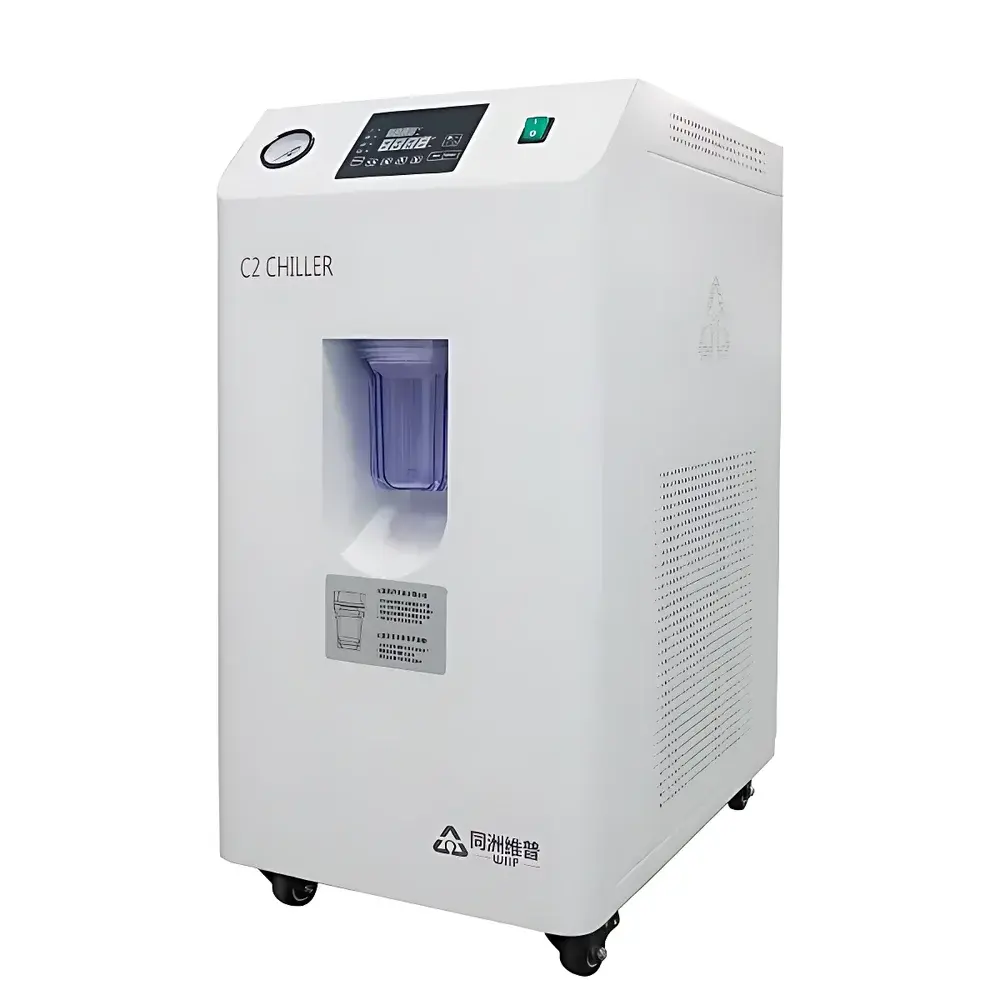
Tongzhou Weipu C2 Circulating Chiller for ICP-MS
| Brand | Tongzhou Weipu |
|---|---|
| Origin | Beijing, China |
| Manufacturer Type | Direct Manufacturer |
| Instrument Type | Integrated Circulating Chiller |
| Cooling Method | Water-Cooled |
| Temperature Control Range | 5–35 °C |
| Cooling Capacity | 1600 W |
| Temperature Stability | ±0.1 °C |
| Reservoir Volume | 20 L |
| Refrigeration Principle | Phase-Change Refrigeration |
Overview
The Tongzhou Weipu C2 Circulating Chiller is an integrated, water-cooled refrigeration system engineered specifically to meet the stringent thermal management requirements of high-sensitivity analytical instrumentation—most notably inductively coupled plasma mass spectrometry (ICP-MS). Unlike general-purpose chillers, the C2 is optimized for continuous, low-noise operation under variable thermal loads typical of plasma-based instruments, where even minor temperature fluctuations can impact detector stability, plasma impedance, and signal-to-noise ratio. Its phase-change refrigeration architecture delivers consistent heat extraction across the full operational range (5–35 °C), with a nominal cooling capacity of 1600 W at 20 °C ambient. The unit employs a hermetically sealed compressor, copper-aluminum microchannel evaporator, and PID-controlled circulation pump to ensure long-term reliability and minimal maintenance in 24/7 laboratory environments.
Key Features
- Integrated design with built-in 20 L stainless-steel reservoir, eliminating external tank dependencies and reducing footprint.
- Precision temperature control with ±0.1 °C stability over the full 5–35 °C setpoint range—validated per ASTM E2877-22 for laboratory chiller performance verification.
- Phase-change refrigeration cycle using R-410A refrigerant, compliant with ISO 5149-2:2014 safety standards for refrigeration systems.
- Corrosion-resistant fluid path (316L stainless steel pump head, EPDM seals, and passivated reservoir) compatible with deionized water and low-conductivity coolant mixtures required by ICP-MS interface components.
- Intelligent flow monitoring with real-time pressure differential sensing and automatic alarm triggering for low-flow or blockage conditions—critical for protecting RF generators and torch assemblies.
- RS-485 Modbus RTU interface for integration into centralized lab infrastructure monitoring systems; optional Ethernet module supports SNMP v3 and Syslog event reporting.
Sample Compatibility & Compliance
The C2 chiller is validated for use with ICP-MS platforms from major OEMs including Thermo Fisher Scientific (iCAP RQ/Q, iCAP TQ), Agilent (8900, 8800), PerkinElmer (NexION 5000), and Shimadzu (ICPMS-2030). It also maintains thermal stability for auxiliary systems such as vacuum pumps (turbo-molecular and cryo-pumps), RF generators, and secondary ion detection electronics. All electrical components conform to IEC 61010-1:2010 for laboratory equipment safety. The unit is designed and tested to support GLP-compliant workflows: temperature setpoints, runtime logs, and fault events are timestamped and stored internally for ≥30 days, satisfying audit-trail requirements under FDA 21 CFR Part 11 when paired with validated data acquisition software.
Software & Data Management
The embedded controller features a 4.3-inch capacitive touchscreen with multilingual UI (English, German, Japanese, Simplified Chinese). Local configuration includes programmable ramp-and-soak profiles, dual-setpoint scheduling (e.g., standby vs. acquisition modes), and password-protected parameter lockdown. Logged data—including inlet/outlet temperatures, flow rate, compressor duty cycle, and error codes—is exportable via USB 2.0 as CSV files. Optional Tongzhou Weipu LabLink™ software (v3.2+) provides remote monitoring, alarm escalation via email/SMS, and automated report generation aligned with ISO/IEC 17025 documentation frameworks. Audit trail records include user ID, timestamp, action type, and pre-/post-change values—fully traceable for regulatory submissions.
Applications
- Primary cooling for ICP-MS plasma torches, interface cones, and quadrupole or collision cell assemblies.
- Thermal stabilization of high-vacuum systems (e.g., turbomolecular pumps, cryopumps) used in ultra-high-resolution mass spectrometry.
- Supporting high-power RF generators (≥2.0 kW) in multi-element ICP-OES and ICP-MS configurations requiring stable impedance matching.
- Cooling of electron-optical columns in SEM/TEM systems where thermal drift compromises sub-nanometer imaging resolution.
- Temperature regulation for glovebox antechambers and inert-atmosphere synthesis reactors operating under controlled dew point conditions.
- Continuous-duty cooling for high-frequency induction furnaces (e.g., 2–5 MHz) used in geological sample fusion and metal alloy preparation.
FAQ
What is the maximum allowable coolant conductivity for ICP-MS compatibility?
For optimal dielectric isolation and corrosion prevention, we recommend ≤1.0 µS/cm (deionized water, resistivity ≥1 MΩ·cm). Conductivity above 5 µS/cm may trigger internal flow alarms.
Does the C2 support external temperature feedback from the instrument?
Yes—the unit accepts 0–10 V or 4–20 mA analog input from OEM-supplied temperature sensors for cascade control, enabling tighter regulation at the point-of-use.
Is the chiller compatible with glycol-water mixtures?
It supports up to 30% v/v propylene glycol for freeze protection down to –15 °C; however, glycol reduces heat transfer efficiency by ~12% and increases viscosity—consult application engineering before deployment.
How often does the internal filter require replacement?
Under standard DI-water operation, the 5 µm particulate filter should be inspected every 6 months and replaced annually—or more frequently if particulate load exceeds 0.5 mg/L.
Can the C2 operate unattended for extended periods?
Yes—its fail-safe architecture includes dry-run protection, high-pressure cutout, and redundant temperature sensors; it meets UL 61010-1 Category B2 environmental rating for continuous operation in Class II laboratories.



