
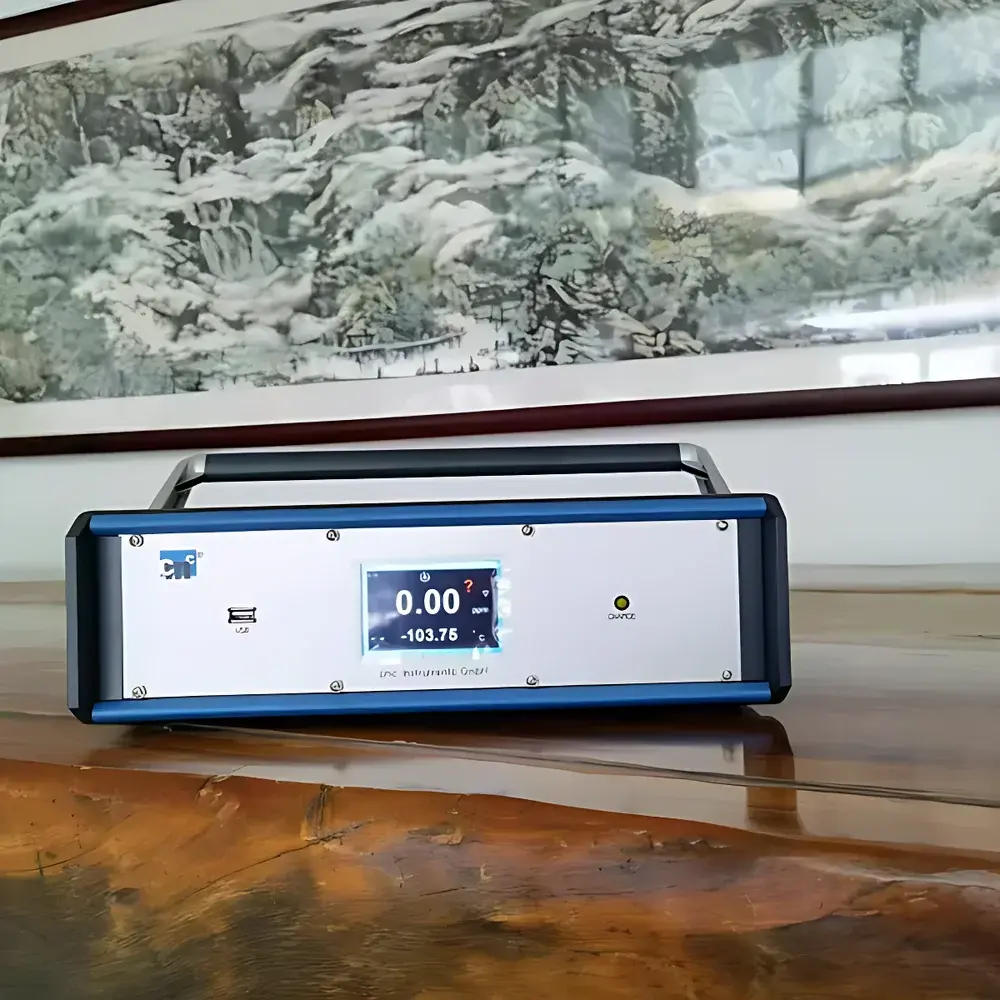
Southland Sensing TMA-210-P-P Portable Electrolytic Dew Point Analyzer
| Brand | Southland Sensing |
|---|---|
| Origin | Germany |
| Model | TMA-210-P-P |
| Product Type | Portable Dew Point Analyzer |
| Measurement Principle | Phosphorus Pentoxide (P₂O₅) Electrolytic Method |
| Operating Temperature Range | −20 °C to +150 °C |
| Accuracy | ±1% of full scale |
| Repeatability | ±0.1% of full scale |
| Measurement Ranges | 0–10 ppm, 0–100 ppm, 0–1000 ppm, 0–2500 ppm (auto/manual range switching) |
| Display | Touchscreen with optional Chinese language interface |
| Output Signals | 4–20 mA (configurable), High/Low alarm relay outputs |
| Power Supply | Rechargeable Li-ion battery or 80–230 VAC, 50–60 Hz |
| Power Consumption | 8 W |
| Enclosure Rating | IP20 |
| Dimensions | 363 mm (W) × 115 mm (H) × 377 mm (D) |
| Weight | ~6 kg |
| Intrinsic Safety | Integrated Zener barrier compliant with IEC/EN 60079-11 for hazardous area use |
Overview
The Southland Sensing TMA-210-P-P is a portable, microprocessor-controlled electrolytic dew point analyzer engineered for trace moisture measurement in demanding industrial gas streams. It employs the well-established phosphorus pentoxide (P₂O₅) sensor principle: water vapor in the sample gas is electrolyzed at a P₂O₅-coated electrode pair—typically platinum or rhodium wires—into hydrogen and oxygen, regenerating P₂O₅ in situ. The resulting electrolysis current is linearly proportional to the partial pressure of water, enabling absolute, calibration-free quantification of moisture down to sub-ppm levels. Unlike optical or capacitive methods, this technique delivers true primary measurement without drift-related recalibration, making it especially suitable for high-purity, corrosive, or reactive gases where sensor stability and chemical compatibility are critical.
Key Features
- True absolute measurement principle: No zero/span calibration required under stable operating conditions; sensor regeneration restores baseline performance without external intervention.
- Robust P₂O₅ sensor architecture with chemically inert glass cell and noble-metal electrodes, validated for continuous operation in aggressive media including Cl₂, HCl, SO₂, H₂S, SF₆, and high-purity carrier gases (He, Ar, N₂, H₂, O₂).
- Four auto-switching measurement ranges (0–10 ppm, 0–100 ppm, 0–1000 ppm, 0–2500 ppm) ensure optimal signal-to-noise ratio across diverse process conditions.
- Integrated Zener safety barrier certified per IEC/EN 60079-11, permitting safe deployment in Zone 1/2 hazardous locations without external barriers.
- Touchscreen HMI with configurable language support (including Chinese), real-time trend display, and on-device data logging (timestamped readings, alarms, system events).
- Low thermal mass design enables rapid response: T₉₀ < 30 seconds for step changes within the same range; full thermal stabilization achieved within 5 minutes after cold start.
Sample Compatibility & Compliance
The TMA-210-P-P is explicitly designed for non-condensing, non-particulate gas streams with no free liquid or aerosol phase. It meets the operational requirements of ISO 8573-1 (compressed air quality), ASTM D6673 (moisture in gaseous hydrocarbons), and IEC 62271-4 (moisture in SF₆-insulated equipment). Its P₂O₅ sensor exhibits minimal cross-sensitivity to common interferents such as CO₂, CH₄, and light hydrocarbons; however, strong reducing agents (e.g., PH₃) or oxidizing halogens (e.g., F₂) require case-specific validation. The instrument complies with EMC Directive 2014/30/EU and Low Voltage Directive 2014/35/EU. Full traceability documentation—including factory calibration certificate (NIST-traceable standards), material declarations (RoHS/REACH), and intrinsic safety certification—is supplied with each unit.
Software & Data Management
Data export is supported via USB port (CSV format) and isolated 4–20 mA analog output with HART protocol option (upon request). The onboard firmware implements audit-trail functionality per FDA 21 CFR Part 11 requirements: all parameter changes, alarm acknowledgments, and calibration events are timestamped and user-logged with immutable records. Optional PC software (TMA-Link v3.x) provides remote configuration, live graphing, batch report generation, and integration with SCADA/DCS systems via Modbus RTU over RS-485. Firmware updates are delivered via signed binary packages to ensure integrity and version control.
Applications
- Monitoring moisture in chlorine, hydrogen chloride, and sulfur dioxide production and purification loops.
- Quality assurance of ultra-high-purity electronic specialty gases (e.g., for semiconductor etching and CVD processes).
- In-line verification of desiccant dryer performance in nitrogen blanketing systems and LNG conditioning skids.
- Moisture compliance testing for SF₆ circuit breakers and GIS installations per IEC 60480 and IEEE C37.122.1.
- Field verification of cryogenic air separation plant product streams (O₂, N₂, Ar) prior to distribution.
- Research-grade moisture profiling in fuel cell feed gas systems and hydrogen refueling infrastructure.
FAQ
How often does the P₂O₅ sensor require maintenance or replacement?
Under normal operation with clean, dry sample gas, the sensor exhibits a service life exceeding 24 months. Regeneration cycles occur automatically during zero-current intervals; manual regeneration is only needed after exposure to condensable contaminants or excessive moisture overload.
Can the TMA-210-P-P measure moisture in natural gas with hydrocarbon content?
Yes—provided total hydrocarbon concentration remains below 5% v/v and no liquid-phase condensate forms upstream. For wet natural gas applications, a coalescing filter and heated sample line are recommended to prevent sensor fouling.
Is the instrument suitable for permanent installation or strictly portable use?
It is optimized for both roles: the ruggedized chassis and internal battery support field surveys, while the 4–20 mA output, relay alarms, and power flexibility allow integration into fixed monitoring stations.
Does the analyzer comply with GLP or GMP documentation requirements?
Yes—the embedded audit trail, electronic signature capability (via optional password-protected admin mode), and calibration history storage meet core GLP/GMP data integrity expectations for regulated laboratories and manufacturing sites.
What sample flow rate and pressure range are recommended?
Optimal performance is achieved at 0.5–2.0 L/min at ambient pressure (±10%); maximum allowable inlet pressure is 1.5 bar(g). A built-in pressure regulator and flowmeter are available as accessories for pressurized sampling.



