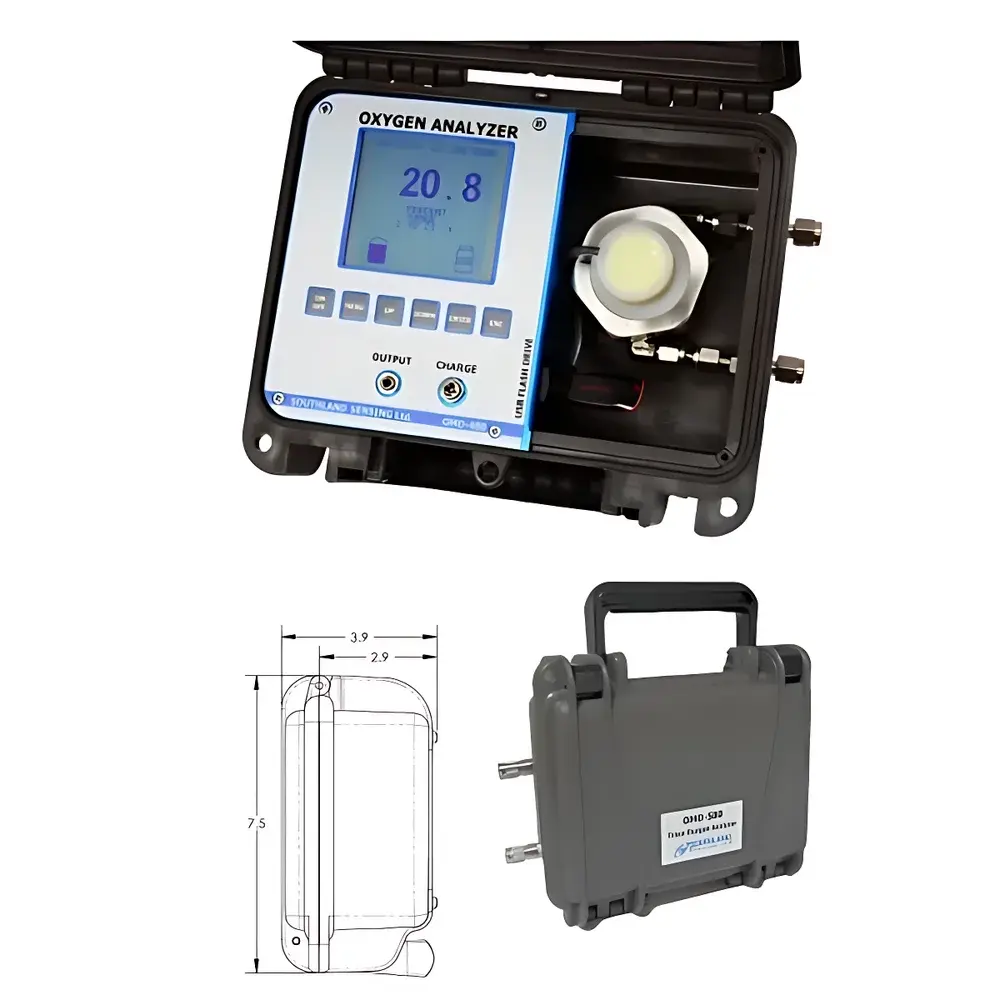
Southland Sensing OMD-480 Portable Percent Oxygen Analyzer
| Origin | USA |
|---|---|
| Manufacturer Type | Authorized Distributor |
| Origin Category | Imported |
| Model | OMD-480 |
| Price Range | USD 1,400 – 4,200 (FOB) |
| Measurement Principle | Electrochemical Fuel Cell (Micro-Fuel Cell) |
| Range Options | 0–1% / 0–5% / 0–10% / 0–25% / 0–100% O₂ (selectable) |
| Detection Limit | 0.01 ppm (in low-range configurations) |
| Accuracy | < ±1% FS |
| Temperature Compensation | Built-in, automatic |
| Operating Temp. | –10 to 50 °C |
| Enclosure Dimensions | 241 × 165 × 96 mm |
| Power Supply | 12–24 VDC, 25 mA |
| Output Signals | 4–20 mA, 0–10 VDC, MODBUS RTU over RS485 (ASCII bi-directional) |
| Sample Flow Rate | 230–2500 mL/min |
| Sensor Lifetime | Typically > 24 months (under recommended conditions) |
| Certifications | CE, RoHS |
| Compliance | Designed for use in non-hazardous areas per IEC 61000-6-2/6-4 |
| Sensor Compatibility | Standard fuel cell for N₂, Ar, He, H₂, hydrocarbon matrices |
| Warranty | 12 months from shipment |
Overview
The Southland Sensing OMD-480 is a portable, micro-fuel-cell-based oxygen analyzer engineered for high-stability, low-maintenance measurement of oxygen concentration across five factory-configurable ranges: 0–1%, 0–5%, 0–10%, 0–25%, and 0–100% O₂ by volume. Unlike paramagnetic or zirconia-based analyzers, the OMD-480 employs a galvanic electrochemical sensor that generates a current proportional to the partial pressure of O₂—enabling true zero-power operation (no external bias voltage required), intrinsic safety in non-explosive environments, and exceptional long-term baseline stability. Its design targets applications where trace-level sensitivity (down to 0.01 ppm in low-range modes), rapid response (< 15 s T₉₀), and immunity to background gas interference (e.g., CO₂, CH₄, H₂, N₂, Ar) are critical. The instrument operates without consumables beyond periodic sensor replacement (typically every 24–36 months depending on exposure profile), eliminating calibration gas dependency for routine operation—making it suitable for unattended monitoring in remote or embedded process control nodes.
Key Features
- Micro-fuel-cell oxygen sensor with built-in temperature compensation and auto-zero stabilization circuitry
- Large backlit LCD display with real-time O₂ reading, unit selection (% or ppm), range indication, and status icons
- Auto-ranging capability across five discrete full-scale spans—user-selectable via DIP switch or configuration software
- Dual programmable alarm relays (SPDT, 5 A @ 250 VAC) with configurable setpoints and hysteresis
- Triple-output interface: isolated 4–20 mA analog output, 0–10 VDC voltage output, and MODBUS RTU over RS485 (ASCII protocol support included)
- Robust aluminum enclosure rated IP65 for industrial environments; operating temperature range –10 to +50 °C
- Low power consumption (25 mA @ 24 VDC) enabling battery or PoE-powered deployment in field applications
- Optional acid-resistant sensor variant available for sampling streams containing CO₂, H₂S, or SO₂ at concentrations up to 5,000 ppm
Sample Compatibility & Compliance
The OMD-480 is validated for continuous analysis of oxygen in inert carrier gases (N₂, Ar, He), reducing atmospheres (H₂), and saturated hydrocarbon streams (e.g., natural gas, refinery off-gas). It is not intended for direct measurement in corrosive, oxidizing, or high-humidity (>90% RH) sample matrices without appropriate conditioning (e.g., particulate filtration, moisture removal, pressure regulation). For compliance-critical installations—including pharmaceutical inerting validation, semiconductor purge verification, or aerospace purge qualification—the device supports audit-ready data logging when integrated with MODBUS-compatible historians. While the analyzer itself carries CE and RoHS declarations, end-user responsibility includes verifying suitability per local electrical safety standards (e.g., UL 61010-1, EN 61000-6-2/6-4) and process safety requirements (e.g., SIL 2 compatibility assessment per IEC 61508 when used in safety instrumented functions).
Software & Data Management
Configuration and diagnostics are performed via MODBUS ASCII commands using standard terminal emulation software (e.g., PuTTY, ModScan) or custom SCADA/HMI drivers. No proprietary PC software is required. All operational parameters—including alarm thresholds, damping time constants, output scaling, and relay logic—are stored in non-volatile memory and survive power cycling. The 4–20 mA output is linearly proportional to O₂ concentration within the selected range and includes NIST-traceable calibration documentation upon request. When deployed in regulated environments (e.g., FDA-regulated pharmaceutical nitrogen blanketing), the OMD-480 may be incorporated into 21 CFR Part 11-compliant systems via third-party data acquisition platforms that provide electronic signatures, audit trails, and user access controls—though the analyzer itself does not implement cryptographic authentication or role-based access.
Applications
- Inert gas purity monitoring in nitrogen generators, hydrogen purifiers, and on-site gas supply systems
- Oxygen leak detection in gloveboxes, dry rooms, and vacuum chambers used in lithium-ion battery manufacturing and semiconductor fabrication
- Process gas verification in thermal processing (e.g., sintering, annealing, brazing) where furnace atmosphere O₂ must remain below 10 ppm
- Quality assurance testing of pipeline natural gas, LNG boil-off gas, and syngas streams for oxidation risk mitigation
- Research-grade oxygen profiling in catalytic reactor effluents, fuel cell test benches, and plasma chemistry setups
- Environmental monitoring of oxygen depletion in confined spaces during maintenance of chemical storage vessels or fermentation tanks
FAQ
What is the expected service life of the fuel cell sensor under typical operating conditions?
Under continuous operation at ambient temperature and with clean, dry sample gas, the standard sensor demonstrates stable performance for 24–36 months. Acid-resistant variants exhibit comparable longevity when exposed to CO₂ ≤ 5,000 ppm; H₂S or SO₂ exposure above 10 ppm accelerates degradation and requires more frequent replacement.
Can the OMD-480 measure oxygen in high-humidity or condensing gas streams?
No. Condensate or sustained relative humidity >90% RH will damage the fuel cell electrolyte. A dedicated sample conditioning system—including refrigerated dryer, coalescing filter, and pressure regulator—is mandatory for such applications.
Is field calibration possible without certified span gas?
Zero calibration can be performed using certified nitrogen (99.999% pure); span calibration requires certified O₂-in-N₂ standard gas matching the selected range. The instrument supports two-point calibration via MODBUS command or front-panel menu.
Does the OMD-480 meet explosion-proof certification requirements?
It is rated for use in non-hazardous (unclassified) locations only. For Class I Div 1/Zone 1 environments, an intrinsically safe barrier kit (e.g., Pepperl+Fuchs KFD2-STC4-Ex1) must be installed between the analyzer and control system.
How does temperature fluctuation affect measurement accuracy?
Internal temperature compensation corrects for thermal drift across the –10 to +50 °C operating range. For applications requiring sub-0.1% FS stability, mounting the analyzer in a temperature-controlled cabinet or using active sample line heating is recommended.