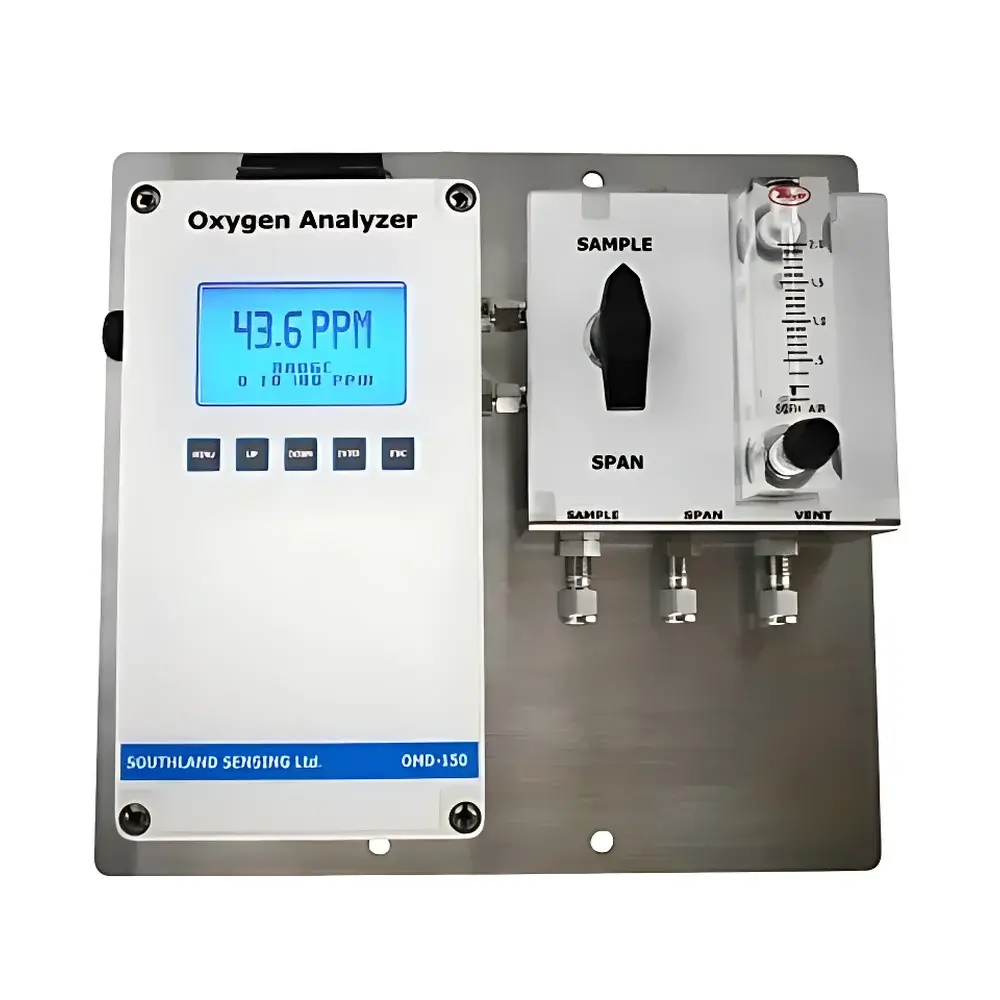
Southland Sensing OMD-150-NG Online Trace Oxygen Analyzer
| Origin | USA |
|---|---|
| Manufacturer Type | Authorized Distributor |
| Origin Category | Imported |
| Model | OMD-150-NG |
| Measurement Ranges | 0–10 ppm, 0–100 ppm, 0–1000 ppm, 0–1%, 0–5%, 0–10%, 0–25%, 0–100% O₂ |
| Accuracy | <1% FS |
| Certifications | CE, UL Class I, Div 2, Groups B, C, D |
| Dimensions | 241 × 165 × 96 mm |
| Operating Temperature | –10 to 50 °C |
| Temperature Compensation | Yes |
| Sensor Type | Miniaturized Electrochemical Fuel Cell |
| Warranty | 12 months |
| Power Supply | 12–24 VDC |
| Current Draw | 25 mA |
| Analog Outputs | 4–20 mA and 0–10 VDC |
| Sample Flow Rate | 230–2500 mL/min |
| Compatible Gases | N₂, Ar, He, H₂, hydrocarbon streams |
| Enclosure Rating | IP65-rated housing |
Overview
The Southland Sensing OMD-150-NG is a compact, field-deployable online trace oxygen analyzer engineered for continuous, real-time measurement of oxygen concentration in inert, reducing, or process gas streams. It employs a proprietary miniaturized electrochemical fuel cell sensor — a galvanic, self-powered transduction technology that delivers stable, drift-free output without external bias voltage or consumable electrolyte refills. Unlike paramagnetic or zirconia-based analyzers, the OMD-150-NG operates on stoichiometric oxygen reduction at the cathode, generating a current linearly proportional to partial pressure of O₂. This principle ensures high specificity for molecular oxygen, minimal cross-sensitivity to CO₂, H₂, CH₄, or N₂, and immunity to flow rate fluctuations within its specified sample flow window (230–2500 mL/min). Designed for integration into nitrogen generation skids, semiconductor purge loops, glovebox atmospheres, and natural gas transmission lines, the analyzer meets stringent requirements for low-power operation, intrinsic safety compliance, and long-term baseline stability in unattended industrial environments.
Key Features
- Electrochemical fuel cell sensor with >24-month typical service life under continuous operation and no routine calibration required
- Configurable measurement ranges spanning trace-level (0–10 ppm) to percent-level (0–100% O₂), selectable at time of order
- Intrinsically safe design certified to UL Class I, Division 2, Groups B, C, D — suitable for hazardous locations without explosion-proof enclosures
- Integrated temperature compensation circuitry ensuring <1% full-scale accuracy across –10 to 50 °C ambient operating range
- Dual analog outputs (4–20 mA and 0–10 VDC) with user-selectable scaling and fault signaling (e.g., sensor failure, low flow)
- IP65-rated aluminum enclosure with corrosion-resistant finish for harsh plant-floor deployment
- Low power consumption (25 mA @ 24 VDC) enabling compatibility with solar-powered or battery-backed remote monitoring systems
- Optional acid-resistant sensor variant for reliable operation in CO₂-, H₂S-, or SO₂-laden gas matrices, such as biogas upgrading or sour natural gas streams
Sample Compatibility & Compliance
The OMD-150-NG is validated for use with non-corrosive, non-condensing process gases including nitrogen, argon, helium, hydrogen, methane, ethane, and other saturated hydrocarbons. Its fuel cell architecture inherently rejects interference from common background gases — validation data per ISO 10728 confirms <0.5% O₂-equivalent response to 10% CO₂, 1000 ppm H₂S, or 5% H₂. For applications involving acidic contaminants, the optional acid-resistant sensor utilizes a modified membrane and electrolyte formulation compliant with ASTM D1946 for trace gas analysis in corrosive media. The analyzer bears CE marking and conforms to EN 61000-6-2 (immunity) and EN 61000-6-4 (emissions). Its Class I, Div 2 certification satisfies NEC Article 500 requirements for installation in potentially explosive atmospheres where flammable gases may be present under abnormal conditions.
Software & Data Management
While the OMD-150-NG operates as a standalone analog transmitter, it is fully compatible with industry-standard SCADA, DCS, and PLC systems via its isolated 4–20 mA output. Optional configuration software (Southland Sensing Configuration Utility v3.2, Windows-based) enables local setup of range selection, damping time (0.1–10 s), zero/span offset, and alarm thresholds using an RS-232 interface. All configuration changes are logged with timestamp and user ID, supporting audit trails required under FDA 21 CFR Part 11 for regulated pharmaceutical or food-grade nitrogen applications. No firmware updates require factory recalibration; sensor replacement is a field-serviceable module swap with automatic gain normalization.
Applications
- Continuous monitoring of residual O₂ in high-purity nitrogen used for semiconductor wafer annealing, photolithography tool purging, and thin-film deposition chambers
- Quality assurance in on-site nitrogen generators supplying blanketing gas for chemical reactors, distillation columns, and API synthesis vessels
- Leak detection and atmosphere integrity verification in argon-purged gloveboxes for lithium-ion battery electrode manufacturing
- Oxygen ingress monitoring in natural gas pipelines prior to custody transfer, per AGA Report No. 8 specifications
- Process control of catalytic deoxygenation units in hydrogen production plants and syngas conditioning systems
- Verification of inerting efficacy in coal pulverizer and biomass storage silos per NFPA 85 guidelines
FAQ
What is the recommended calibration frequency for the OMD-150-NG?
For trace-range configurations (0–10 ppm), annual zero calibration using certified <10 ppb O₂ zero gas is recommended. Percent-range models typically require calibration only after sensor replacement or exposure to over-range conditions.
Can the OMD-150-NG measure oxygen in wet gas streams?
No. Condensable moisture must be removed upstream using a Peltier cooler or permeation dryer; water vapor accelerates electrolyte depletion and causes temporary signal drift.
Is the sensor affected by pressure fluctuations?
Yes — the fuel cell responds to O₂ partial pressure. For applications with variable total system pressure, a pressure-compensated model (OMD-150-NG-P) or external pressure transmitter input is required for accurate concentration reporting.
Does the analyzer support digital communication protocols like Modbus?
Not natively; however, third-party 4–20 mA to Modbus RTU converters (e.g., Moore Industries TCM series) are widely deployed in conjunction with the OMD-150-NG in legacy DCS integrations.
What maintenance is required beyond sensor replacement?
None. The unit contains no moving parts, optical components, or consumables other than the field-replaceable sensor cartridge. Routine inspection of sample inlet filter and flowmeter calibration every 12 months is advised.
Related Products