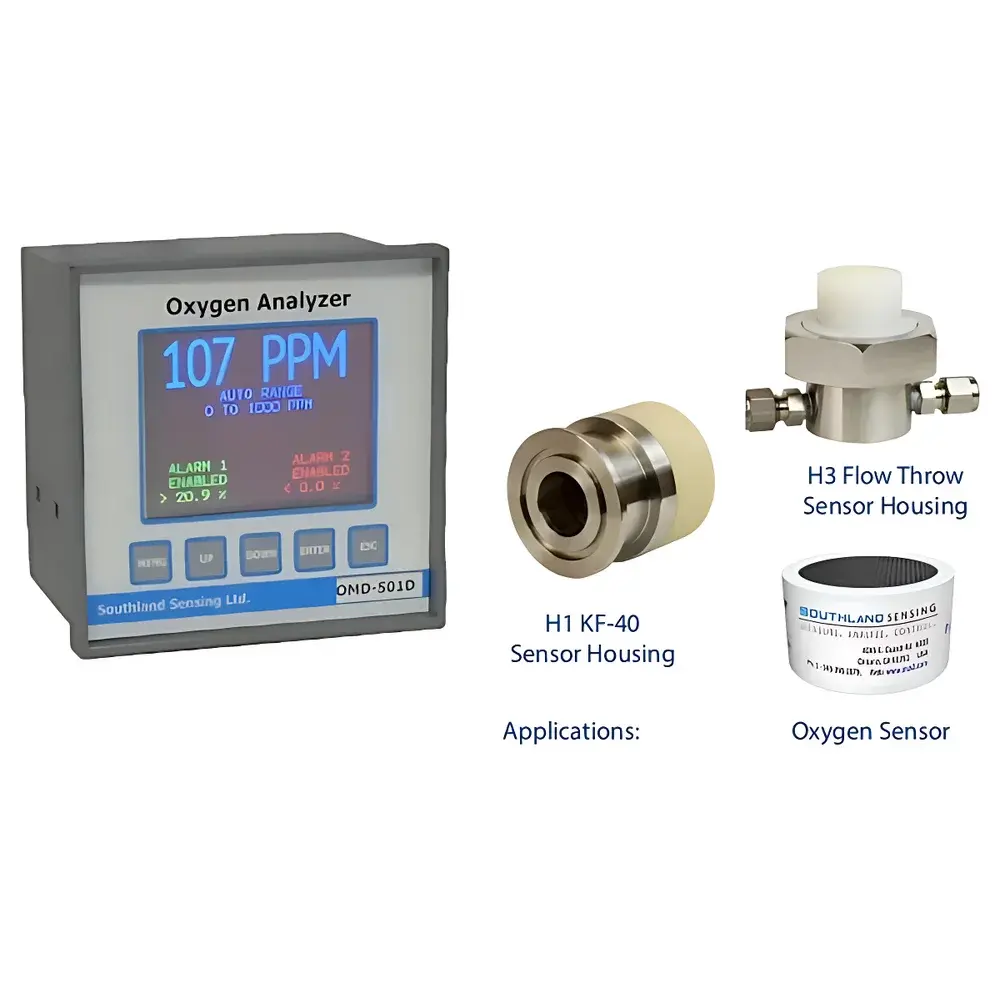
Southland Sensing OMD-501D Online PPM Oxygen Analyzer
| Origin | USA |
|---|---|
| Manufacturer Type | Authorized Distributor |
| Origin Category | Imported |
| Model | OMD-501D |
| Price Range | USD 1,400 – 4,200 (FOB) |
| Measurement Ranges | 0–10 ppm / 0–100 ppm / 0–1,000 ppm / 0–1% / 0–25% O₂ |
| Sensor Type | Miniaturized Electrochemical Fuel Cell |
| Accuracy | < ±1% FS |
| Certifications | CE Marked |
| Dimensions | 241 × 165 × 96 mm |
| Operating Temperature | −10 to +50 °C |
| Temperature Compensation | Built-in |
| Power Supply | 12–24 VDC |
| Current Consumption | 25 mA |
| Analog Outputs | 4–20 mA and 0–10 VDC (isolated) |
| Sample Flow Rate | 230–2,500 mL/min |
| Compatible Gases | N₂, Ar, He, H₂, hydrocarbon streams, and other inert or reducing matrices |
| Acid-Gas Option | Available with H₂S/CO₂/SO₂-resistant sensor |
| Warranty | 12 months |
Overview
The Southland Sensing OMD-501D Online PPM Oxygen Analyzer is an industrial-grade electrochemical analyzer engineered for continuous, real-time measurement of trace to percent-level oxygen concentrations in process gas streams. It employs a miniaturized, temperature-compensated fuel cell sensor — a galvanic electrochemical transducer that generates a current proportional to the partial pressure of O₂ diffusing across a selective membrane. Unlike paramagnetic or zirconia-based analyzers, the fuel cell design offers inherent linearity, zero power requirement at the sensor element, and immunity to background gas interference from non-acidic inert or reducing atmospheres (e.g., N₂, Ar, H₂, CH₄). Its robust architecture supports deployment in demanding environments including nitrogen generation skids, hydrogen purification loops, semiconductor purge lines, and high-purity gas distribution systems. The OMD-501D is not intended for ambient air monitoring or combustion exhaust applications; rather, it is calibrated and validated for use in controlled, low-particulate, dry gas matrices where long-term baseline stability and repeatability are critical to process integrity.
Key Features
- Multi-range capability: Configurable for five standard measurement spans — 0–10 ppm, 0–100 ppm, 0–1,000 ppm, 0–1% (10,000 ppm), and 0–25% O₂ — selectable at time of order or via field calibration protocol.
- Integrated microcontroller-based signal conditioning with auto-zero stabilization and digital filtering to suppress transient noise from flow fluctuations or thermal drift.
- True temperature compensation circuitry ensures measurement fidelity across the full operating range (−10 to +50 °C), eliminating need for external thermostatic enclosures in most indoor installations.
- Low-power design (25 mA @ 24 VDC) enables integration into distributed control systems (DCS) or PLC networks without auxiliary power regulation.
- Compact form factor (241 × 165 × 96 mm) facilitates panel-mount or pipe-rack installation with minimal footprint; front-access terminal block simplifies wiring and maintenance.
- Dual analog outputs (4–20 mA and 0–10 VDC, both isolated) support redundant data logging, alarm triggering, and cascade control loop integration.
- Optional acid-gas-resistant sensor variant available for applications involving CO₂, H₂S, or SO₂ — utilizing proprietary electrolyte formulation and corrosion-inhibiting electrode metallurgy.
Sample Compatibility & Compliance
The OMD-501D is validated for use with dry, particle-free gas streams containing nitrogen, argon, helium, hydrogen, methane, ethane, and other saturated hydrocarbons. It is incompatible with halogenated gases, chlorine, ozone, or high-humidity samples (>90% RH) unless paired with an integrated sample conditioning system (e.g., refrigerated dryer, coalescing filter). For compliance-critical installations — such as pharmaceutical inerting, food packaging blanketing, or semiconductor fab tool purging — the analyzer meets CE marking requirements per Directive 2014/30/EU (EMC) and 2014/35/EU (LVD). While not intrinsically safe certified, it may be deployed in Zone 2/Class I, Division 2 areas when installed per IEC 60079-14 guidelines. Data integrity aligns with GLP and GMP principles through stable analog output traceability; optional audit trail logging requires external SCADA or historian integration.
Software & Data Management
The OMD-501D operates as a standalone analog transmitter and does not include embedded firmware-upgradable software or local display. Configuration and diagnostics are performed via external multimeter or loop calibrator verifying mA/V output against known span gases (e.g., NIST-traceable 10 ppm O₂ in N₂). Calibration intervals are typically 3–6 months depending on exposure history and process cleanliness; factory calibration certificates (ISO/IEC 17025-accredited) are provided with each unit. For digital integration, the 4–20 mA signal is compatible with Modbus RTU via optional analog-to-Modbus converter modules (sold separately). No FDA 21 CFR Part 11 functionality is embedded; electronic record retention must be managed externally via compliant DCS or MES platforms.
Applications
- Continuous monitoring of residual O₂ in nitrogen generator outlet streams (target ≤10 ppm for electronics manufacturing).
- In-line verification of oxygen scavenging efficiency in modified atmosphere packaging (MAP) gas mixtures.
- Leak detection and integrity validation in glovebox and inert-atmosphere furnaces used for battery material synthesis.
- Process control of catalytic deoxygenation units in hydrogen refining, where sub-100 ppm O₂ thresholds prevent catalyst poisoning.
- Quality assurance testing of high-purity argon supplied to semiconductor CVD/PVD tools.
- Monitoring of protective purge gas purity in LNG vaporization and cryogenic storage facilities.
FAQ
What is the expected service life of the fuel cell sensor under normal operating conditions?
Typical functional lifespan is 24–36 months when exposed to clean, dry gas streams within specified range limits. Exposure to condensate, particulates, or acidic contaminants reduces longevity; use of the acid-resistant sensor variant extends life in CO₂-rich natural gas or biogas applications.
Can the OMD-501D measure oxygen in humid or wet gas streams?
No — water vapor condensation will permanently damage the fuel cell electrolyte. A dedicated sample conditioning system (e.g., permeation dryer or chilled mirror dew point controller) is mandatory for applications exceeding 70% RH.
Is field recalibration possible without sending the unit to a service center?
Yes — zero and span adjustments can be performed using two certified calibration gases and a handheld mA meter, following the procedure outlined in the OEM Technical Manual Rev. 4.2.
Does the analyzer support HART communication protocol?
No — the OMD-501D provides only analog outputs. HART-enabled variants (e.g., OMD-501H) are available upon request but require separate configuration and pricing.
What documentation is included with shipment?
Each unit ships with CE Declaration of Conformity, Factory Calibration Report (including as-found/as-left data), Installation & Operation Manual (English), and ISO 17025-accredited calibration certificate traceable to NIST standards.
Related Products