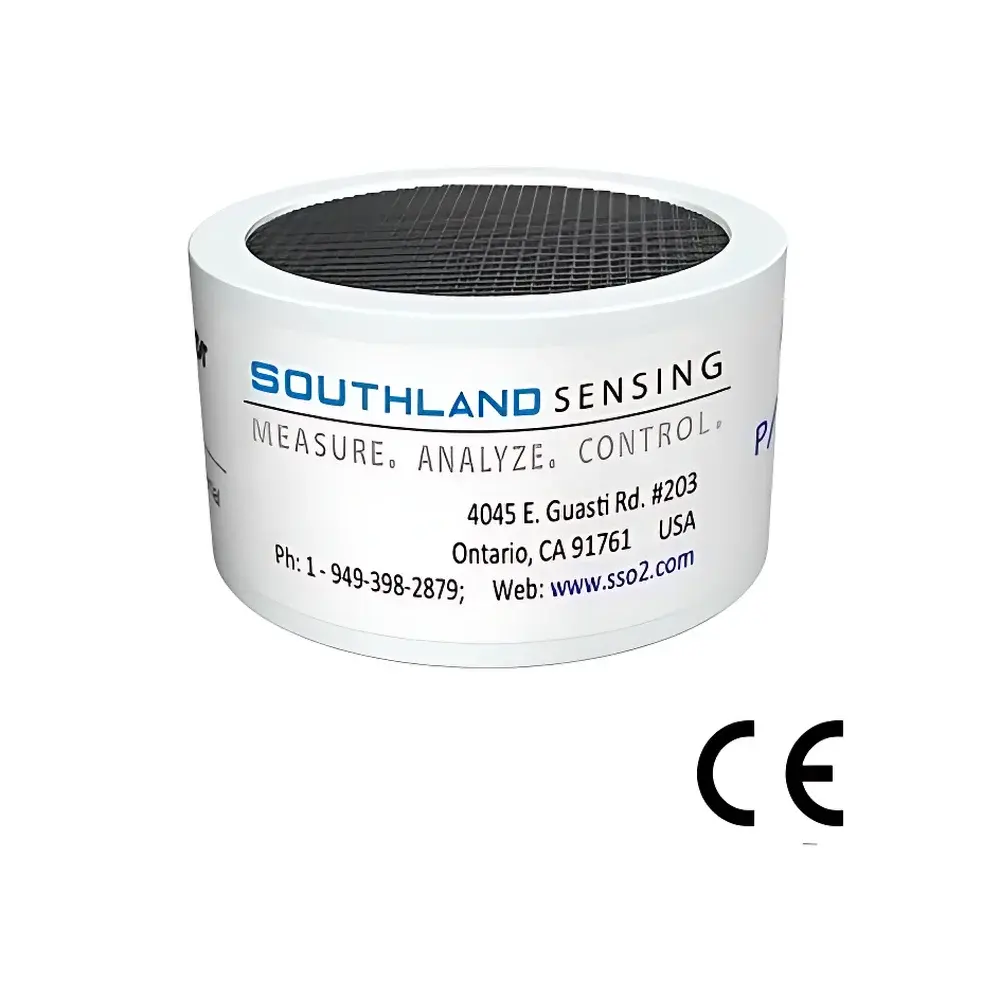
Southland Sensing TO2-1X Micro-Fuel-Cell Oxygen Sensor
| Origin | USA |
|---|---|
| Manufacturer Type | Authorized Distributor |
| Origin Category | Imported |
| Model | TO2-1X |
| Price Range | USD 1–9,999 |
Overview
The Southland Sensing TO2-1X is a high-stability, electrochemical micro-fuel-cell oxygen sensor engineered for continuous, low-concentration oxygen monitoring in inert and reactive process gas streams. Unlike paramagnetic or zirconia-based analyzers, the TO2-1X employs a solid-state, ambient-temperature fuel cell principle—where oxygen diffuses through a selective membrane and undergoes reduction at the cathode, generating a linear current proportional to partial pressure (ppm to % O₂). This architecture eliminates the need for external heating, calibration gases, or frequent zero/span adjustments, making it ideal for unattended operation in nitrogen generation systems, hydrogen purification loops, semiconductor purge lines, and high-purity gas distribution networks. Designed for integration into OEM analyzers and standalone process controllers, the TO2-1X delivers trace-level resolution with inherent immunity to CO₂, hydrocarbons, and most non-oxidizing background gases—critical for applications where cross-sensitivity compromises measurement integrity.
Key Features
- Micro-fuel-cell sensing element with 0.01 ppm lower detection limit and full-scale range from 0–10 ppm up to 0–10,000 ppm (1%) O₂
- Linear analog current output (285–590 µA) directly proportional to O₂ partial pressure—compatible with standard 4–20 mA transmitters via external shunt resistor
- T₉₀ response time ≤13 seconds across full scale, enabling real-time feedback for closed-loop inerting control
- High repeatability (±0.5% FS) and accuracy (±1% FS) validated per ISO 17025-accredited test protocols
- Operating temperature range: 0–50 °C; storage: 0–45 °C; humidity tolerance: 0–100% RH (non-condensing)
- Two programmable SPDT alarm relays for high/low O₂ threshold notification and system interlock
- Integrated PCB footprint with center-foil cathode (negative) and outer-foil anode (positive)—designed for automated SMT assembly and hermetic module encapsulation
- Expected operational lifetime of 20–25 months under continuous flow conditions (0.5–5 SCFH recommended); 12-month limited warranty
Sample Compatibility & Compliance
The TO2-1X is chemically compatible with N₂, Ar, He, H₂, CO₂, CH₄, and other non-corrosive industrial gases. It is not suitable for use in strongly oxidizing environments (e.g., >25% O₂), halogenated compounds, or vapors containing sulfur oxides or heavy metals, which may poison the catalytic electrode surface. The sensor meets CE marking requirements for electromagnetic compatibility (EMC Directive 2014/30/EU) and conforms to RoHS 2011/65/EU material restrictions. While not certified to ATEX or IECEx, its low-power, intrinsically safe signal output (≤1 mW) allows deployment in Zone 2 classified areas when installed per IEC 60079-14 guidelines. For regulated industries—including pharmaceutical nitrogen validation (USP ), semiconductor fab gas purity audits (SEMI F21), and pipeline quality assurance (ASTM D1946)—the TO2-1X supports GLP-compliant data logging when paired with compliant host instrumentation.
Software & Data Management
As a hardware-level sensing element, the TO2-1X does not include embedded firmware or onboard memory. Its analog output is intended for integration into third-party analyzer platforms supporting 4–20 mA or 0–5 VDC input modules. When deployed with analyzers compliant with FDA 21 CFR Part 11, the sensor’s stable baseline and minimal drift ( 0.9999 over 0–1000 ppm) and thermal compensation circuitry that corrects for temperature-induced sensitivity shifts (2.54%/°C coefficient applied externally or within host controller logic).
Applications
- Nitrogen generator outlet monitoring for food packaging, laser cutting, and electronics manufacturing
- H₂ purity verification downstream of PEM electrolyzers and PSA units
- Blanketing gas analysis in chemical reactors and API synthesis suites
- O₂ ingress detection in vacuum furnace purge cycles and aerospace composite curing chambers
- Leak testing of sealed enclosures using inert gas decay methods
- Quality control of ultra-high-purity (UHP) gases supplied to semiconductor photolithography tools
FAQ
What is the recommended sample flow rate for optimal performance?
0.5–5 SCFH (standard cubic feet per hour) ensures laminar diffusion control without membrane over-pressurization or drying.
Can the TO2-1X be used in hydrogen-rich environments?
Yes—its fuel cell design operates reliably in H₂ matrices; however, exposure to >5% H₂ without adequate O₂ partial pressure may cause temporary output suppression until equilibrium reestablishes.
Is periodic calibration required?
Zero calibration is optional and only necessary if long-term baseline drift exceeds specification; span calibration is recommended annually or after sensor replacement, using certified NIST-traceable O₂ standards.
How does temperature affect measurement accuracy?
The sensor exhibits a defined 2.54%/°C sensitivity coefficient; accurate compensation requires either host-system temperature feedback or placement in a thermostatically stabilized sample stream.
What defines the end-of-life for this sensor?
End-of-life is indicated by irreversible loss of linearity (>2% FS deviation), increased T₉₀ (>25 s), or inability to achieve full-scale output after span adjustment—typically occurring after 20–25 months of continuous operation.