
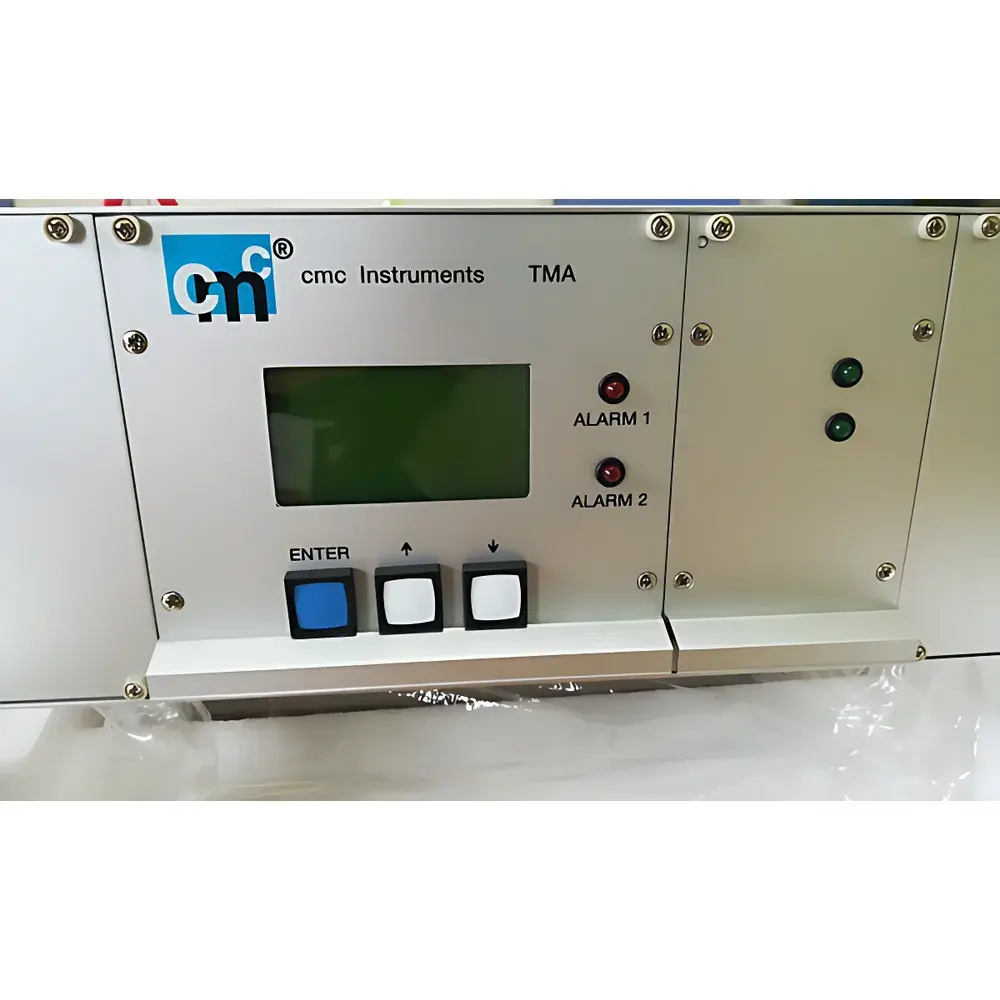
CMC TMA-204-P P₂O₅ Electrolytic Trace Moisture Analyzer
| Origin | Germany |
|---|---|
| Manufacturer Type | Authorized Distributor |
| Origin Category | Imported |
| Model | TMA-204-P |
| Product Type | Online Dew Point Analyzer |
| Operating Principle | Phosphorus Pentoxide (P₂O₅) Electrolytic Method |
| Operating Temperature Range | −5 to 50 °C |
| Accuracy | ±0.1 ppm (v/v) |
| Repeatability | ±0.5% of reading |
| Measurement Range | 0–10 / 0–100 / 0–1000 / 0–2500 ppm (v/v), auto-ranging |
| Full-Scale Accuracy | ±1% FS |
| Sensitivity | 0.1% FS |
| Analog Output | 4–20 mA or 0–10 V DC |
| Alarm Outputs | 2 SPDT relays |
| Display | Backlit LCD |
| Sample Flow Rate | 20 NL/h |
| Recommended Sample Pressure | 0.1–0.5 barg |
| Sample Temperature Range | 5–150 °C |
| T₅₀ Response Time | <8 s |
| Ambient Temperature Range | 5–65 °C |
| Cable Length | Standard 3 m, up to 300 m optional |
| Enclosure Options | 19″ rack-mount (482 × 133 × 350 mm), wall-mount (300 × 260 × 280 mm), benchtop (257 × 160 × 316 mm) |
Overview
The CMC TMA-204-P is a high-precision, online trace moisture analyzer engineered for continuous, real-time quantification of water vapor in industrial process gases at sub-part-per-million (ppmv) levels. It employs the well-established phosphorus pentoxide (P₂O₅) electrolytic measurement principle: water molecules in the sample gas are selectively and irreversibly electrolyzed on a hygroscopic P₂O₅-coated sensor element into hydrogen and oxygen. The resulting electrolysis current is stoichiometrically proportional to the water concentration—enabling direct, linear, and drift-free measurement without chemical interference from most carrier gases. Unlike optical or capacitive methods, this technique delivers intrinsic zero stability and eliminates the need for frequent recalibration—even under dynamic process conditions. The instrument is specifically designed for demanding applications involving corrosive, reactive, or flammable gases where conventional sensors degrade rapidly or yield unreliable data.
Key Features
- True electrolytic P₂O₅ sensor with platinum or rhodium electrode configuration—optimized for long-term stability in aggressive gas matrices including Cl₂, HCl, SO₂, H₂S, and high-purity noble gases (He, Ar, Kr, Xe)
- Auto-ranging capability across four user-selectable spans: 0–10, 0–100, 0–1000, and 0–2500 ppmv, ensuring optimal signal-to-noise ratio across wide concentration gradients
- Sub-second T₅₀ response (<8 s) enabled by optimized gas path geometry and low thermal mass sensor design—critical for closed-loop process control
- Full microprocessor-based architecture with built-in self-diagnostic routines at power-up and continuous sensor health monitoring
- NAMUR-compliant electrical interface (NE 43) for seamless integration into distributed control systems (DCS) and safety instrumented systems (SIS)
- Three mechanical configurations: 19″ rack-mount, wall-mount, and benchtop—each certified to IP65 ingress protection when installed per specification
Sample Compatibility & Compliance
The TMA-204-P demonstrates broad compatibility with over 25 industrial and specialty gases—including but not limited to N₂, O₂, H₂, CO₂, CH₄, SF₆, Freons, acetylene, ozone, deuterium, and fluorine. Its P₂O₅ sensor remains inert toward non-reactive gases and exhibits minimal cross-sensitivity to common contaminants such as hydrocarbons or CO. For highly acidic or oxidizing streams (e.g., Cl₂, F₂), sensor lifetime is extended via optional electrode regeneration protocols executed in situ—requiring no disassembly or offline servicing. The analyzer complies with IEC 61000-6-2 (EMC immunity) and IEC 61000-6-4 (EMC emissions), and its analog outputs meet SIL 2 requirements per IEC 61508 when integrated with certified safety logic solvers. While not intrinsically safe by default, explosion-proof enclosures (ATEX II 2G Ex d IIB T4) are available as factory-installed options.
Software & Data Management
The embedded firmware supports Modbus RTU (RS-485) and optional HART 7 communication protocols, enabling bidirectional parameter configuration, real-time diagnostics, and event logging. All measurement data—including raw current values, temperature-compensated ppm readings, relay status, and sensor voltage—are timestamped and stored in non-volatile memory with configurable retention (up to 30 days at 1-minute intervals). Audit trails comply with GLP/GMP documentation requirements: changes to calibration constants, range selection, or alarm thresholds are logged with user ID, timestamp, and pre-/post-values. Optional PC software provides trend visualization, report generation (PDF/CSV), and export-compatible data structures aligned with ASTM E2500-22 for analytical instrument qualification.
Applications
- High-purity electronics-grade gas monitoring in semiconductor fab bulk gas delivery systems (e.g., ultra-dry N₂ purge lines, Ar sputtering gas)
- Moisture control in cryogenic air separation units (ASUs) for liquid oxygen and nitrogen production
- In-line verification of dryness specifications for SF₆ insulation gas in high-voltage switchgear per IEC 60480
- Process validation of chlorine drying towers in chlor-alkali plants per ISO 8573-8 Class 1 (≤0.1 ppmv)
- Quality assurance during synthesis and filling of pharmaceutical propellants (e.g., HFA-134a, HFA-227ea)
- Hydrogen fuel cell feed gas certification per SAE J2719 and ISO 14687-2:2019 (≤0.1 ppmv H₂O)
FAQ
Does the P₂O₅ sensor require periodic recalibration?
No—this analyzer operates on a fundamental electrochemical principle where the sensor output is inherently tied to Faraday’s law. Calibration is performed only once during commissioning; subsequent verification is conducted via traceable NIST-traceable moisture standards at user-defined intervals.
Can the TMA-204-P measure moisture in hot, high-pressure gas streams?
Yes—the sample conditioning system supports inlet temperatures up to 150 °C and pressures up to 0.5 barg. External cooling or pressure reduction is required only if the process exceeds these limits.
What maintenance is required for long-term operation?
Routine maintenance consists of quarterly visual inspection of the sensor window and annual replacement of the desiccant in the internal sample dryer cartridge. Electrode regeneration is performed automatically when sensor voltage drift exceeds defined thresholds.
Is the instrument compliant with FDA 21 CFR Part 11 for electronic records?
When operated with the optional audit trail module and configured with user authentication, electronic signatures, and secure data export, the system meets predicate rule requirements for Part 11 compliance in regulated pharmaceutical and biotech environments.
Related Products






