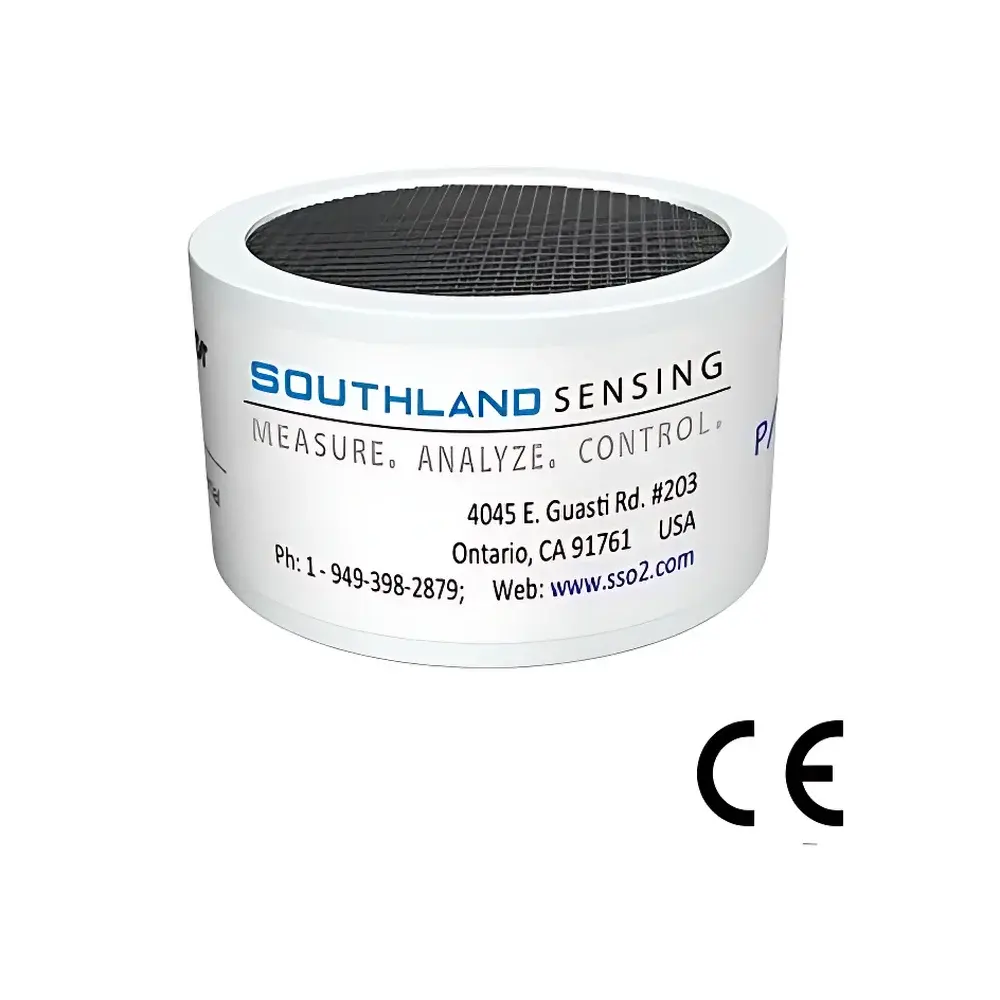
Southland Sensing PO2-160 Percent Oxygen Sensor
| Origin | USA |
|---|---|
| Manufacturer Type | Authorized Distributor |
| Origin Category | Imported |
| Model | PO2-160 |
| Price Range | USD 1–9,999 |
Overview
The Southland Sensing PO2-160 is a high-reliability, electrochemical fuel-cell-based percent oxygen sensor engineered for continuous, real-time measurement of oxygen concentration across a wide dynamic range—from trace-level (0.01 ppm) up to 100% O₂ in inert, reducing, or hydrocarbon-rich process streams. Unlike paramagnetic or zirconia-based analyzers, the PO2-160 employs a proprietary miniature galvanic fuel cell that generates a linear, temperature-compensated current output (285–590 µA) proportional to ambient O₂ partial pressure. This principle ensures intrinsic safety, zero power consumption at the sensing element, and immunity to background gas interference from N₂, H₂, Ar, He, CO₂, CH₄, and other non-reactive or mildly reducing matrices—making it especially suitable for nitrogen blanketing, hydrogen purification, semiconductor purge monitoring, and aerospace inerting systems where catalytic poisons or thermal instability rule out alternative technologies.
Key Features
- Fuel-cell sensing architecture with no internal heating, consumable electrodes, or external bias voltage—enabling true maintenance-free operation over extended service intervals.
- Auto-ranging analog output supporting five standard full-scale configurations: 0–1%, 0–5%, 0–10%, 0–25%, and 0–100% O₂, selected via DIP switch or firmware configuration.
- High-stability microcontroller-based signal conditioning with built-in temperature compensation (2.54%/°C), T₉₀ response time ≤13 seconds, and full-scale accuracy of ±1% FS with repeatability better than ±0.5% FS.
- Robust industrial enclosure rated IP65; operating temperature range 0–50°C, storage range 0–45°C, and humidity tolerance 0–100% RH (non-condensing).
- Two configurable SPDT alarm relays (dry contact, 5 A @ 250 VAC) programmable for high/low O₂ thresholds or fault conditions including sensor timeout and signal loss.
- Standard PCB-mount design with center-foil cathode (negative) and outer-foil anode (positive); compatible with OEM integration into gas analyzers, panel-mounted transmitters, and custom process skids.
Sample Compatibility & Compliance
The PO2-160 demonstrates exceptional compatibility with non-corrosive, low-particulate gas streams—including N₂, Ar, He, H₂, CO₂, natural gas, and refinery off-gases—provided moisture remains below dew point and condensation is avoided. It is not recommended for use in strongly oxidizing environments (>100% O₂ partial pressure), halogenated gases, sulfur compounds (e.g., H₂S, SO₂), or vapors containing silicone oils or heavy hydrocarbons that may coat the membrane. The sensor complies with IEC 61000-6-2 (EMC immunity) and IEC 61000-6-4 (EMC emission) standards. Its design supports integration into systems meeting FDA 21 CFR Part 11 requirements when paired with compliant data acquisition hardware and audit-trail-enabled software—commonly deployed in GMP-compliant semiconductor fab tool purging, pharmaceutical inerting, and aerospace ground support equipment.
Software & Data Management
While the PO2-160 operates as a standalone analog sensor, its output is fully compatible with industry-standard 4–20 mA or 0–10 V signal conditioning modules, PLC analog inputs (e.g., Allen-Bradley 1769-IF4, Siemens SM 331), and SCADA/HMI platforms (Ignition, WinCC, FactoryTalk). When integrated into Southland Sensing’s optional transmitter modules (e.g., TX-160 series), it supports Modbus RTU/ASCII over RS-485, USB-CDC virtual COM port configuration, and real-time diagnostics including sensor health status, calibration timestamp, and temperature-corrected output logging. All firmware updates and configuration changes are traceable and support GLP/GMP audit requirements through timestamped event logs and user-access control levels.
Applications
- On-line monitoring of residual O₂ in nitrogen generators (PSA & membrane), hydrogen purifiers, and argon recovery loops.
- Process gas quality assurance in semiconductor CVD/PVD tool chambers, wafer annealing furnaces, and photolithography nitrogen blankets.
- Safety interlock verification in inerted storage tanks, LNG vaporizers, and aviation fuel systems per ASTM D6643 and MIL-STD-1330D.
- Combustion air optimization and flue gas deoxygenation control in thermal processing furnaces and heat-treating lines.
- Research-grade O₂ profiling in catalytic reaction studies, battery electrolyte decomposition analysis, and high-temperature metallurgical atmosphere characterization.
FAQ
What is the expected operational lifetime under continuous use?
Typical field life is 20–25 months when operated within specified temperature, flow (0.5–5 SCFH), and humidity limits. Shelf life prior to installation is six months from date of manufacture.
Can the PO2-160 be calibrated in-situ without removing it from the process line?
Yes—zero calibration is achievable using certified nitrogen (≤0.1 ppm O₂); span calibration requires a certified span gas matching the configured range (e.g., 5.00% O₂ in N₂). No physical disassembly is required.
Is the sensor compatible with hydrogen-rich atmospheres?
Yes—unlike zirconia sensors, the fuel-cell chemistry is inherently stable in H₂ environments up to 100% concentration, provided no catalyst poisons (e.g., CO, NH₃, Cl₂) are present.
Does the PO2-160 require periodic electrolyte replenishment?
No—the sealed, self-contained fuel cell uses a solid polymer electrolyte; no liquid refills, membrane replacements, or scheduled maintenance are needed during its service life.
How does temperature variation affect measurement stability?
Internal compensation corrects for thermal drift at 2.54%/°C; for applications requiring <±0.1% FS thermal error, optional external temperature feedback or PID-controlled sample conditioning is recommended.