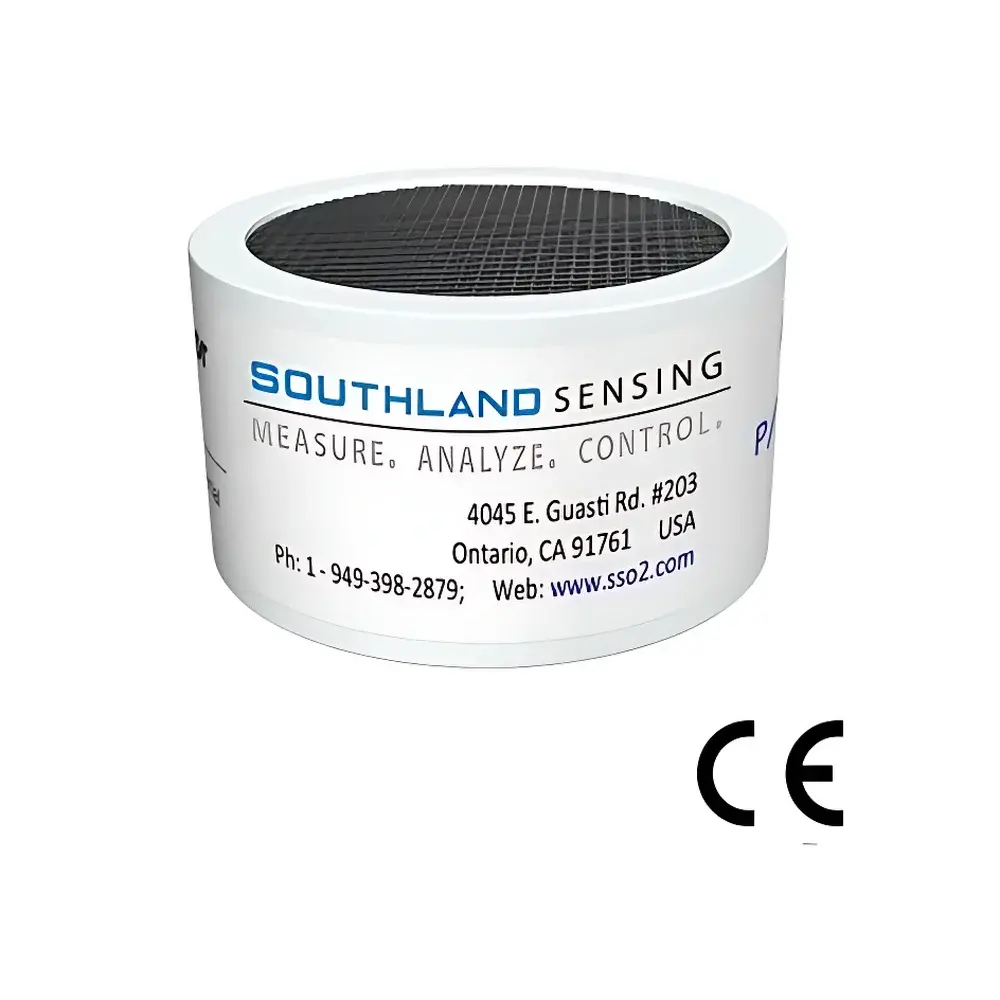
Southland Sensing TO2-1T-A PPM-Level Electrochemical Oxygen Sensor
| Origin | USA |
|---|---|
| Manufacturer Type | Authorized Distributor |
| Origin Category | Imported |
| Model | TO2-1T-A |
| Price Range | USD 1–9,999 |
Overview
The Southland Sensing TO2-1T-A is a high-stability, electrochemical fuel-cell-based oxygen sensor engineered for trace-level (ppm) and percent-range oxygen measurement in demanding industrial process gas streams. Unlike optical or zirconia-based analyzers, the TO2-1T-A employs a proprietary miniature galvanic fuel cell that generates a current proportional to O₂ partial pressure—eliminating the need for external power supply while delivering inherently linear, temperature-compensated output. Its core design targets applications requiring continuous, maintenance-free monitoring of oxygen contamination in inert or reactive atmospheres, including nitrogen blanketing, hydrogen purification, semiconductor purge gas validation, and high-purity gas production. The sensor operates on the principle of electrochemical reduction of molecular oxygen at a catalyzed cathode, producing a stable microampere-level current (285–590 µA full scale) directly correlatable to O₂ concentration across five selectable ranges: 0–1 ppm, 0–10 ppm, 0–100 ppm, 0–1,000 ppm, 0–1% vol, and 0–25% vol.
Key Features
- Fuel-cell architecture with zero-power operation—no internal battery or external excitation required
- Five factory-configurable measurement ranges supporting both ultra-trace (0.01 ppm detection limit) and high-concentration (up to 25% O₂) applications
- Fast T90 response time of ≤13 seconds across all ranges, validated per ASTM D6245 for ambient gas analysis
- High metrological stability: ±1% full-scale accuracy and ±0.5% full-scale repeatability under controlled flow and temperature conditions
- Integrated temperature compensation with coefficient of 2.54%/°C—enabling reliable operation across 0–50°C ambient range
- Dual programmable relay outputs for high/low alarm thresholds, configurable via external logic interface
- Robust PCB-mount design with center-foil cathode (negative) and outer-foil anode (positive), optimized for OEM integration into analyzer housings and gas sampling modules
- Extended service life: 20–25 months typical operational lifetime when used within specified humidity (0–100% RH, non-condensing) and flow (0.5–5 SCFH) envelopes
Sample Compatibility & Compliance
The TO2-1T-A is chemically compatible with N₂, H₂, Ar, He, CO₂, CH₄, and other non-corrosive, non-acidic process gases. It is not recommended for use in chlorine-, sulfur-, or halogen-containing streams, nor in environments with >10 ppm SO₂, NOₓ, or H₂S without upstream scrubbing. The sensor meets ISO 9001-certified manufacturing protocols and is routinely deployed in facilities compliant with FDA 21 CFR Part 11 (when integrated into validated analyzer systems), USP for inert gas qualification, and SEMI F57-0304 for semiconductor-grade nitrogen purity verification. Its performance characteristics align with ASTM D6245 (Standard Test Method for Determination of Oxygen in Gaseous Hydrogen) and IEC 61000-6-2/6-3 for electromagnetic compatibility in industrial settings.
Software & Data Management
As a transducer-level device, the TO2-1T-A delivers analog current output (4–20 mA or 0–1 V optional via external signal conditioner) and requires integration into a host analyzer or PLC system for digitization, scaling, and data logging. When paired with Southland-compatible readout electronics (e.g., TOX-200 series transmitters), it supports Modbus RTU over RS-485, enabling seamless integration into SCADA and DCS platforms. Audit-trail-capable firmware versions support GLP/GMP-compliant calibration logging—including date/time stamp, operator ID, span gas lot number, and pre/post-calibration deviation records—meeting requirements for regulated pharmaceutical and microelectronics manufacturing environments.
Applications
- On-line monitoring of O₂ impurity in nitrogen generators (PSA/VSA), hydrogen purifiers, and argon recovery loops
- Real-time verification of inert gas blanket integrity during welding, heat treatment, and vacuum furnace operations
- Process gas quality assurance in semiconductor fabrication—monitoring purge lines, chamber backfill, and wafer handling environments
- Oxygen leak detection in cryogenic LNG transfer systems and high-pressure natural gas transmission pipelines
- Research-grade oxygen profiling in controlled-atmosphere furnaces, catalyst testing rigs, and fuel cell test benches
- Environmental safety interlocks for hydrogen storage and distribution infrastructure per NFPA 2 and CGA G-5.5 standards
FAQ
What is the recommended sample gas flow rate for optimal accuracy and longevity?
0.5–5 standard cubic feet per hour (SCFH) is specified; sustained flow outside this range may accelerate electrolyte depletion or induce mechanical stress.
Can the TO2-1T-A be calibrated in-situ without removing it from the process line?
Yes—zero and span calibration can be performed using certified N₂ (zero gas) and trace O₂-in-N₂ standards (e.g., 10 ppm, 100 ppm) while installed, provided flow and pressure conditions remain stable.
Is temperature compensation automatic or user-adjustable?
Compensation is fully embedded in the sensor’s analog circuitry; no external configuration is required—the output inherently corrects for ambient drift within 0–50°C.
What does the 12-month warranty cover?
The warranty covers material and workmanship defects under normal use; it excludes damage from improper installation, exposure to incompatible gases, condensation, or mechanical shock.
How is sensor end-of-life determined in practice?
End-of-life is indicated by ≥20% reduction in span output relative to initial calibration, persistent zero drift exceeding ±2 ppm, or failure to meet T90 specification after cleaning and recalibration.