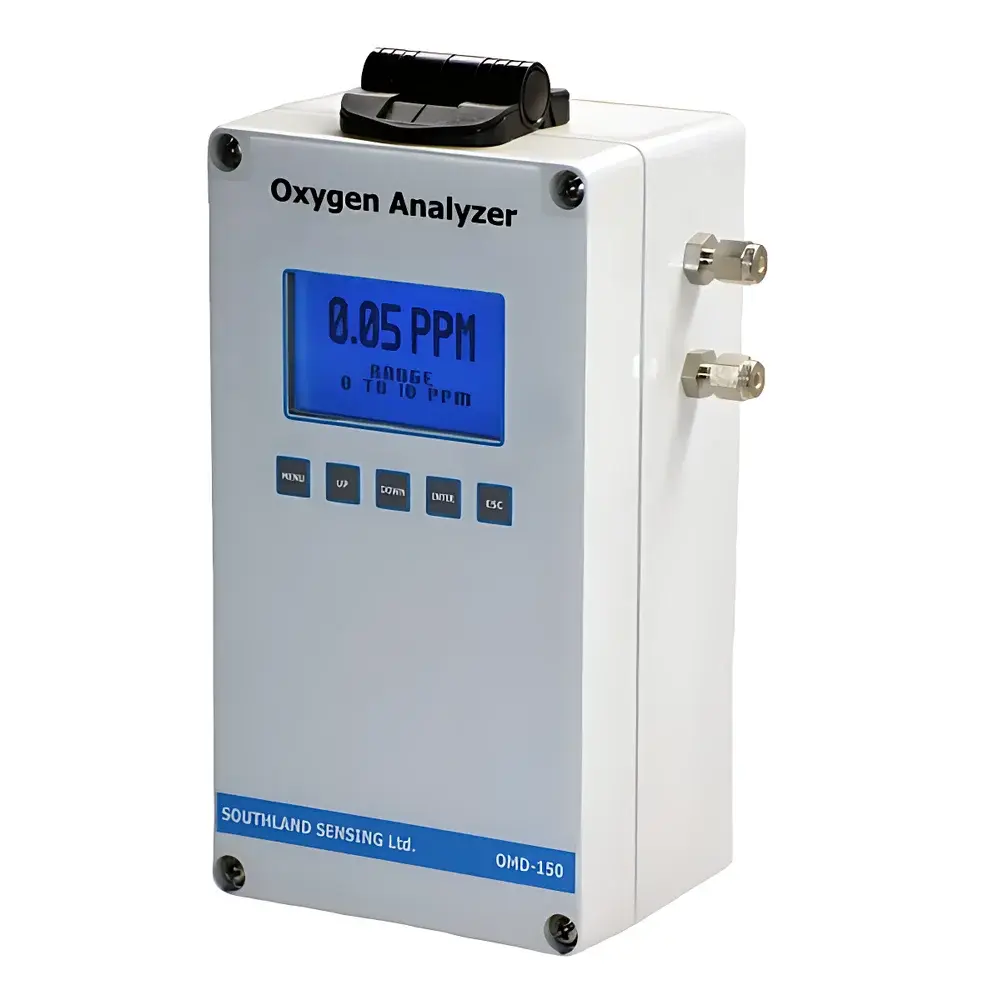
Southland Sensing OMD-150-1 Trace Oxygen Analyzer
| Origin | USA |
|---|---|
| Manufacturer Type | Authorized Distributor |
| Origin Category | Imported |
| Model | OMD-150-1 |
| Measurement Ranges | 0–1 ppm, 0–10 ppm, 0–100 ppm, 0–1000 ppm, 0–25% O₂ |
| Accuracy | <1% FS |
| Certifications | CE, Optional ATEX/IECEx Intrinsically Safe (with MTL Zener barrier) |
| Dimensions | 241 × 165 × 96 mm |
| Operating Temperature | –10 to 50 °C |
| Temperature Compensation | Built-in |
| Sensor Type | Miniaturized Electrochemical Fuel Cell |
| Warranty | 12 months |
| Power Supply | 12–24 VDC |
| Current Consumption | 25 mA |
| Analog Outputs | 4–20 mA and 0–10 VDC |
| Sample Flow Rate | 230–2500 mL/min |
| Compatible Gases | N₂, Ar, He, H₂, other inert or reducing gases (H₂S/SO₂/CO₂-compatible variants available on request) |
Overview
The Southland Sensing OMD-150-1 Trace Oxygen Analyzer is a compact, field-deployable electrochemical analyzer engineered for continuous, real-time quantification of dissolved or gaseous oxygen at trace levels—from sub-part-per-trillion (ppt) detection thresholds up to 25% volume concentration. It employs a proprietary miniaturized fuel cell sensor operating on the principle of galvanic oxygen reduction: molecular O₂ diffuses through a selective membrane into an aqueous electrolyte, where it undergoes cathodic reduction (O₂ + 2H₂O + 4e⁻ → 4OH⁻), generating a linear current proportional to partial pressure. This zero-power-consumption sensing architecture eliminates drift associated with polarized electrodes and ensures stable baseline performance over extended operational cycles—critical for high-purity gas monitoring in semiconductor fab environments, inert blanketing systems, and cryogenic air separation units.
Key Features
- Multi-range configurable measurement capability: factory-set or field-selectable spans include 0–1 ppm, 0–10 ppm, 0–100 ppm, 0–1000 ppm, and 0–25% O₂—enabling single-instrument deployment across diverse process stages.
- Integrated temperature compensation circuitry maintains accuracy across –10 to 50 °C ambient conditions without external thermostatic control.
- Intrinsically safe (IS) configuration available per IEC 60079-11, certified with MTL Zener barriers for Zone 1/21 hazardous area installation (ATEX/IECEx compliant upon customization).
- Low-power design: nominal 25 mA draw at 12–24 VDC supports integration into battery-backed or loop-powered control systems.
- Dual analog outputs (4–20 mA and 0–10 VDC) provide redundancy and compatibility with legacy DCS, PLC, and SCADA architectures.
- Modular sensor cartridge enables rapid field replacement with minimal calibration downtime; typical service life exceeds 24 months under continuous operation in clean inert matrices.
Sample Compatibility & Compliance
The OMD-150-1 is validated for use with nitrogen, argon, helium, hydrogen, and other non-corrosive, non-acidic process gases. For applications involving H₂S, SO₂, CO₂, or halogenated compounds, Southland Sensing offers acid-resistant sensor variants featuring chemically stabilized electrolytes and corrosion-inhibiting electrode coatings. All configurations comply with CE marking requirements under Directive 2014/30/EU (EMC) and 2014/35/EU (LVD). Optional IS certification aligns with IEC 60079-0, -11, and -26 standards. The analyzer meets functional safety requirements for SIL 2-capable systems when integrated with certified logic solvers per IEC 61511.
Software & Data Management
While the OMD-150-1 operates as a stand-alone analog transmitter, its output signals are fully compatible with industry-standard data acquisition platforms including Emerson DeltaV, Honeywell Experion PKS, and Siemens Desigo CC. When paired with Southland’s optional USB-to-RS485 interface module, users gain access to real-time diagnostics—including sensor health status, temperature log, and zero/span verification history—via the vendor’s Windows-based OMD Configuration Utility. Audit trails support GLP/GMP compliance, and all configuration changes are timestamped and user-logged in accordance with FDA 21 CFR Part 11 requirements for electronic records.
Applications
- High-purity nitrogen and hydrogen generation: monitoring O₂ breakthrough in PSA and membrane separation skids.
- Semiconductor manufacturing: verifying oxygen contamination below 1 ppb in ultra-high-purity (UHP) purge gases for CVD, ALD, and lithography tool chambers.
- Pharmaceutical inerting: validating residual O₂ levels in lyophilizer chambers and API dry-blending vessels per USP guidelines.
- Metallurgical processing: real-time tracking of furnace atmosphere oxidation potential during annealing, sintering, and brazing operations.
- Nuclear power plant coolant gas monitoring: detecting radiolytic O₂ accumulation in primary containment purge streams.
FAQ
What is the recommended calibration frequency for the OMD-150-1 in continuous operation?
Calibration is advised every 3–6 months depending on exposure history; zero calibration using certified nitrogen (99.9999% purity) and span calibration using certified O₂/N₂ mixtures traceable to NIST standards are required.
Can the OMD-150-1 measure oxygen in compressed natural gas (CNG) or biogas streams?
Standard configurations are not rated for hydrocarbon-rich or acidic gas matrices; however, custom sensor assemblies with sulfur-tolerant membranes and acid-scavenging electrolytes are available upon engineering review.
Is the unit suitable for outdoor installation in unheated enclosures?
Yes, provided ambient temperature remains within –10 to 50 °C and relative humidity does not exceed 90% non-condensing; optional IP65-rated enclosure kits are available for direct-mount applications.
Does the analyzer support Modbus RTU or HART communication protocols?
No native digital protocol is embedded; however, third-party analog-to-Modbus converters (e.g., Moore Industries SP-300 series) are widely deployed in conjunction with the 4–20 mA output.
How does sensor poisoning affect long-term stability—and what mitigation strategies exist?
Exposure to H₂S >1 ppm or SO₂ >5 ppm accelerates electrolyte degradation; Southland Sensing provides application-specific sensor selection guides and recommends pre-filtration with activated carbon or zinc oxide scrubbers where such contaminants are anticipated.
Related Products