
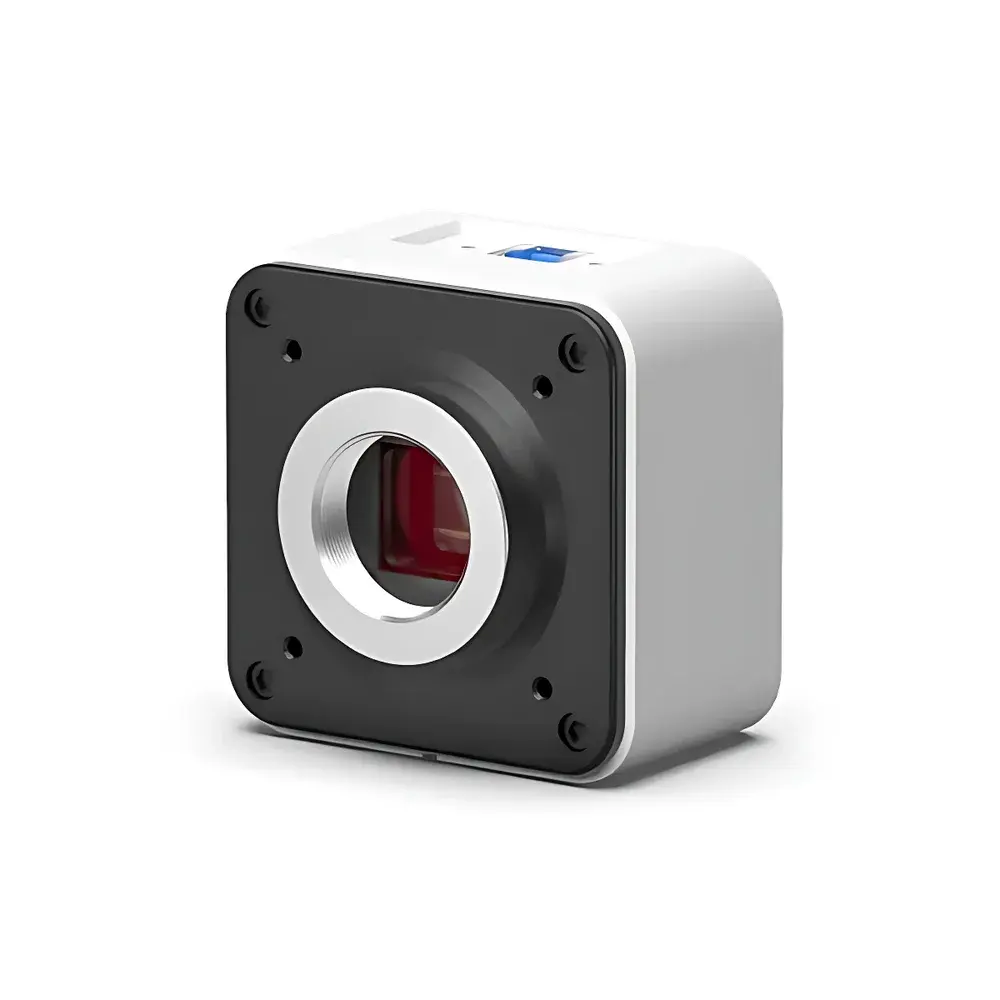
TUCSEN MIchrome 16 Fluorescence/Biological/Polarizing/Metallurgical/Stereo Microscope Camera
| Brand | TUCSEN |
|---|---|
| Origin | Fujian, China |
| Manufacturer Type | OEM/ODM Manufacturer |
| Region of Origin | Domestic (China) |
| Model | MIchrome 16 |
| Image Resolution | 16 MP (4608 × 3456) |
| Pixel Size | 1.34 µm × 1.34 µm |
| Sensor Size | 6.2 mm × 4.6 mm |
| Readout Speed | 12 fps @ USB 3.0 |
| Sensor Model | Sony IMX206CQC |
| Color | Color |
| Shutter Type | Rolling Shutter |
| Interface | C-mount |
| Data Interface | USB 3.0 |
| Dimensions | 68 × 68 × 46 mm |
| Weight | 327 g |
| Multi-camera Support | Up to 4 synchronized units |
Overview
The TUCSEN MIchrome 16 is a high-performance, multi-modal CMOS microscope camera engineered for precision optical imaging across fluorescence, biological, polarized light, metallurgical, and stereo microscopy applications. Unlike conventional single-purpose imaging modules, the MIchrome 16 integrates a scientific-grade Sony IMX206CQC CMOS sensor with a native resolution of 16 megapixels (4608 × 3456), delivering exceptional spatial fidelity and dynamic range under variable illumination conditions. Its compact C-mount design ensures seamless mechanical and optical compatibility with standard upright, inverted, and modular microscope platforms—including Zeiss, Leica, Nikon, Olympus, and custom-built systems—while maintaining parfocality and minimal vignetting across magnification ranges from 1× to 100×. The camera operates on a rolling shutter architecture optimized for low-noise, high-fidelity acquisition in both brightfield and low-light fluorescence modalities, with calibrated spectral response aligned to CIE 1931 color space for quantitative colorimetric reproducibility.
Key Features
- 16 MP global-calibrated CMOS sensor (Sony IMX206CQC) with 1.34 µm pixel pitch and 6.2 mm × 4.6 mm active area
- Dual real-time computational imaging modes: hardware-accelerated mosaic stitching and depth-of-field (DoF) fusion, enabled via Mosaic 2.0 software engine
- USB 3.0 interface supporting sustained 12 fps at full resolution; stable bandwidth allocation prevents frame drop during long-duration time-lapse or Z-stack acquisition
- Integrated ISP pipeline leveraging TUCSEN’s proprietary color science algorithms—correcting quantum efficiency non-uniformity and chromatic aberration-induced hue shifts across visible and near-UV emission bands (365–650 nm)
- C-mount optical interface with ±0.1 mm axial tolerance; compatible with infinity-corrected and finite-conjugate optical paths without relay lens requirement
- Support for synchronized multi-camera operation (up to four units), enabling dual-wavelength ratiometric imaging or stereoscopic acquisition without external trigger hardware
Sample Compatibility & Compliance
The MIchrome 16 is validated for use in ISO/IEC 17025-accredited laboratories performing routine QC/QA in pharmaceutical, semiconductor, and materials science domains. Its spectral response profile meets ASTM E308-22 requirements for photometric measurement traceability when paired with NIST-traceable calibration targets. For regulated environments, the Mosaic 2.0 software platform supports audit trail logging, user role-based access control, and electronic signature functionality compliant with FDA 21 CFR Part 11 Annex 11 and EU GMP Annex 11 guidelines. The camera itself carries CE marking per Directive 2014/30/EU (EMC) and 2014/35/EU (LVD), and its housing conforms to IP20 ingress protection for controlled laboratory settings.
Software & Data Management
Mosaic 2.0 serves as the unified acquisition and processing environment—deployed as a Windows-native application with optional Linux SDK support. It provides native TIFF, HDF5, and OME-TIFF export formats for interoperability with ImageJ/Fiji, QuPath, HALO, and MATLAB-based analysis pipelines. All stitched mosaics and DoF-fused stacks retain embedded EXIF metadata including objective magnification, exposure time, gain, white balance coefficients, and stage coordinate mapping (when integrated with motorized stages via RS-232 or USB HID protocols). Raw data buffers are stored in lossless 12-bit linear format prior to ISP correction, preserving photon-count integrity for downstream quantitative intensity analysis.
Applications
- Fluorescence tissue section screening with multi-channel co-localization (DAPI/FITC/TRITC/Cy5)
- Metallurgical grain boundary and phase distribution analysis under polarized illumination
- PCB solder joint inspection and micro-crack detection using differential interference contrast (DIC) or darkfield
- Live-cell imaging workflows requiring rapid focus stacking across heterogeneous sample topographies
- Educational microscopy labs requiring robust, maintenance-free digital imaging infrastructure
- Forensic fiber and pigment identification where spectral fidelity and spatial resolution are forensically admissible
FAQ
Is the MIchrome 16 compatible with third-party microscope control software such as Micro-Manager or ASI Stage?
Yes—TUCSEN provides a documented GenICam-compliant SDK with C++, Python, and LabVIEW bindings, enabling integration into open-source and commercial automation frameworks.
Does the camera support hardware triggering for synchronization with external light sources or shutters?
It features a TTL-compatible GPIO port (opto-isolated) supporting both input trigger and output strobe modes, configurable via register-level commands in the SDK.
Can Mosaic 2.0 perform batch processing of previously acquired Z-stacks for retrospective DoF fusion?
Yes—the software includes an offline processing module that accepts folder-based TIFF sequences and applies identical fusion algorithms used in real-time acquisition.
What is the maximum cable length supported for stable USB 3.0 operation?
With active optical USB 3.0 extension cables, reliable operation is maintained up to 10 meters; passive copper cables are rated for ≤3 meters per USB-IF specifications.
Is firmware upgrade capability available in the field?
Firmware updates are delivered through Mosaic 2.0’s built-in updater utility and require no additional hardware programmer—verified checksums ensure integrity during flash programming.




