
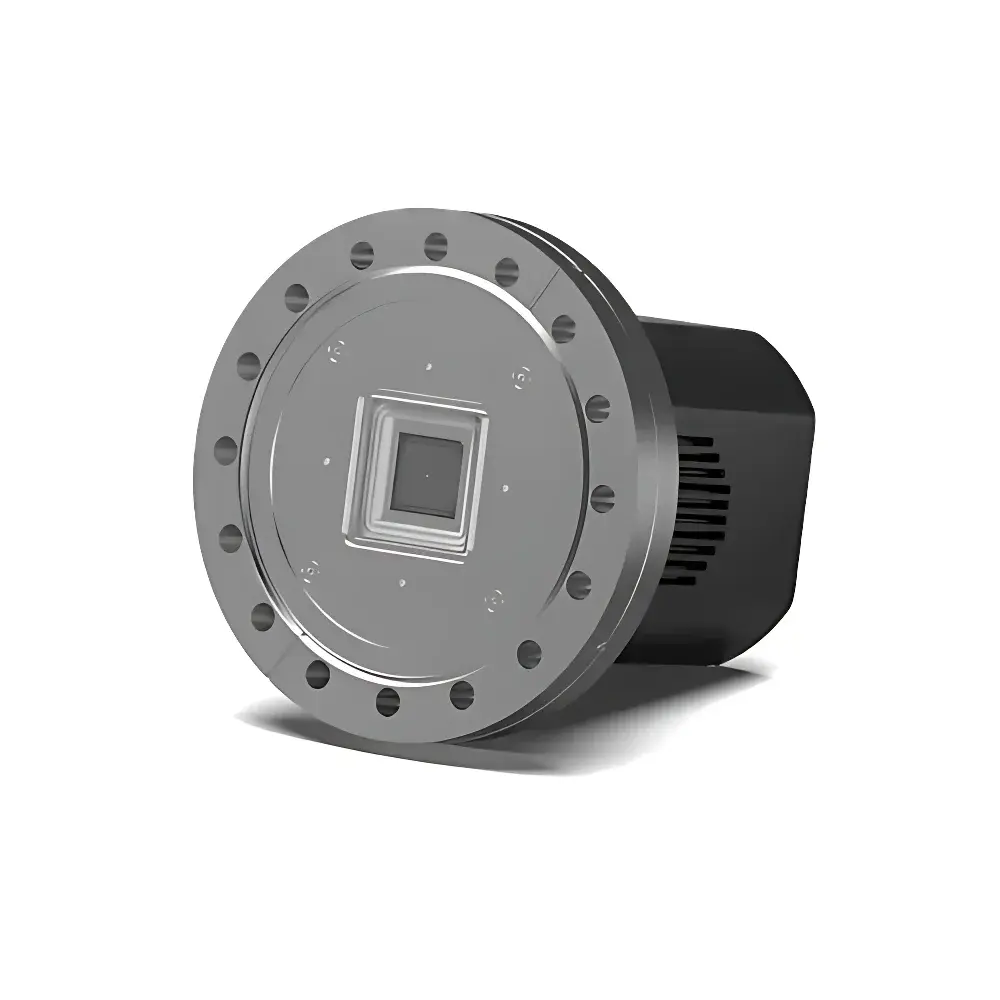
TUCSEN Dhyana XF95 External-Beam Soft X-ray sCMOS Camera
| Brand | TUCSEN |
|---|---|
| Origin | Fujian, China |
| Manufacturer Type | Original Equipment Manufacturer (OEM) |
| Regional Category | Domestic (China) |
| Model | Dhyana XF95 (External-Beam) |
| Pricing | Upon Request |
| Image Resolution | 4.2 MP, 2048 (H) × 2048 (V) |
| Pixel Size | 11 µm × 11 µm |
| Sensor Active Area | 22.5 mm × 22.5 mm |
| Readout Speed | HDR Mode: 24 fps |
| Standard Mode | 48 fps |
| Dynamic Range | 90 dB |
| Peak Quantum Efficiency | ~100% @ 80–1000 eV |
Overview
The TUCSEN Dhyana XF95 External-Beam Soft X-ray sCMOS Camera is a high-performance, vacuum-compatible imaging sensor engineered for synchrotron radiation facilities, free-electron laser (FEL) beamlines, and laboratory-scale soft X-ray (SXR) and extreme ultraviolet (EUV) experiments. Unlike conventional front-illuminated or AR-coated back-illuminated sensors, the XF95 integrates a custom uncoated back-illuminated sCMOS chip—GSENSE 400BSI-PS—optimized specifically for photon energies between 80 eV and 1000 eV. Within this range, it achieves peak quantum efficiency (QE) approaching 100%, with >90% average QE across the band. This performance stems from elimination of anti-reflection coatings that absorb low-energy photons and from deep depletion architecture enabling efficient charge collection at soft X-ray wavelengths. The camera operates in external-beam configuration, meaning it captures radiation outside the vacuum chamber via a thin, transmission-grade Be or SiN window—enabling integration into existing beamline endstations without requiring internal sensor placement.
Key Features
- Vacuum compatibility up to 10⁻⁷ Pa, validated per ISO 20483 (vacuum component testing), supporting direct mounting on UHV-compatible flanges (DN100 CF standard)
- Thermoelectric cooling to −50 °C (at 20 °C water-coolant temperature), reducing dark current to ≤0.5 e⁻/pixel/s and enabling exposure durations up to 300 seconds with sub-electron noise floor
- Ultra-low read noise: 1.6 e⁻ (median), measured per EMVA 1288 standard, ensuring high signal fidelity in low-flux SXR diffraction and ptychography
- High-speed dual-gain readout architecture: 48 fps in standard mode; 24 fps in high-dynamic-range (HDR) mode with simultaneous short/long exposure capture
- 12-bit and 16-bit selectable output depth, with >99% linearity and calibrated non-uniformity correction (DSNU ≤ 0.2 e⁻, PRNU ≤ 0.3%)
- Flexible triggering: hardware TTL inputs (exposure start, global reset, readout end), programmable pulse polarity, and µs-resolution timestamping for time-resolved pump-probe studies
Sample Compatibility & Compliance
The XF95 is designed for use with synchrotron bending magnet and insertion device beamlines, tabletop laser-produced plasma sources, and EUV lithography testbeds. Its spectral response (80–1000 eV) aligns with key absorption edges including C K-edge (284 eV), O K-edge (543 eV), Fe L-edge (707 eV), and Ni L-edge (853 eV), supporting X-ray absorption spectroscopy (XAS), coherent diffraction imaging (CDI), and zone-plate microscopy. The sensor’s radiation hardness has been verified under cumulative doses exceeding 10⁴ Gy (SiO₂-equivalent), meeting IEC 62585 requirements for long-term operation in high-flux environments. Mechanical integration conforms to ISO-KF/DN100 CF vacuum interface standards, and thermal management complies with SEMI F47-0212 for transient power load tolerance. The system supports GLP-compliant audit trails when used with TUCSEN’s Mosaic SDK and third-party acquisition platforms.
Software & Data Management
The XF95 is supported by TUCSEN’s native Mosaic acquisition suite (Windows/Linux), offering real-time histogram analysis, region-of-interest (ROI) binning (2×2, 4×4), and non-uniformity correction with user-loadable flat-field maps. It provides native drivers for LabVIEW (NI-IMAQdx), MATLAB (Image Acquisition Toolbox), and Micro-Manager (v2.0+), enabling seamless integration into automated beamline control systems. The CameraLink and USB 3.0 interfaces support lossless data streaming at full frame rate; metadata—including exposure time, sensor temperature, trigger latency, and vacuum status—is embedded in each frame header per HDF5 1.12 schema. SDKs in C/C++ and C# include thread-safe memory-mapped buffers and asynchronous callback registration, facilitating deterministic timing in time-resolved experiments compliant with IEEE 1588 PTP synchronization.
Applications
- Soft X-ray ptychographic tomography of biological specimens and nanomaterials
- Time-resolved resonant inelastic X-ray scattering (RIXS) at synchrotron beamlines
- EUV mask inspection and actinic aerial image metrology
- Plasma diagnostics in laser-driven SXR sources (e.g., nitrogen, oxygen, or carbon Kα emission imaging)
- Coherent diffractive imaging of magnetic domain structures using circularly polarized SXR
- Single-shot femtosecond SXR imaging at FEL facilities, leveraging shutterless rolling-scan operation
FAQ
Is the XF95 suitable for in-vacuum installation?
Yes—the camera housing meets UHV specifications up to 10⁻⁷ Pa and can be directly mounted on DN100 CF flanges. Optional bake-out capability supports temperatures up to 70 °C.
What is the minimum detectable photon flux at 300 eV?
At −40 °C sensor temperature and 1-second exposure, the system achieves single-photon sensitivity with SNR > 5 for ≥10 photons/pixel, validated using monochromatized synchrotron light.
Does the camera support global shutter operation?
No—it uses a precise electronic rolling shutter with <1 µs row-to-row skew; however, global reset functionality enables synchronized exposure initiation across all rows for pump-probe applications.
Can the XF95 be integrated into EPICS-based control systems?
Yes—via the open-source areaDetector driver (ADTucsen), which provides NDArray-based image streaming, PV-accessible acquisition parameters, and support for HDF5 file writing with metadata embedding.
Is firmware upgrade supported remotely?
Yes—field-upgradable firmware is delivered via signed binary packages through the Mosaic software suite, with checksum verification and rollback capability to ensure beamline operational continuity.





