
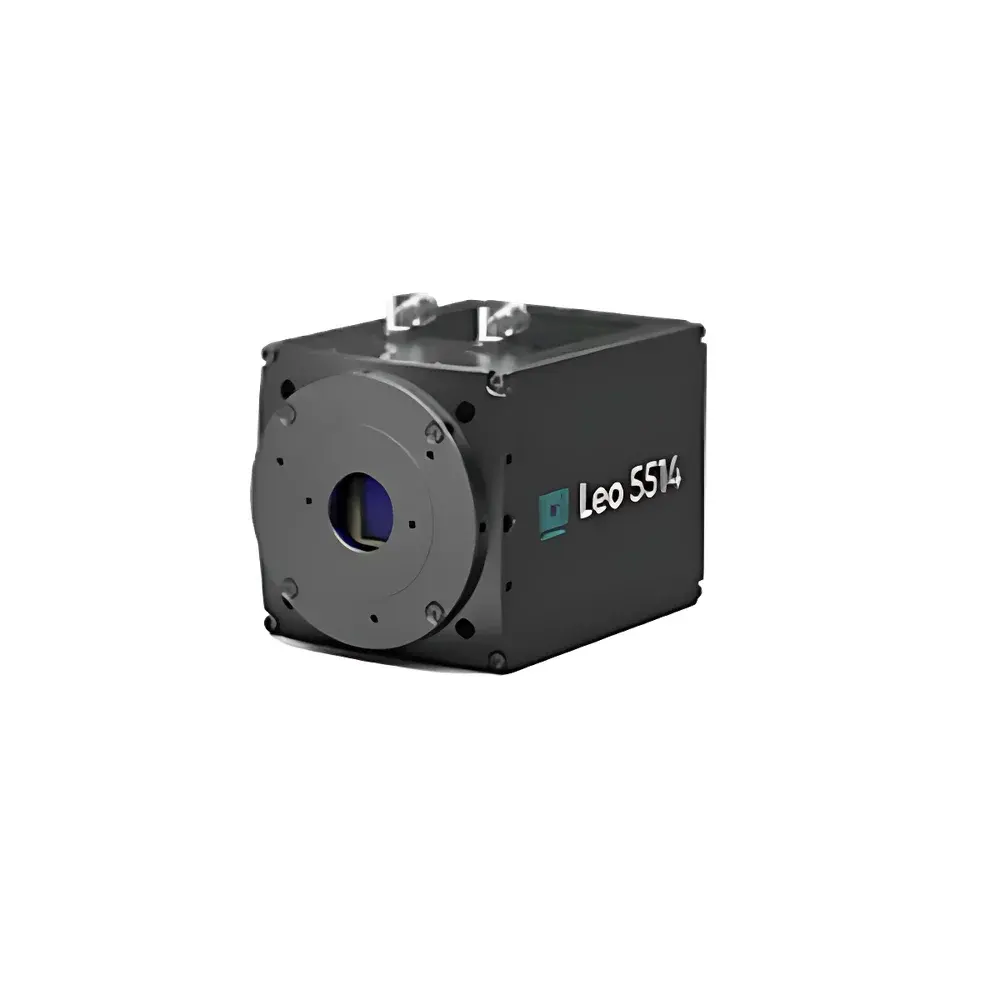
Tucsen Leo 5514 Pro BSI sCMOS Camera
| Brand | Tucsen |
|---|---|
| Origin | Fujian, China |
| Manufacturer Type | OEM Manufacturer |
| Product Origin | Domestic (China) |
| Model | Leo 5514 Pro |
| Image Resolution | 4608 (H) × 3072 (V) |
| Pixel Size | 5.5 µm × 5.5 µm |
| Sensor Diagonal | 30.5 mm |
| Readout Speed | 670 fps @ 8-bit |
| Dynamic Range | 77.5 dB |
| Quantum Efficiency | 83% |
| Read Noise | < 2 e⁻ (HDR & 12-bit, Gain 4) |
| Full Well Capacity | 15 ke⁻ (HDR), 30 ke⁻ (After Binned) |
| Frame Rates | 670 fps @ 8-bit |
| Cooling | Air-cooled to +10°C @ 25°C ambient |
| Interface | 100G CoaXPress over Fiber (COF) via QSFP28 |
| Mount | T-mount / F-mount / C-mount compatible |
| Weight | < 1.5 kg |
Overview
The Tucsen Leo 5514 Pro is a high-performance back-illuminated scientific CMOS (BSI sCMOS) camera engineered for demanding optical imaging applications in life sciences, spatial omics, semiconductor metrology, and next-generation sequencing instrumentation. Built around the GSPRINT5514BSI sensor, it integrates global shutter architecture with deep-depletion back-illumination to deliver exceptional quantum efficiency (83% peak), ultra-low read noise (<2 e⁻ under HDR/12-bit conditions), and high-speed acquisition—up to 670 frames per second at 8-bit depth. Unlike rolling-shutter sensors, its true global shutter eliminates motion-induced skew and time-dependent pixel latency, making it suitable for voltage-sensitive fluorescence imaging, fast calcium dynamics, multi-dimensional time-lapse microscopy, and synchronized multi-camera acquisition in light-sheet or structured illumination systems.
Key Features
- Back-Illuminated Global Shutter sCMOS: Combines high QE (83%) and temporal fidelity across all pixels without rolling shutter artifacts—critical for quantitative intensity correlation, electrophysiology-coupled imaging, and high-throughput screening.
- Large Format Imaging: 30.5 mm diagonal sensor with 25.34 mm × 16.90 mm active area enables wide-field coverage, reducing tile-based stitching errors in whole-slide scanning, spatial transcriptomics, and large-area wafer inspection.
- High-Speed Data Pipeline: Native 100G CoaXPress over Fiber (COF) interface ensures deterministic, low-jitter, real-time transfer of full-resolution 14 MP images—eliminating USB or PCIe bandwidth bottlenecks in integrated OEM instruments.
- Thermal Stability Architecture: Dual-mode cooling (air/water) maintains sensor temperature at +10°C (air-cooled) or –5°C (water-cooled), suppressing dark current to <1 e⁻/pixel/s (at –5°C), essential for long-exposure super-resolution modalities such as STORM or PALM.
- Multi-Bit Depth Flexibility: Supports 8-, 10-, 12-, and 16-bit digitization, enabling dynamic range optimization per application—e.g., 77.5 dB at 12-bit for high-contrast tissue imaging or 16-bit for quantitative spectral unmixing in multiplexed IHC.
Sample Compatibility & Compliance
The Leo 5514 Pro is designed for integration into ISO 13485-compliant diagnostic instrument platforms and GLP/GMP-aligned research systems. Its mechanical and electrical specifications conform to standard OEM integration requirements—including Hirose-trigger I/O for synchronization with lasers, shutters, and stage controllers. The camera supports hardware-level trigger modes (Exposure Start, Exposure End, Readout End, Trigger Ready) and complies with CoaXPress 2.0 and QSFP28 MSA specifications. While not certified as an IVD device itself, its performance metrics meet typical validation thresholds for FDA 21 CFR Part 11–aligned data acquisition in regulated environments when deployed within validated instrument workflows.
Software & Data Management
Tucsen provides native SDKs for Windows and Linux (C/C++, Python, MATLAB), supporting seamless integration into custom acquisition engines and third-party platforms including Micro-Manager, MetaMorph, and NIS-Elements. All image metadata—including exposure time, gain, temperature, bit depth, and trigger configuration—is embedded in TIFF/RAW headers per TIFF/EP standard. The SDK implements audit-trail–ready logging for frame-level timestamping and acquisition parameter tracking, facilitating traceability in GLP-compliant spatial biology pipelines. Optional firmware updates are delivered via signed binary packages with SHA-256 checksum verification to ensure integrity during field deployment.
Applications
- Spatial Omics & Multiplexed Imaging: Enables high-fidelity, stitch-free capture of whole-tissue sections labeled with cyclic immunofluorescence (CyCIF) or in situ sequencing probes—leveraging large FOV and high SNR for subcellular feature segmentation.
- Super-Resolution Microscopy: Serves as a primary detector in STED, SIM, and single-molecule localization microscopy (SMLM), where global shutter timing precision and low read noise directly impact localization accuracy and labeling density quantification.
- Live-Cell Functional Imaging: Captures rapid subcellular events (e.g., vesicle trafficking, mitochondrial fission) without temporal distortion, especially when coupled with voltage-sensitive dyes or genetically encoded calcium indicators (GECIs).
- Semiconductor Inspection & Metrology: Integrated into automated defect review stations and mask inspection tools requiring high-resolution, high-frame-rate imaging of photomasks and wafers under UV or DUV illumination.
- Next-Generation Sequencing Instrumentation: Functions as the core imaging engine in benchtop sequencers performing fluorescent base calling, where pixel-level linearity and inter-frame consistency are critical for base-calling fidelity.
FAQ
Does the Leo 5514 Pro support hardware triggering for synchronized multi-camera setups?
Yes—it features six programmable TTL-compatible trigger outputs (Readout End, Exposure, Exposure Start, Read Out, Trigger Ready, High/Low) and Hirose HR10A-7P input connectors for precise external synchronization.
What optical mounts are natively supported?
The camera includes interchangeable T-mount, F-mount, and C-mount adapter options, allowing direct coupling to microscope ports, telecentric lenses, or industrial optics without additional spacers.
Is the 100G COF interface compatible with existing CoaXPress frame grabbers?
No—the Leo 5514 Pro uses CoaXPress over Fiber (COF), which requires a QSFP28-based host interface and is not electrically compatible with legacy coaxial CXP-12 or CXP-6 frame grabbers.
Can the camera operate continuously at full frame rate without thermal throttling?
Under water-cooled conditions (coolant at 20°C), the sensor sustains stable –5°C operation during sustained 670 fps acquisition; air-cooled mode limits continuous runtime depending on ambient airflow and enclosure design.
How is calibration data handled for quantitative intensity applications?
Factory-measured flat-field, dark-frame, and gain maps are provided in machine-readable JSON format and can be applied in real time via SDK or offline during post-processing to ensure pixel-to-pixel response uniformity.



