
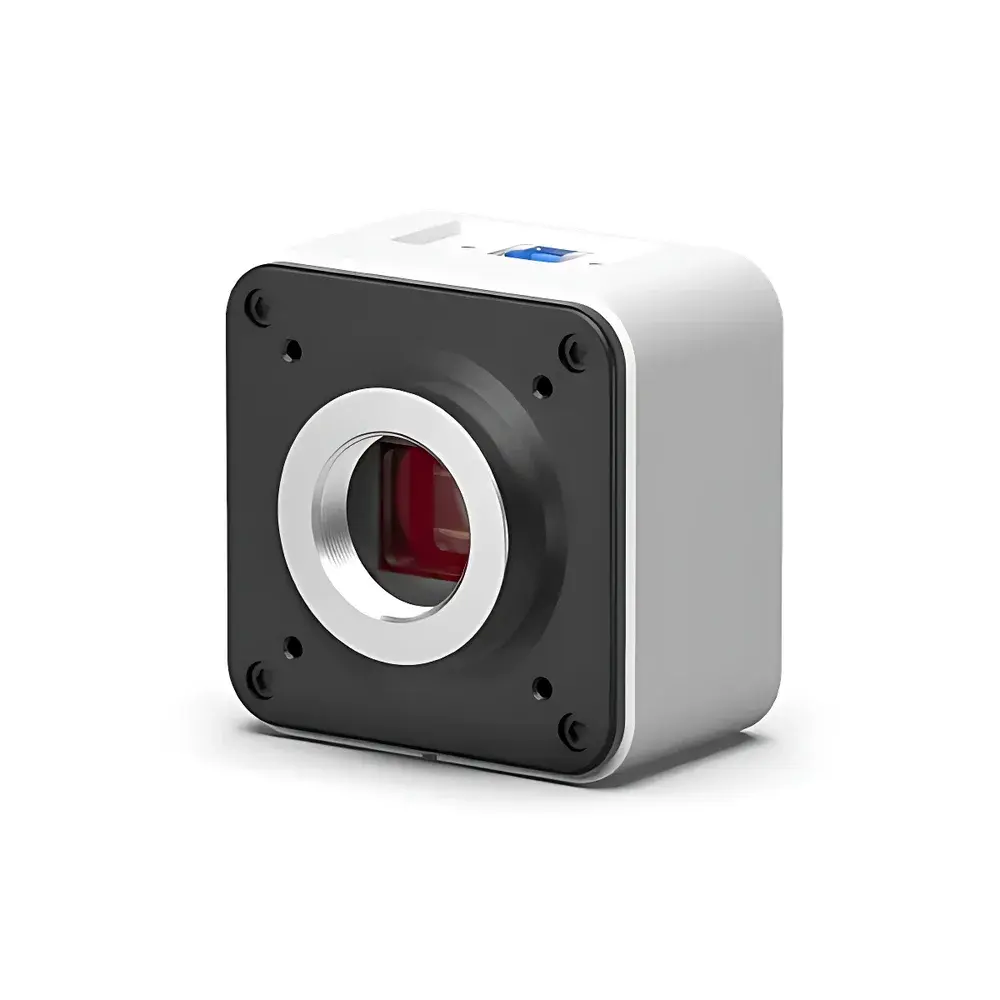
Tucsen GT12 Scientific CMOS Camera for Fluorescence, Biological, Polarized Light, Metallurgical and Stereo Microscopy
| Brand | Tucsen |
|---|---|
| Origin | Fujian, China |
| Manufacturer Type | Original Equipment Manufacturer (OEM) |
| Region of Manufacture | Domestic (China) |
| Model | GT12 |
| Image Resolution | 4000 (H) × 3000 (V) |
| Pixel Size | 1.34 µm × 1.34 µm |
| Sensor Active Area | 5.4 mm × 4.0 mm |
| Readout Speed | 15 fps @ USB 2.0 |
Overview
The Tucsen GT12 is a high-performance scientific CMOS camera engineered for integration with multi-modal optical microscopy platforms—including fluorescence, biological, polarized light, metallurgical, and stereo microscopes. Built around the Sony IMX206CQC global-color CMOS sensor, the GT12 delivers native 12-megapixel resolution (4000 × 3000) with a compact 1/2.8″ optical format (7.77 mm diagonal). Its architecture leverages on-sensor graphics acceleration to achieve sustained 15 fps frame rates over USB 2.0—a fivefold improvement over conventional USB 2.0 cameras—without compromising bit depth or dynamic range. Designed for quantitative imaging workflows, the GT12 supports precise exposure control (1 µs to 1 s), rolling shutter operation, and hardware-level synchronization triggers, making it suitable for time-lapse cytology, grain boundary analysis in metallography, birefringence mapping in polymer science, and low-light fluorescence imaging where photon efficiency and temporal fidelity are critical.
Key Features
- 12 MP Sony IMX206CQC CMOS sensor with 1.34 µm pixel pitch and 5.4 mm × 4.0 mm active area
- Real-time graphics acceleration engine enabling 15 fps full-resolution acquisition via USB 2.0 interface
- Dual-domain color processing pipeline: biologically optimized spectral rendering for histopathology and industrial-grade chromatic fidelity for metallurgical surface contrast
- Full-featured Mosaic V2 software suite supporting image capture, annotation, multi-point measurement (length, angle, area, intensity profile), and compliant report generation (PDF, DICOM, TIFF, JPG, PNG)
- C-mount mechanical interface with standardized flange distance (17.526 mm) for seamless integration across OEM and third-party microscope systems
- Low-power design (2 W typical consumption) and thermally stable housing (68 × 68 × 42.5 mm, 236 g) suitable for embedded or benchtop deployment
Sample Compatibility & Compliance
The GT12 supports diverse sample types across regulated and research environments: unstained live cells, DAPI/Hoechst-stained nuclei, FITC/TRITC-labeled antibodies, anisotropic crystalline structures, polished metal cross-sections, and macroscopic biological specimens under oblique illumination. Its output formats—including DICOM-compliant metadata embedding—facilitate integration into PACS and LIMS infrastructures. While not certified as a medical device per FDA 510(k) or CE-IVD, the GT12 conforms to ISO 13485-aligned manufacturing practices (as verified by Tucsen’s Fujian-based ISO 9001:2015-certified facility) and meets electromagnetic compatibility requirements per EN 61326-1 for laboratory equipment. Firmware and SDK support audit-trail logging for GLP/GMP-aligned documentation workflows.
Software & Data Management
Mosaic V2 provides a unified GUI for acquisition, calibration, and quantitative analysis. It includes flat-field correction, background subtraction, gamma adjustment, and ROI-based histogram statistics. The SDK (C, C++, C#, DirectShow, TWAIN) enables custom automation in MATLAB, Python (via ctypes or OpenCV wrappers), and LabVIEW. Up to four GT12 units can be synchronized and controlled simultaneously—critical for multi-angle stereo reconstruction or multi-channel fluorescence unmixing. All acquired images retain EXIF-like metadata (exposure, gain, timestamp, sensor temperature), ensuring traceability. Export options include lossless TIFF (16-bit), compressed JPEG (user-adjustable quality), PNG (with alpha channel), and DICOM Series (conforming to PS3.3 and PS3.10 standards).
Applications
- Fluorescence microscopy: Co-localization studies requiring precise channel registration and low-noise widefield capture
- Pathology digitization: High-fidelity RGB rendering of H&E and immunohistochemical slides at sub-cellular resolution
- Materials science: Grain size distribution analysis in ASTM E112-compliant metallography; phase contrast enhancement for ceramic composites
- Polarized light imaging: Quantitative retardation mapping of liquid crystal displays or pharmaceutical crystallinity assessment
- Stereo inspection: PCB solder joint verification, botanical morphology documentation, and forensic evidence imaging
FAQ
Is the GT12 compatible with Windows 11 and macOS Ventura or later?
Yes—the Mosaic V2 software supports Windows 7–11 (32/64-bit) and macOS 10.15–14.x. Native ARM64 binaries are provided for Apple Silicon Macs.
Does the camera support hardware triggering and external synchronization?
Yes—TTL-compatible trigger input/output pins enable precise timing coordination with shutters, stages, or light sources.
Can I perform real-time image processing (e.g., deconvolution or spectral unmixing) using the onboard GPU acceleration?
No—the graphics acceleration is dedicated to sensor readout and pipeline preprocessing (demosaicing, white balance, gamma); computationally intensive algorithms require host-CPU or GPU offloading via SDK.
What is the dark current specification at room temperature?
Typical dark current is ≤0.05 e⁻/pixel/s at 25°C, measured per Sony IMX206CQC datasheet specifications.
Is calibration data (e.g., flat-field or pixel response non-uniformity maps) provided with the camera?
Yes—each unit ships with factory-acquired flat-field reference frames and optional NIST-traceable irradiance calibration reports upon request.



