
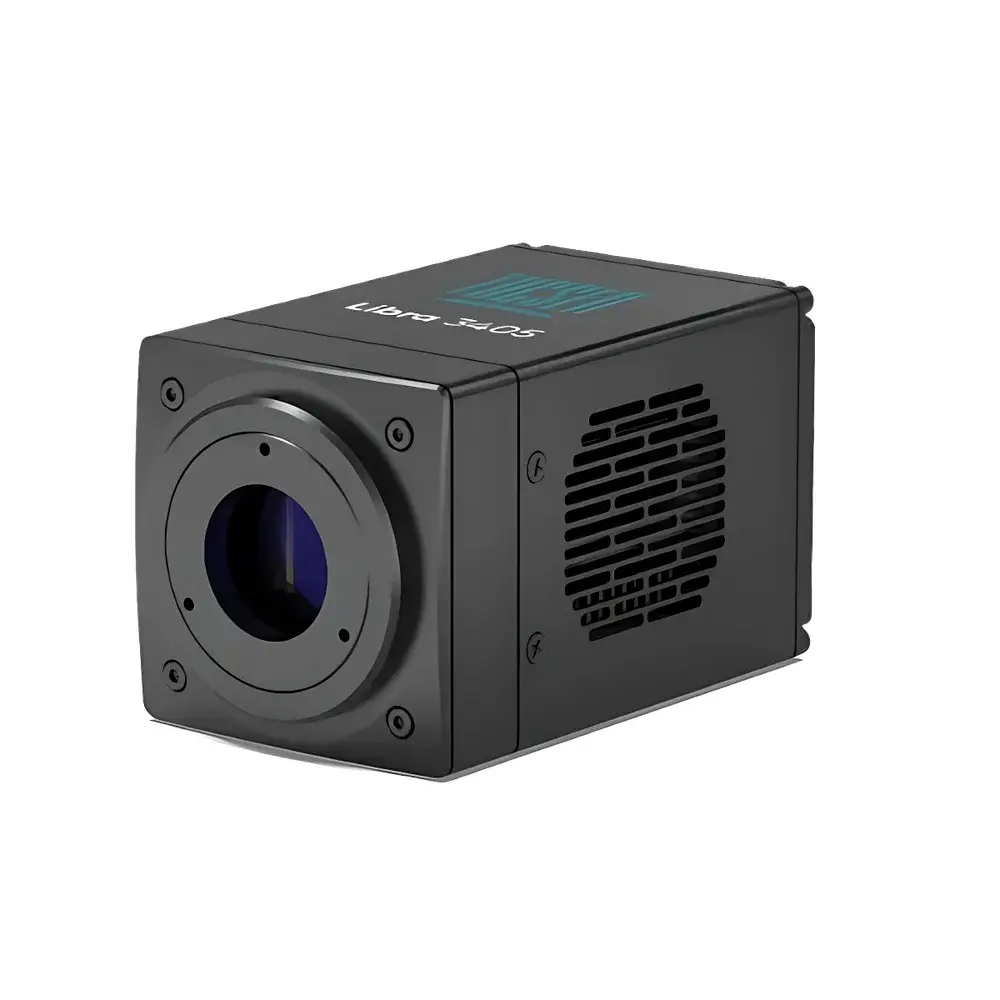
Tucsen Libra 3405M sCMOS Camera for Digital Pathology Scanning, Microscopy Imaging, and Industrial Inspection
| Brand | Tucsen |
|---|---|
| Origin | Fujian, China |
| Manufacturer Type | OEM Manufacturer |
| Region of Origin | Domestic (China) |
| Model | Libra 3405M |
| Pricing | Upon Request |
| Image Resolution | 2448 (H) × 2048 (V) |
| Pixel Size | 3.4 µm × 3.4 µm |
| Sensor Active Area | 8.3 mm × 7.0 mm |
| Readout Speed | 164 fps @ 8-bit |
| Peak Quantum Efficiency | 75% @ 540 nm |
| Sensor Type | Front-Side Illuminated (FSI) sCMOS |
| Diagonal | 10.9 mm (2/3″ format) |
| Full-Well Capacity | 8.9 ke⁻ (High Full-Well mode, 12-bit) |
| Read Noise | 1.4 e⁻ (High Sensitivity mode, 12-bit median) |
| Shutter Type | Global Shutter |
| Exposure Range | 1 µs – 10 s |
| Cooling Method | Fan-Assisted Air Cooling (ΔT = −15°C below ambient) |
| Dark Current | 0.5 e⁻/pixel/s @ 10°C |
| Interface | 10G GigE Vision (Hirose 12-pin trigger I/O) |
| Bit Depth | 8/10/12-bit selectable |
| Mount | C-Mount |
| Power | 12 V / 5 A |
| Power Consumption | 30 W |
| Dimensions | 60 mm × 60 mm × 100 mm |
| Weight | 489 g |
Overview
The Tucsen Libra 3405M is a high-performance, globally shuttered scientific CMOS (sCMOS) camera engineered for demanding applications in digital pathology slide scanning, high-fidelity fluorescence microscopy, and precision industrial machine vision inspection. Built around the Gpixel GMAX3405 FSI sCMOS sensor, it delivers exceptional quantum efficiency across a broad spectral range (350–1100 nm), with peak sensitivity at 540 nm (75%) and usable near-infrared response up to 850 nm (33%). Its global shutter architecture eliminates motion-induced distortion—critical for synchronized multi-channel fluorescence acquisition, time-resolved tissue imaging, and high-speed automated optical inspection (AOI) of moving substrates. The 10GigE Vision interface enables sustained full-frame throughput of 164 fps at 8-bit depth, supporting real-time volumetric stitching in whole-slide imaging (WSI) systems and low-latency feedback loops in closed-loop manufacturing QA platforms.
Key Features
- Front-side illuminated (FSI) sCMOS sensor with 2448 × 2048 resolution and 3.4 µm pixel pitch, optimized for light collection efficiency and spatial fidelity in low-signal modalities.
- Three programmable gain modes—High Full-Well (8.9 ke⁻), Balanced (4.2 ke⁻), and High Sensitivity (0.48 ke⁻)—enabling dynamic adaptation to varying photon flux conditions without hardware reconfiguration.
- Fan-assisted active cooling stabilizes sensor temperature to ≤10°C under ambient conditions (25°C), suppressing dark current to 0.5 e⁻/pixel/s and ensuring thermal stability over extended acquisition sessions.
- Hardware-triggered global shutter with sub-microsecond timing precision and configurable output signals (exposure, readout, trigger-ready) for deterministic synchronization with motorized stages, LED excitation sources, or laser pulse generators.
- On-board FPGA-based image processing including defect pixel correction (DPC), region-of-interest (ROI) readout, and hardware binning (1×1, 2×2, 4×4), reducing host CPU load and enabling real-time preprocessing.
- Compliant with GigE Vision 2.0 and GenICam3 standards; supports IEEE 1588 Precision Time Protocol (PTP) for multi-camera temporal alignment in distributed imaging clusters.
Sample Compatibility & Compliance
The Libra 3405M is designed for integration into regulated and research-grade instrumentation where repeatability, traceability, and environmental robustness are essential. Its spectral response supports standard fluorophores (DAPI, FITC, TRITC, Cy5), NIR dyes (IR780, IR800), and unstained brightfield histopathology. The camera meets IEC 61000-6-2 (immunity) and IEC 61000-6-4 (emissions) for industrial environments. While not certified as a medical device per ISO 13485, its performance characteristics align with ASTM E2925-21 (Standard Practice for Characterizing Scientific Cameras) and support GLP/GMP-compliant documentation workflows when deployed in validated digital pathology scanners or QC inspection stations. Firmware logging and metadata embedding (timestamp, exposure, gain, temperature) facilitate audit-ready data provenance.
Software & Data Management
The camera is natively supported by Tucsen’s SamplePro and MosaicV3 acquisition suites, offering intuitive multi-channel tiling, Z-stack alignment, and batch export in TIFF, ND2, and OME-TIFF formats compliant with Bio-Formats. It integrates seamlessly with open-source platforms including Micro-Manager 2.0 (via custom adapter) and PyHamamatsu/PyGigE libraries. A comprehensive SDK provides C/C++, C#, and Python APIs with thread-safe asynchronous acquisition, memory-mapped frame buffers, and callback-driven event handling. All drivers conform to Windows Driver Framework (WDF) and Linux udev rules, enabling headless operation in containerized analysis pipelines (e.g., Dockerized QuPath or HALO preprocessing modules). Metadata is embedded per Frame Header specification (GenICam SFNC), ensuring compatibility with PACS, LIS, and MES systems requiring DICOM-SR or JSON-LD structured annotations.
Applications
- Digital pathology: High-throughput whole-slide scanning of H&E, IHC, and multiplex IF slides with minimal photobleaching and consistent signal-to-noise across large FOVs.
- Live-cell and fixed-tissue fluorescence microscopy: Quantitative colocalization studies, FRAP, and calcium imaging requiring precise exposure control and low read noise in high-sensitivity mode.
- Industrial metrology: Sub-pixel edge detection on PCB traces, semiconductor wafer defects, and micro-optical component alignment using real-time ROI streaming and hardware binning.
- Remote sensing & spectroscopy: Coupled with grating spectrometers or filter wheels for UV-VIS-NIR spectral profiling in environmental monitoring or material science labs.
- Time-lapse cytology: Long-duration (>72 h) acquisition with thermal drift compensation via integrated temperature telemetry and auto-gain recalibration triggers.
FAQ
Is the Libra 3405M suitable for FDA-regulated digital pathology systems?
It is not an FDA-cleared device, but its hardware specifications, metadata fidelity, and deterministic triggering meet technical prerequisites for inclusion in Class II 510(k)-cleared WSI platforms when validated per IEC 62304 and ISO 14971.
Can the camera operate in vacuum or high-humidity environments?
No—it is rated for 10–85% RH non-condensing and 0–40°C ambient operation; extended environmental deployment requires custom enclosure engineering.
Does the SDK support real-time GPU-accelerated preprocessing?
Yes—the C++ API exposes raw frame pointers compatible with CUDA, OpenCL, and Vulkan compute pipelines; sample implementations for deconvolution and background subtraction are provided in the developer package.
What is the expected lifetime of the fan cooling system under continuous operation?
Rated for >30,000 hours MTBF at 25°C ambient; fan speed is dynamically throttled based on internal thermistor readings to balance noise, power, and longevity.
Are firmware updates delivered over GigE, and do they preserve user calibration profiles?
Yes—updates are applied via HTTP POST to the camera’s embedded web server; all user-defined LUTs, DPC maps, and ROI presets are retained across version upgrades.




