
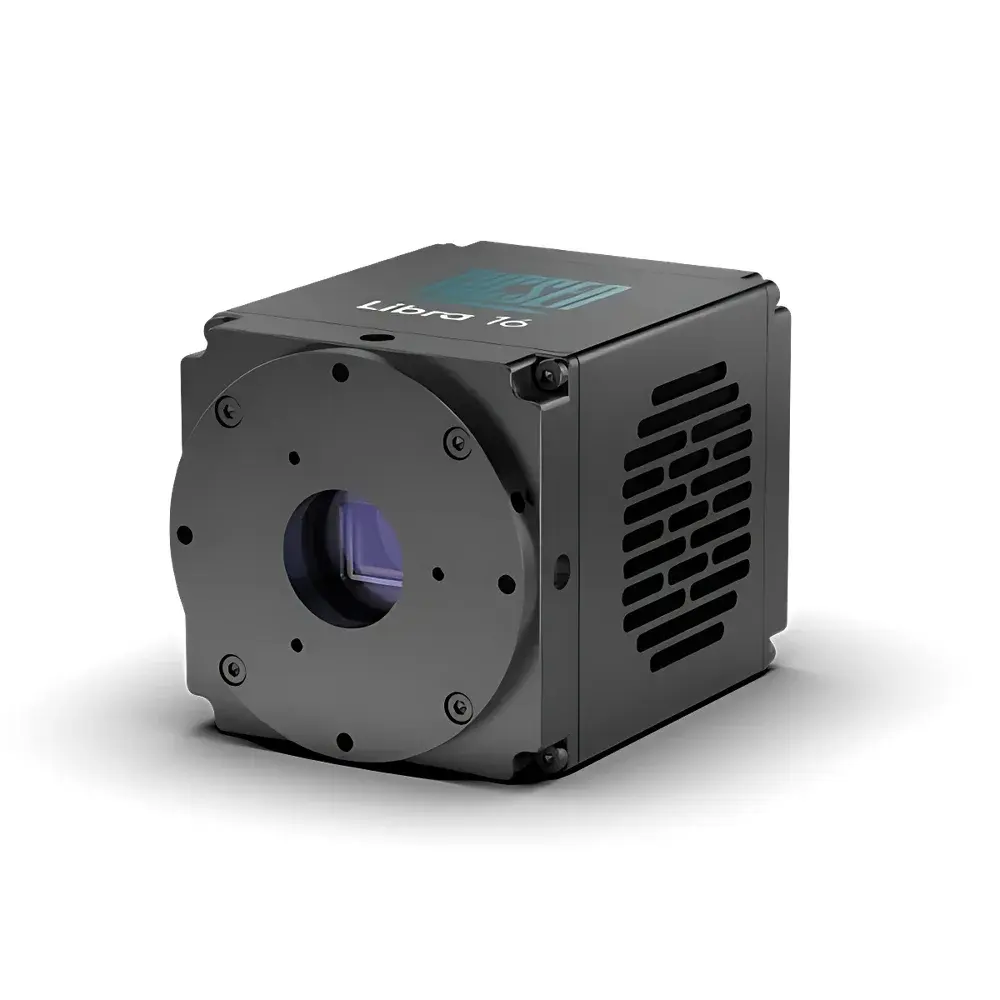
Tucsen Libra 22 Scientific CMOS Camera for Fluorescence Imaging, Tissue Slide Scanning, High-Throughput & Live-Cell Microscopy
| Brand | Tucsen |
|---|---|
| Origin | Fujian, China |
| Manufacturer Type | Original Equipment Manufacturer (OEM) |
| Regional Category | Domestic (PRC) |
| Model | Libra 22 |
| Pricing | Upon Request |
| Image Resolution | 4096 × 4096 |
| Pixel Size | 3.4 µm × 3.4 µm |
| Sensor Diagonal | 22 mm |
| Readout Speed | 6.5 fps @ High-Resolution Mode |
| Quantum Efficiency | 92% @ 530 nm |
Overview
The Tucsen Libra 22 is a high-performance back-illuminated scientific CMOS (sCMOS) camera engineered for quantitative fluorescence microscopy, whole-slide tissue imaging, time-lapse live-cell observation, and high-throughput screening applications. Built around the Sony IMX571BLR-J sensor—a 22 mm diagonal, 4096 × 4096 pixel BSI sCMOS device—the Libra 22 delivers exceptional photon detection efficiency and low-noise performance critical for demanding low-light biological imaging. Its optical design aligns precisely with standard fluorescence microscope field-of-view diameters (20–25 mm), minimizing vignetting and geometric distortion across wide-field acquisitions. The camera operates on a robust thermoelectric (TEC) cooling architecture, stabilizing sensor temperature to 0°C (ambient 26°C), thereby suppressing dark current (< 0.01 e⁻/pixel/s) and enabling long-exposure, high-fidelity signal capture without thermal noise accumulation.
Key Features
- Back-illuminated sCMOS sensor (Sony IMX571BLR-J) with 92% peak quantum efficiency at 530 nm—optimized for common fluorophores including FITC, GFP, and YFP.
- Ultra-low read noise of 1.0 e⁻ (high-gain mode) and 14-bit/16-bit selectable bit depth for dynamic range flexibility in both low-signal and high-intensity scenarios.
- Dual-pixel-binning modes (2×2, 3×3, 4×4) and programmable ROI support for adaptive spatial resolution and accelerated frame rates up to 37 fps in high-speed mode.
- TEC-based active cooling system maintaining stable sensor temperature at 0°C—critical for reproducible quantitative intensity measurements over extended acquisition periods.
- Flexible triggering interface (hardware/software) supporting global reset, exposure start/end, and TTL-compatible logic levels—enabling precise synchronization with motorized stages, light sources, and environmental control units.
- USB 3.0 interface with Hirose 12-pin connector ensures deterministic data transfer and power delivery (12 V / 6 A), compliant with industrial-grade reliability requirements.
Sample Compatibility & Compliance
The Libra 22 supports monochrome imaging only, eliminating chromatic interpolation artifacts and maximizing spatial fidelity for multi-channel fluorescence registration. Its 15.4 mm × 15.4 mm active area and C-mount optical interface ensure seamless integration with upright, inverted, and light-sheet microscopes from major OEMs—including Zeiss, Nikon, Olympus, and Leica—without requiring custom relay optics. The camera complies with CE, FCC, and RoHS directives. While not certified for clinical diagnostics under IEC 62304 or FDA 510(k), its hardware architecture and firmware logging capabilities support GLP/GMP-aligned workflows when deployed within validated laboratory information management systems (LIMS). Data provenance is preserved via timestamped metadata embedding (exposure time, gain, temperature, binning) in TIFF and HDF5 formats.
Software & Data Management
The Libra 22 is natively supported by Tucsen’s Mosaic 3.0 platform—a modular, open-architecture imaging suite incorporating real-time deconvolution, multi-dimensional stitching (Z-stack, tile scan, time-series), and batch-processing pipelines. Mosaic 3.0 provides full audit-trail functionality, including user login tracking, parameter change history, and exportable CSV logs—facilitating compliance with 21 CFR Part 11 requirements for electronic records and signatures. SDKs for C, C++, C#, LabVIEW, MATLAB, and Micro-Manager 2.0 enable deep integration into custom acquisition frameworks. All raw image data are stored in lossless formats with embedded EXIF-like metadata, ensuring traceability from acquisition to publication-level analysis.
Applications
- Quantitative fluorescence imaging: Single-molecule localization microscopy (SMLM), FRET, FLIM, and calcium imaging where photon budget and signal-to-noise ratio are limiting factors.
- Tissue slide scanning: Automated whole-slide digitization of IHC, IF, and H&E-stained sections at ×20–×40 magnification with sub-micron spatial sampling.
- Live-cell dynamics: Long-term time-lapse monitoring of mitosis, organelle trafficking, and cytoskeletal remodeling under physiological CO₂ and temperature control.
- High-throughput screening (HTS): Integration into automated microscopy platforms for phenotypic assays, compound library evaluation, and CRISPR screen validation.
- Neuroscience imaging: Wide-field calcium imaging in brain slices and organoids, leveraging high QE and low noise for detecting subtle ΔF/F transients.
FAQ
What is the maximum sustained frame rate at full resolution?
6.5 fps at 4096 × 4096 pixels in high-resolution mode; up to 37 fps in high-speed binning mode (2×2) with reduced FOV.
Does the camera support global shutter operation?
No—it uses a precision-controlled rolling shutter optimized for fluorescence applications; global reset functionality ensures temporal consistency across frames.
Is the Libra 22 compatible with Windows 11 and Linux distributions?
Yes—official drivers and SDKs are provided for Windows 10/11 (64-bit) and Ubuntu LTS (20.04+, kernel 5.4+).
Can the camera be used in vacuum or high-humidity environments?
It is rated for operation at 0–45°C and 0–95% non-condensing humidity; vacuum use is not supported due to TEC cooling dependency on ambient heat dissipation.
How is calibration data managed for quantitative intensity measurements?
Flat-field, dark-frame, and pixel-response non-uniformity (PRNU) corrections are applied in real time via Mosaic 3.0; calibration files are user-loadable and version-controlled within project archives.





