
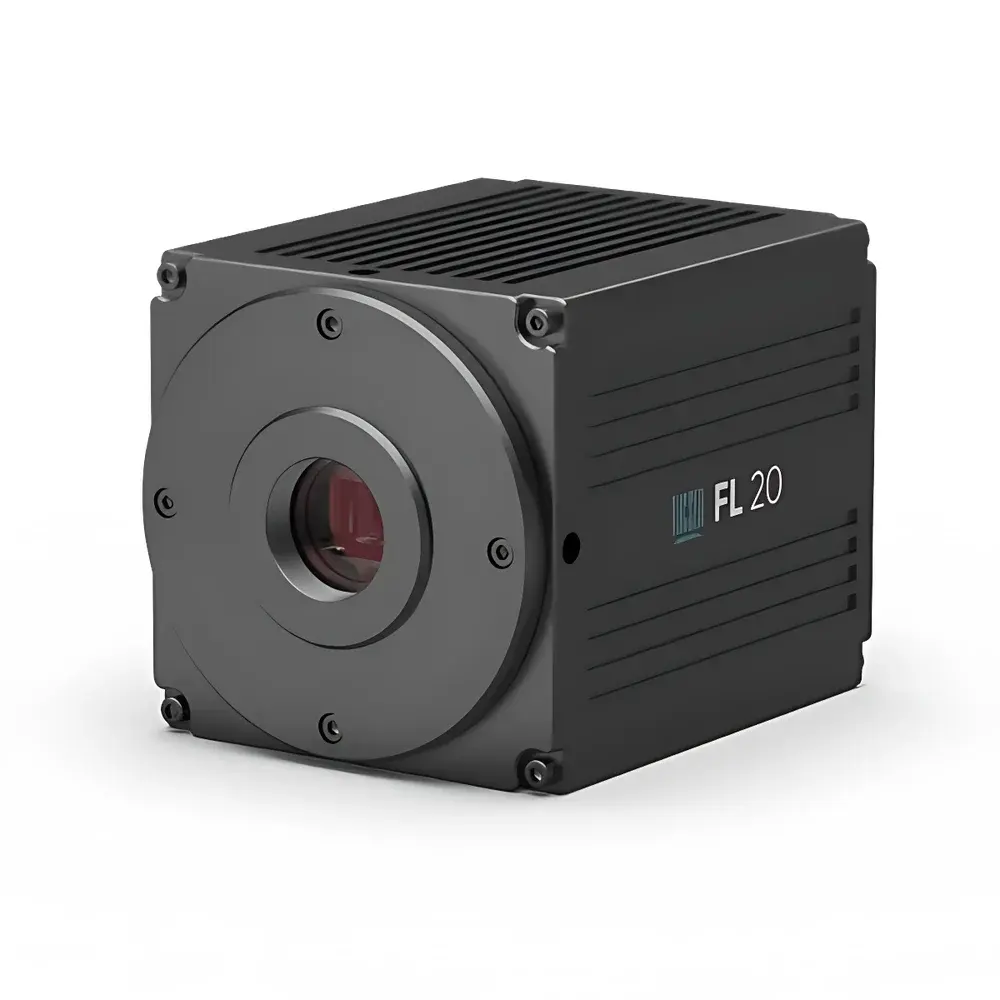
TUCSEN FL20 Fluorescence/Polarized Light/DIC Microscopy sCMOS Camera
| Brand | TUCSEN |
|---|---|
| Origin | Fujian, China |
| Manufacturer Type | OEM Manufacturer |
| Regional Category | Domestic (China) |
| Model | FL20 |
| Pricing | Upon Request |
| Image Resolution | 5472 (H) × 3648 (V), 20 MP |
| Pixel Size | 2.4 µm × 2.4 µm |
| Sensor Format | 13.1 mm × 8.8 mm (1″ diagonal) |
| Readout Speed | 14 fps @ 20 MP (8-bit) |
| Quantum Efficiency | 84% @ 535 nm |
| Dark Current | 0.001 e⁻/pixel/s |
| Read Noise | < 1 e⁻ |
| Bit Depth | 16-bit |
| Exposure Range | 18 µs – 3000 s (20 MP), down to 3 µs (re-binned modes) |
| Shutter Type | Rolling |
| Binning Options | 2×2, 3×3, 4×4 |
| Interface | USB 3.0 |
| Mount | C-mount |
| Operating Temp. | 0–40 °C |
| Storage Temp. | −10–60 °C |
| Dimensions | 85 mm × 85 mm × 109 mm |
| OS Support | Windows & Linux |
| SDK | C/C++/C#, DirectShow, TWAIN |
| Image Formats | TIFF, JPEG, PNG, DICOM |
Overview
The TUCSEN FL20 is a high-performance, scientific-grade sCMOS camera engineered specifically for multimodal optical microscopy applications—including fluorescence, polarized light, and Differential Interference Contrast (DIC). Built around the Sony IMX183CLK-J back-illuminated (BSI) CMOS sensor, the FL20 delivers 20 megapixels of resolution (5472 × 3648) across a 1-inch optical format (15.86 mm diagonal), enabling full-field coverage of standard microscope intermediate image planes without cropping or stitching. Its deep-cooled architecture—utilizing proprietary semiconductor thermoelectric cooling—maintains sensor temperature significantly below ambient, suppressing dark current to just 0.001 e⁻/pixel/s and ensuring exceptional signal-to-noise ratio (SNR) in low-light fluorescence imaging. With peak quantum efficiency of 84% at 535 nm—well-aligned with common FITC and GFP emission spectra—the FL20 provides superior photon capture efficiency critical for quantitative intensity measurements and time-lapse studies.
Key Features
- Back-illuminated 20 MP sCMOS sensor (Sony IMX183CLK-J) with 1″ optical format for optimal field-of-view matching in upright and inverted microscopes.
- Ultra-low read noise (< 1 e⁻ RMS) and sub-electron dark current enable high-fidelity acquisition in ultra-low-light conditions, including single-molecule fluorescence and live-cell imaging.
- Programmable exposure range from 3 µs to 3600 s—supporting both rapid kinetic imaging and long-exposure weak-signal detection across multiple binning modes (2×2, 3×3, 4×4).
- Real-time intelligent image processing engine embedded in firmware: includes dynamic background subtraction, flat-field correction, and real-time histogram stretching—accessible via one-click operation without compromising frame rate or metadata integrity.
- USB 3.0 interface ensures sustained 14 fps throughput at full 20 MP resolution (8-bit), with optional 16-bit mode for extended dynamic range in demanding quantitative workflows.
- Rugged, fanless mechanical design (85 × 85 × 109 mm) with passive heat dissipation and industrial-grade thermal regulation—validated for continuous operation in ISO Class 5–7 cleanroom environments and GLP-compliant laboratories.
Sample Compatibility & Compliance
The FL20 is fully compatible with all major microscope platforms supporting C-mount optical coupling—including Nikon Eclipse, Olympus BX/IX series, Zeiss Axio, and Leica DM series—enabling seamless integration into existing fluorescence, polarization, and DIC imaging pipelines. Its 16-bit linear output and calibrated gain/offset tables support traceable intensity quantification per ASTM E2717 and ISO 17025 requirements. The camera’s firmware and SDK comply with FDA 21 CFR Part 11 Annex 11 principles for audit trail logging, electronic signature support, and data integrity assurance—making it suitable for regulated QC/QA environments in pharmaceutical, biotech, and clinical research labs operating under GMP/GLP frameworks.
Software & Data Management
TUCSEN Mosaic software provides native acquisition, annotation, and batch export functionality with support for TIFF (uncompressed and LZW), JPEG, PNG, and DICOM formats—ensuring compatibility with PACS systems and third-party analysis tools (e.g., Fiji/ImageJ, HALO, Visiopharm). The cross-platform SDK (C/C++, C#, DirectShow, TWAIN) enables custom integration into LabVIEW, Python (via PyTUCSEN), MATLAB, and enterprise LIMS environments. Up to four FL20 units can be synchronized via hardware trigger or software timestamp alignment for multi-channel or multi-position acquisition. All acquired images retain embedded EXIF metadata—including exposure time, gain, temperature, and sensor ID—for reproducible experiment documentation and regulatory submission readiness.
Applications
- Quantitative fluorescence imaging of fixed and live specimens stained with DAPI, FITC, TRITC, Cy5, and other common fluorophores.
- Polarized light microscopy for crystallographic analysis, birefringence mapping in polymer films, mineral identification, and stress-induced anisotropy assessment.
- DIC contrast enhancement for label-free visualization of unstained cellular organelles, membrane dynamics, and microtubule networks in transparent biological samples.
- Time-lapse cytology and developmental biology studies requiring high spatial fidelity and temporal stability over hours or days.
- Materials science inspection—including thin-film uniformity, grain boundary characterization, and defect analysis in semiconductor wafers and photovoltaic substrates.
- Forensic document examination and archival digitization where color fidelity, geometric accuracy, and metadata traceability are mandated.
FAQ
Is the FL20 compatible with non-TUCSEN microscope systems?
Yes—the FL20 uses industry-standard C-mount optics and supports adjustable flange distance calibration; it integrates natively with Nikon, Olympus, Zeiss, Leica, and Thorlabs microscope stands.
Does the camera support hardware triggering and synchronization?
Yes—TTL-compatible input/output trigger ports allow precise external synchronization with shutters, light sources, or stage controllers for multi-modal or high-speed acquisition protocols.
Can I perform quantitative intensity measurements using the FL20?
Yes—factory-calibrated linearity (±0.5% deviation over full dynamic range), certified EMVA 1288 performance metrics, and 16-bit raw output ensure metrological traceability for pixel-value-based quantitation.
What operating systems are supported?
Native drivers and SDK libraries are provided for Windows 10/11 (x64) and Ubuntu LTS (20.04+, x64); ARM64 and macOS support available upon request via custom SDK build.
Is the FL20 suitable for regulated environments such as pharmaceutical QA?
Yes—full compliance with FDA 21 CFR Part 11 (audit trails, user authentication, data immutability), ISO 13485-aligned manufacturing, and documented validation packages are available under NDA for GxP deployment.




