
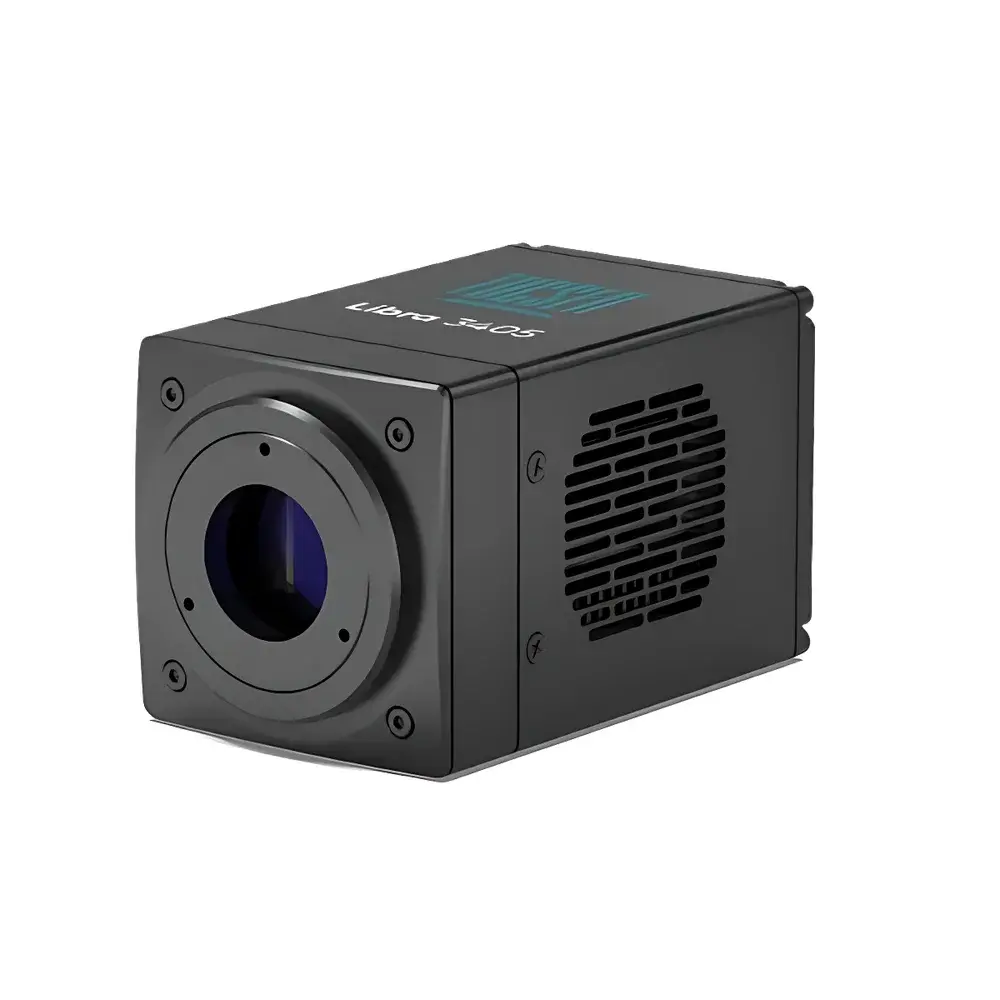
Tucsen Libra 3405C sCMOS Camera for Digital Pathology, Microscopy & Industrial Inspection
| Brand | Tucsen |
|---|---|
| Origin | Fujian, China |
| Manufacturer Type | OEM/ODM Manufacturer |
| Region of Origin | Domestic (China) |
| Model | Libra 3405C |
| Pricing | Upon Request |
| Image Resolution | 2856 (H) × 2848 (V) |
| Pixel Size | 3.4 µm × 3.4 µm |
| Readout Speed | 164 fps @ 8-bit |
| Sensor Type | FSI sCMOS (Color) |
| Sensor Model | Gpixel GMAX3405 |
| Diagonal Size | 10.9 mm (2/3″) |
| Active Area | 8.3 mm × 7.0 mm |
| Full-Well Capacity | 9 ke⁻ (High Well), 4.5 ke⁻ (Balanced), 0.7 ke⁻ (High Sensitivity) @ 12-bit |
| Read Noise | 3.7 e⁻ (High Well), 2.3 e⁻ (Balanced), 1.4 e⁻ (High Sensitivity) @ 12-bit |
| Shutter Type | Global Shutter |
| Exposure Range | 12.2 µs – 10 s |
| Cooling Method | Air-cooled (ΔT = −15°C below ambient at 25°C) |
| Dark Current | 0.5 e⁻/pix/s @ 10°C |
| Trigger Modes | Hardware / Software (Hirose 12-pin) |
| Interface | 10G GigE Vision |
| Bit Depth | 8-bit / 10-bit / 12-bit |
| Optical Mount | C-Mount |
| Power Supply | 12 V / 5 A |
| Power Consumption | 32 W |
| Dimensions | 60 mm × 60 mm × 100 mm |
| Weight | ~489 g |
| Operating Temperature | 0–40°C |
| Humidity | 10–85% RH (non-condensing) |
| Storage Temp. | −10–60°C |
Overview
The Tucsen Libra 3405C is a high-performance, color scientific CMOS camera engineered for demanding applications in digital pathology slide scanning, fluorescence and brightfield microscopy, and precision industrial inspection. Built around the Gpixel GMAX3405 front-side illuminated (FSI) sCMOS sensor, it delivers exceptional quantum efficiency across a broad spectral range—from 350 nm (UV-enhanced response) to 1100 nm (near-infrared)—enabling reliable multi-modal imaging without hardware switching. Its global shutter architecture eliminates motion-induced distortion, making it suitable for dynamic sample observation, high-speed stage scanning, and time-resolved acquisition in automated imaging platforms. The camera supports native 10GigE Vision compliance, offering sustained bandwidth up to 10 Gbps—more than three times the throughput of USB 3.0—ensuring minimal latency and deterministic frame delivery in synchronized multi-camera or real-time analysis systems.
Key Features
- Ultra-wide spectral sensitivity (350–1100 nm) with UV-enhanced quantum efficiency, optimized for both visible-light histopathology and NIR-compatible fluorescent probes.
- True global shutter operation with sub-millisecond exposure control (12.2 µs–10 s), preserving spatial fidelity during rapid stage movement or live-cell tracking.
- Native 10GigE Vision interface compliant with IEEE 802.3ae and EMVA 1288 standards; supports jumbo frames, packet resend, and precise timestamping for traceable acquisition workflows.
- On-camera AI-accelerated white balance and color correction engine—no host CPU load required—adapting dynamically to varying illumination spectra (e.g., halogen, LED, mercury/xenon arc) and correlated color temperature (CCT) shifts.
- Three programmable gain modes (High Well, Balanced, High Sensitivity) with calibrated full-well capacities and quantified read noise profiles per mode, enabling application-specific SNR optimization.
- Integrated FPGA-based binning (1×1, 2×2, 4×4), ROI selection, and defect pixel correction (DPC), reducing data volume without compromising downstream quantitative analysis integrity.
- Air-cooling system maintains sensor temperature at ≤10°C under ambient conditions of 25°C, suppressing dark current to <0.5 e⁻/pix/s and ensuring thermal stability over extended acquisitions.
Sample Compatibility & Compliance
The Libra 3405C is compatible with standard C-mount optical paths and integrates seamlessly into FDA-regulated digital pathology scanners (e.g., whole-slide imaging systems conforming to ISO 15189 and CAP checklist requirements). Its spectral response meets ASTM E308-22 spectral matching criteria for colorimetric reproducibility in diagnostic imaging. The camera’s deterministic triggering (hardware/software via Hirose-12 pin), frame-accurate timestamps, and non-volatile configuration storage support audit-ready operation under GLP/GMP environments. While not intrinsically certified, its GigE Vision protocol stack enables integration with FDA 21 CFR Part 11-compliant software platforms when deployed with appropriate electronic signature and audit trail layers.
Software & Data Management
The Libra 3405C is supported by Tucsen’s cross-platform SDK (C/C++, C#, Python) and third-party compatibility with Micro-Manager 2.0, MosaicV3, and SamplePro—enabling plug-and-play integration into open-source and commercial image acquisition pipelines. All firmware and calibration metadata (including sensor flat-field, DPC maps, and gain/offset tables) are embedded in the image header (GenICam-compliant XML), ensuring traceability across acquisition sessions. Raw 12-bit linear data output preserves dynamic range for quantitative intensity analysis (e.g., IHC scoring, particle brightness measurement), while on-device 8/10/12-bit depth selection allows bandwidth-constrained deployments without sacrificing bit-depth flexibility.
Applications
- Digital pathology: Whole-slide scanning at 20×–40× magnification with true-color fidelity for H&E, trichrome, and multiplex IHC/IF staining evaluation.
- Fluorescence microscopy: Simultaneous dual-channel acquisition (e.g., FITC/TRITC or DAPI/Cy5) leveraging high QE in blue-green and red-NIR bands.
- Industrial metrology: High-speed AOI (automated optical inspection) of PCB traces, semiconductor wafers, and micro-optical components using motion-free global shutter capture.
- Live-cell imaging: Time-lapse acquisition of mitotic events or calcium transients with minimal phototoxicity due to high photon detection efficiency and low read noise in High Sensitivity mode.
- Remote field instrumentation: Compact form factor (60 × 60 × 100 mm) and air-cooled design enable deployment in space-constrained enclosures or mobile lab carts.
FAQ
Does the Libra 3405C support GenICam-compliant parameter control?
Yes—it fully implements the GenICam SFNC (Standard Feature Naming Convention) specification, enabling standardized access to exposure, gain, ROI, trigger, and color processing parameters via any GenICam-compliant host application.
Is the AI white balance algorithm customizable or trainable by the user?
No—the model is pre-trained and fixed in firmware; however, users can disable AI correction and apply manual white balance or custom LUTs via the SDK.
Can the camera operate continuously at 164 fps without thermal throttling?
Yes—under ambient temperatures ≤30°C and with adequate airflow, the air-cooling system sustains stable sensor temperature and frame rate for >2 hours of uninterrupted acquisition.
What level of radiometric calibration is provided with the camera?
Each unit ships with factory-measured EMVA 1288-compliant linearity, uniformity, and absolute quantum efficiency data, accessible through the SDK and embedded in image metadata.
Is there hardware-level support for external synchronization with other instruments (e.g., lasers or shutters)?
Yes—the Hirose-12 pin connector provides dedicated lines for input trigger, exposure sync, readout strobe, and programmable TTL outputs, supporting tight timing coordination in multi-modal setups.




