
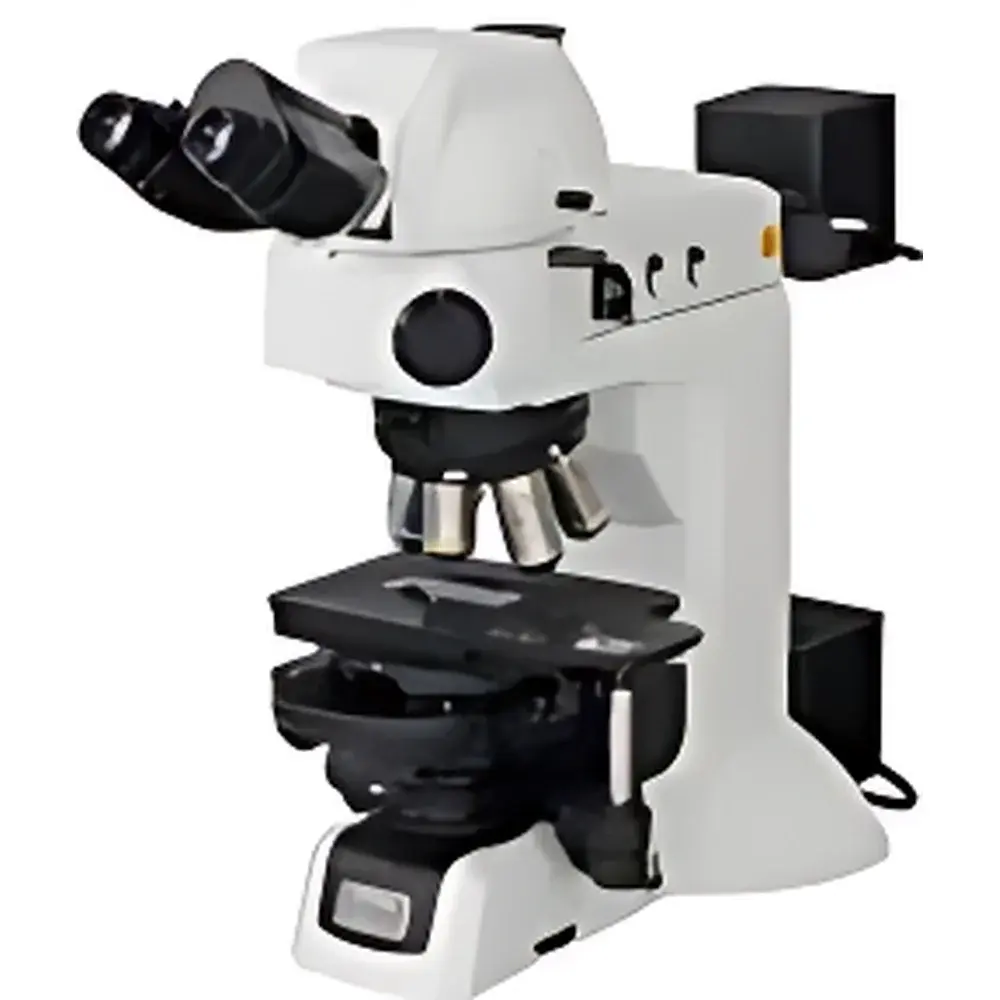
Nikon LV100N POL Polarizing Microscope
| Brand | Nikon |
|---|---|
| Origin | Japan |
| Model | LV100N POL |
| Optical System | CFI60 Infinity-Corrected |
| Illumination | 12V/50W Halogen with Köhler Illumination & Homogenizing Fly-Eye Lens |
| Polarization Components | Rotatable Analyzer (0.1° resolution), Focusing Bertrand Lens, Standard λ/4 Retardation Plate & Quartz Wedge, Optional Senarmont Compensator (0–1λ range) |
| Stage | Rotatable Circular Stage (360°, 1° scale, 45° detents), Mechanical Stage (35 × 25 mm travel), Optional High-Profile Stage for Thick Samples |
| Focus Travel | 30 mm with Upper-Limit Safety Stop |
| Compliance | RoHS-compliant lens elements (lead-free arsenic glass) |
| Software Compatibility | NIS-Elements AR/BR (image stitching, quantitative birefringence mapping, automated report generation) |
| Observation Modes | Transmitted Polarized Light, Reflected Polarized Light, Brightfield, Darkfield, DIC, Phase Contrast, Fluorescence, Interference Contrast |
Overview
The Nikon LV100N POL is a research-grade transmitted/reflected polarizing microscope engineered for high-fidelity birefringence analysis in materials science, geology, pharmaceutical development, and semiconductor process control. It operates on the fundamental principle of anisotropic light propagation—measuring phase retardation, optical axis orientation, and interference figure geometry in birefringent specimens under controlled linearly polarized illumination. Its CFI60 infinity-corrected optical architecture delivers diffraction-limited resolution across the full visible spectrum, minimizing chromatic and spherical aberrations essential for quantitative crystallographic characterization. The system integrates precision polarization optics—including a motorized or manually rotatable analyzer with 0.1° angular resolution—and supports both conoscopic and orthoscopic observation modalities, enabling rigorous determination of optic sign, extinction angles, and refractive index differentials in crystalline and polymeric media.
Key Features
- CFI60 infinity-corrected optical path with apochromatically corrected polarizing objectives (e.g., CFI P Achromat 4×–100× Oil), optimized for zero-strain mounting and minimal stress-induced birefringence in lens assemblies.
- 12V/50W halogen illumination with fly-eye homogenizer ensures uniform Köhler illumination across the entire field of view—delivering 20–40% higher effective brightness than conventional 100W sources while reducing thermal drift by >50%, critical for long-duration stress mapping and time-lapse birefringence studies.
- Dual-mode illumination capability via LV-UEPI-N universal epi-illumination turret, enabling seamless switching between transmitted polarized light (for thin sections, polymer films, liquid crystals) and reflected polarized light (for metallurgical samples, coated wafers, and opaque mineral surfaces).
- High-precision mechanical stage with 35 × 25 mm XY travel and detachable configuration; combined with a 360° rotatable circular stage (graduated at 1° intervals, with positive 45° indexing stops) for accurate azimuthal alignment of anisotropic domains.
- Focusing system features 30 mm vertical travel and upper-limit safety stop to prevent objective collision during rapid sample exchange—a key requirement in high-throughput QA/QC labs handling diverse specimen heights (e.g., rock thin sections, semiconductor packages, and 3D tissue scaffolds).
Sample Compatibility & Compliance
The LV100N POL accommodates standard 24 × 50 mm and 46 × 28 mm geological thin sections, as well as industrial substrates up to 40 mm in height when equipped with optional high-profile stages. Its modular condenser system—LV-CUD U-shaped universal dry condenser—supports brightfield, darkfield, DIC, and phase contrast in addition to polarized light, facilitating correlative multimodal analysis without reconfiguration. All optical components comply with EU RoHS Directive 2011/65/EU, utilizing lead-free arsenic glass in objective lenses to eliminate hazardous substance migration during extended thermal cycling. The system meets ASTM D4123 (standard test method for birefringence of plastics), ISO 10110-5 (specification for optical elements—stress birefringence), and USP (microscopic identification of pharmaceutical crystals), supporting GLP/GMP-aligned documentation workflows when paired with NIS-Elements BR software and FDA 21 CFR Part 11–compliant audit trail modules.
Software & Data Management
NIS-Elements AR/BR software provides native integration for quantitative polarized light microscopy. Key capabilities include real-time birefringence intensity mapping, automatic extinction angle measurement, interference figure centroid detection, and multi-channel spectral deconvolution for composite retardation analysis. Image stitching algorithms support mosaic acquisition over large-area geological slides (e.g., 100 × 75 mm petrographic mounts), while batch processing enables standardized reporting per ISO/IEC 17025 requirements. All metadata—including analyzer angle, compensator insertion status, objective magnification, and illumination intensity—is embedded in TIFF/OME-TIFF files for traceable data lineage. Export formats include CSV for statistical analysis in MATLAB or Python-based birefringence modeling pipelines.
Applications
- Materials Science: Quantitative assessment of molecular orientation in electrospun polymer fibers, residual stress distribution in tempered glass and OLED encapsulation layers, and domain alignment in ferroelectric thin films.
- Geosciences: Identification of mineral assemblages in petrographic thin sections (e.g., distinguishing plagioclase twins from quartz undulatory extinction), determination of optic sign in micas and amphiboles, and strain analysis in deformed metamorphic rocks.
- Pharmaceuticals: Polymorph screening of active pharmaceutical ingredients (APIs), detection of crystallinity loss in lyophilized formulations, and validation of chiral purity via optical rotation correlation.
- Semiconductor Manufacturing: Stress-induced birefringence mapping in SiO₂/SiNₓ dielectric stacks, defect localization in bonded wafer interfaces, and evaluation of photoresist anisotropy post-bake.
- Life Sciences: Visualization of collagen fiber alignment in decellularized ECM scaffolds, microtubule polarity in fixed neuronal cultures, and amyloid fibril chirality in ex vivo brain tissue sections.
FAQ
Does the LV100N POL support quantitative retardation measurement?
Yes—when used with the optional Senarmont compensator and NIS-Elements BR software, it enables calibrated retardation quantification from 0 to 1λ with sub-nanometer resolution based on analyzer rotation interpolation.
Can it be configured for both transmission and reflection polarized light simultaneously?
No—illumination mode is selected via the LV-UEPI-N turret; however, rapid manual switching (<5 seconds) between modes is supported without realignment.
Is the system compatible with third-party digital cameras?
Yes—via C-mount or Nikon’s proprietary F-mount interface, supporting scientific CMOS and sCMOS sensors with pixel size ≥3.45 µm and full-frame readout.
What is the maximum usable numerical aperture (NA) in polarized light mode?
Up to NA 0.95 with the CFI P Achromat 100× Oil objective, maintaining polarization fidelity through strain-free immersion lens design.
Does Nikon provide application-specific training for geological thin section analysis?
Yes—Nikon Metrology offers certified workshops aligned with IUGS petrographic standards, including hands-on sessions on interference figure interpretation and Michel-Levy chart correlation.




