
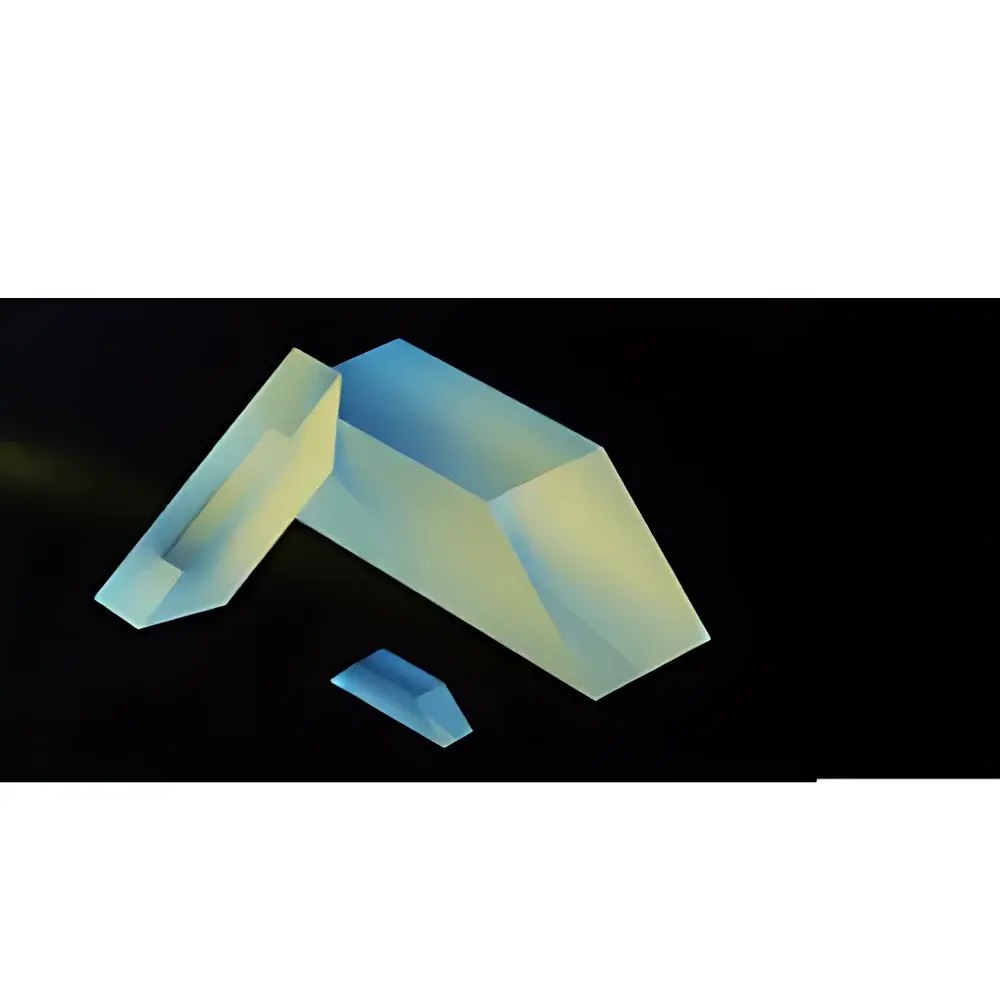
MiXran Meg1043 Dove Prism
| Brand | MiXran |
|---|---|
| Model | Meg1043 |
| Prism Type | Dove Prism |
| Material | Optical Grade BK7 Glass |
| Surface Quality | 60-40 Scratch-Dig |
| Surface Flatness | λ/4 @ 632.8 nm |
| Coating | Optional VIS AR Coating (400–700 nm, R<0.5% per surface) |
| Dimension Tolerance | ±0.1 mm |
| Angle Tolerance | ±1 arcmin |
| Clear Aperture | ≥90% of nominal dimension |
| Damage Threshold | >5 J/cm² @ 1064 nm, 10 ns, 10 Hz |
Overview
The MiXran Meg1043 Dove Prism is a precision optical component engineered for image rotation and beam steering in collimated light paths. Based on the principle of total internal reflection within a trapezoidal BK7 glass body, the Dove prism rotates an input image by twice the angular deviation of the prism itself—enabling continuous 360° image rotation without altering magnification or introducing axial displacement. Unlike retroreflectors or roof prisms, the Dove configuration preserves wavefront fidelity and polarization state when used with properly aligned, collimated illumination. Its compact geometry and symmetric design make it suitable for integration into laser alignment systems, interferometric setups, optical encoders, and rotating mirror alternatives in industrial metrology and academic optics laboratories.
Key Features
- Optically homogeneous BK7 substrate with refractive index nd = 1.5168 @ 587.6 nm and Abbe number νd = 64.2, ensuring minimal chromatic dispersion across the visible spectrum.
- Standard surface quality of 60-40 scratch-dig per MIL-PRF-13830B, verified via phase contrast microscopy and interferometric inspection.
- Surface flatness maintained at λ/4 @ 632.8 nm (HeNe wavelength), supporting high-precision applications requiring wavefront preservation.
- Optional broadband antireflection coating (VIS-AR) applied to both entrance and exit faces—optimized for 400–700 nm with average reflectance <0.5% per surface and residual absorption <0.1%.
- Tight mechanical tolerances: dimensional accuracy ±0.1 mm, apex angle tolerance ±1 arcminute, enabling repeatable mounting in kinematic or adjustable optomechanical mounts.
- Clear aperture exceeding 90% of nominal cross-section, minimizing vignetting in multi-element imaging trains.
Sample Compatibility & Compliance
The Meg1043 Dove Prism is compatible with standard 1-inch and 2-inch optical mounts (e.g., Thorlabs KM100, Newport U100 series) via custom adapter rings or direct integration into lens tubes. It operates effectively under ambient laboratory conditions (15–30°C, <60% RH) and exhibits no thermal birefringence up to 40°C. All units are manufactured and tested in accordance with ISO 10110-7 (surface imperfections) and ISO 10110-3 (surface form tolerances). While not certified for aerospace or medical device use, the prisms meet general-purpose optical component requirements outlined in ANSI/OEOSC OP1.002 and are traceable to NIST-calibrated interferometers used during final inspection.
Software & Data Management
As a passive optical element, the Meg1043 requires no firmware, drivers, or software integration. However, its performance parameters—including angular deviation vs. rotation angle, transmission spectra (with/without AR coating), and theoretical wavefront error—are documented in the accompanying technical datasheet (Rev. 2024-BK7-Dove-Meg1043). Users may import these specifications into optical design platforms such as Zemax OpticStudio or CODE V using provided .ZMX or .DAT files. Calibration reports include interferometric surface maps (wrapped and unwrapped phase data) and spectral transmittance curves measured on a PerkinElmer Lambda 1050+ UV/Vis/NIR spectrophotometer. All test records comply with GLP documentation standards and support audit-ready traceability for QA/QC workflows.
Applications
- Laser beam homogenization and rotary scanning in LIDAR calibration targets.
- Image rotation in Fourier plane filtering and spatial light modulation experiments.
- Compact alternative to motorized goniometers in polarization-sensitive ellipsometry systems.
- Alignment reference in multi-axis optical coordinate measurement machines (CMMs).
- Teaching modules for undergraduate optics labs covering ray tracing, image formation, and aberration analysis.
- Integration into OEM spectroscopic instruments where space-constrained, zero-magnification image rotation is required.
FAQ
What is the maximum input beam diameter supported by the Meg1043?
The clear aperture supports collimated beams up to 90% of the nominal prism width—e.g., 18 mm for the Meg1043-20 variant. Beam clipping occurs beyond this limit, inducing diffraction artifacts and reduced transmission uniformity.
Can the Meg1043 be used with pulsed lasers?
Yes—when coated with VIS-AR and operated within specified damage thresholds (>5 J/cm² @ 1064 nm, 10 ns pulse width), it is suitable for Q-switched Nd:YAG and Ti:sapphire oscillator outputs.
Is there a version available with UV or NIR coatings?
Custom coatings (e.g., MgF₂ for UV, SiO₂/Ta₂O₅ for NIR) are available upon request; lead time increases by 3–4 weeks and requires minimum order quantity of 5 units.
How does temperature affect rotational accuracy?
Thermal expansion of BK7 (α ≈ 7.1 × 10⁻⁶ /°C) induces negligible angular drift (<0.02° over 20°C range); active thermal stabilization is not required for most lab-grade applications.
Are mounting fixtures included?
No—prisms ship unmounted. Recommended mounting solutions include kinematic prism holders (e.g., Thorlabs PRM1Z8) or custom-machined aluminum cells with adjustable tip/tilt screws for fine alignment.





