
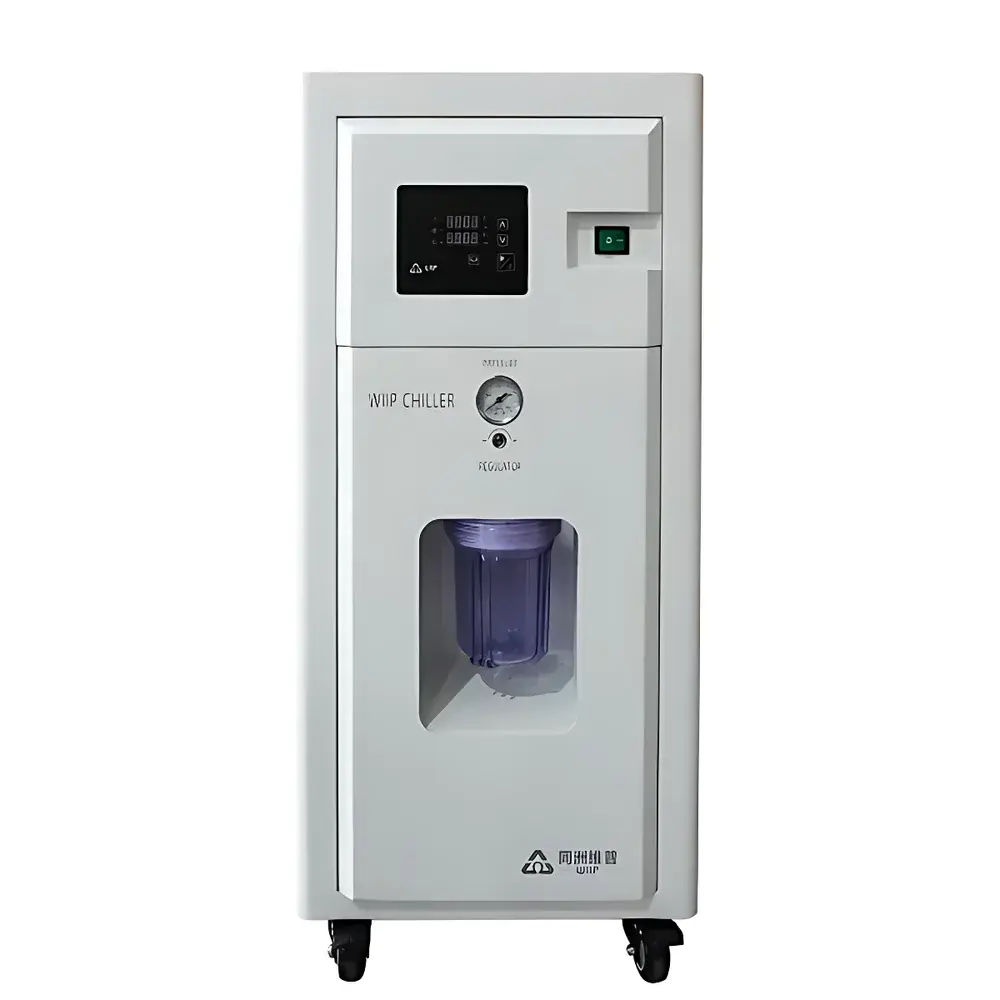
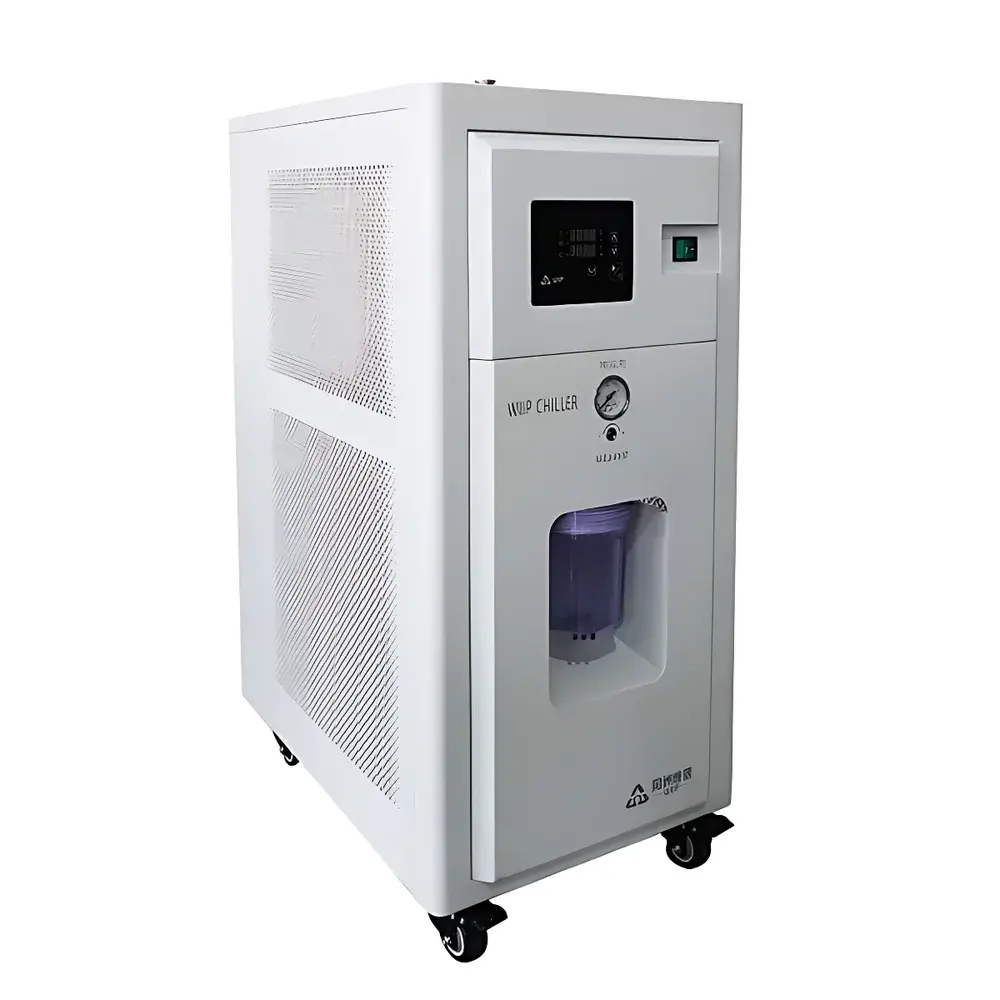
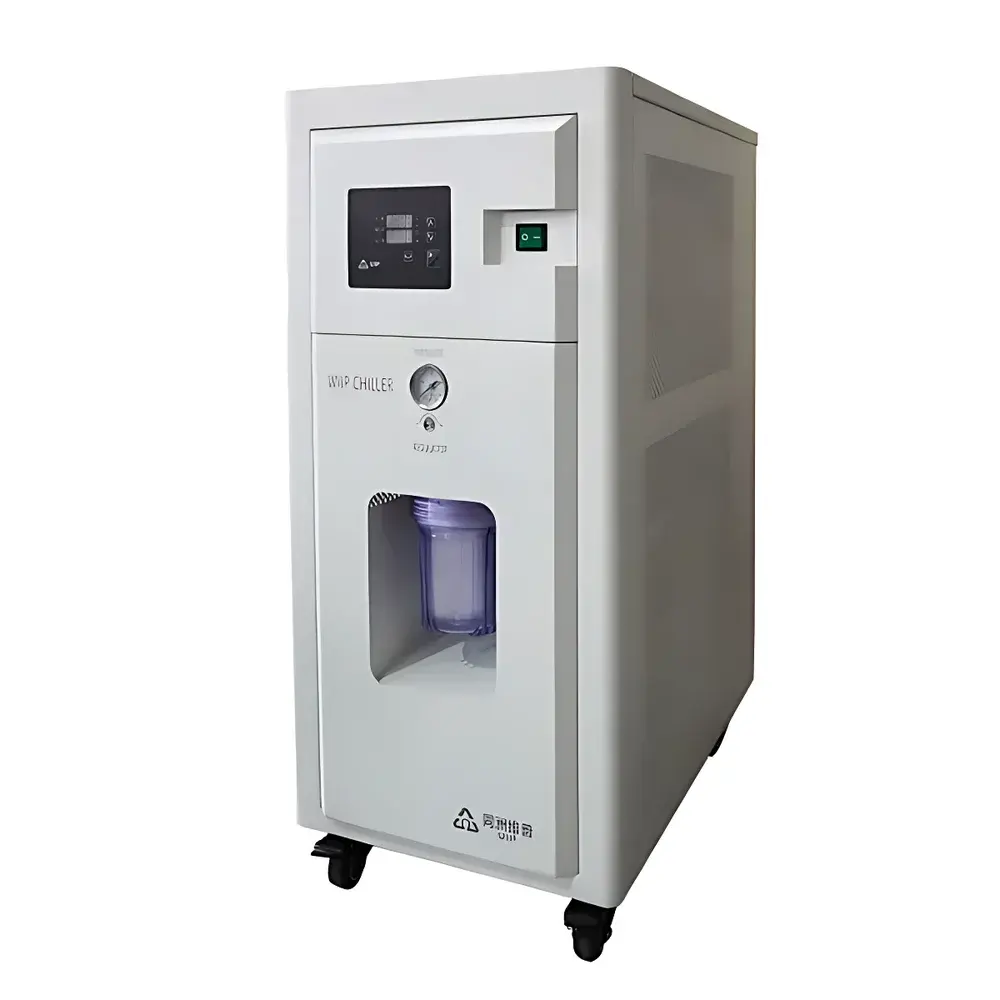
Tongzhou Weipu H2 Integrated Circulating Chiller for ICP Plasma Etching Systems
| Brand | Tongzhou Weipu |
|---|---|
| Origin | Beijing, China |
| Manufacturer Type | Direct Manufacturer |
| Regional Category | Domestic (China) |
| Model | H2 Integrated Circulating Chiller for ICP Plasma Etching |
| Instrument Type | Integrated (All-in-One) |
| Cooling Method | Water-Cooled |
| Temperature Control Range | −40 °C to 95 °C |
| Cooling Capacity | 1200–1400 W |
| Temperature Stability | ±0.1 °C to ±0.3 °C |
| Reservoir Volume | 2.5–8 L |
| Operating Principle | Phase-Change Refrigeration |
Overview
The Tongzhou Weipu H2 Integrated Circulating Chiller is an engineered thermal management solution specifically designed to maintain precise, stable coolant temperatures for high-precision laboratory instrumentation requiring continuous, low-noise, and contamination-free heat removal. It operates on a closed-loop phase-change refrigeration cycle—utilizing environmentally compliant refrigerants (R-410A or R-134a, depending on regional compliance requirements)—to deliver consistent cooling performance across a broad operational range from −40 °C to +95 °C. Unlike conventional air-cooled chillers, the H2 employs a water-cooled condenser architecture, enabling efficient heat rejection in confined laboratory environments where ambient airflow is restricted or acoustic constraints are stringent. Its primary application domain includes thermal stabilization of plasma-based analytical and fabrication systems—particularly inductively coupled plasma (ICP) etching tools, ICP-OES and ICP-MS spectrometers, RF generators, and high-power RF matching networks—where even transient thermal drift can compromise process repeatability, plasma impedance stability, and etch rate uniformity.
Key Features
- Integrated all-in-one design with compact vertical footprint—optimized for under-bench or adjacent placement beside ICP etch chambers, mass spectrometers, or laser sources.
- Low-speed, large-diameter axial fan combined with vibration-damped compressor mounting to achieve acoustic emissions below 52 dBA at 1 m—critical for quiet lab environments and noise-sensitive applications such as electron microscopy or ultra-low-vibration optical setups.
- Multi-stage fluid conditioning system: includes integrated particulate filter (5 µm nominal), activated carbon cartridge for organic contaminant removal, and optional deionization module for resistivity >1 MΩ·cm—ensuring coolant purity compatible with sealed recirculation loops in ICP torches and RF coil cooling jackets.
- Dual-sensor temperature feedback loop with PID-controlled expansion valve modulation—enabling ±0.1 °C stability over extended operation (>8 h), verified per ASTM E2234 calibration protocol.
- CE-marked enclosure with universal voltage input (100–240 VAC, 50/60 Hz), conforming to EN 61000-6-3 (EMC emission) and EN 61000-6-2 (immunity) standards; supports global deployment without hardware modification.
- Real-time monitoring of critical parameters—including refrigerant pressure (high/low side), flow rate (0.5–8 L/min), reservoir level, and coolant conductivity—via embedded LCD interface with configurable alarm thresholds and relay outputs for interlock integration with host instruments.
Sample Compatibility & Compliance
The H2 chiller is validated for continuous-duty operation with instruments demanding thermally stable coolant delivery at flow rates between 1.2 and 6.5 L/min and pressure differentials up to 3.5 bar. It meets ISO 17025-relevant environmental control requirements for accredited testing laboratories when deployed with traceable NIST-traceable temperature sensors (optional). The unit complies with RoHS 2011/65/EU and REACH SVHC regulations regarding hazardous substances. For regulated environments—including GLP-compliant QC labs and GMP-aligned semiconductor R&D facilities—the H2 supports optional audit-ready data logging (CSV export via USB) and configurable event-triggered alarms aligned with FDA 21 CFR Part 11 electronic record principles (user authentication, time-stamped action logs, and non-erasable history).
Software & Data Management
While the H2 operates autonomously via its front-panel interface, optional RS485 Modbus RTU or Ethernet TCP/IP communication enables integration into centralized facility monitoring systems (e.g., LabVantage, Siemens Desigo, or custom SCADA platforms). Firmware v3.2+ supports programmable setpoint ramps, scheduled temperature profiles, and remote status interrogation. All operational logs—including temperature deviation events, flow interruption alerts, and filter life estimation—are timestamped and stored onboard for ≥30 days. Data export is performed via removable microSD card or direct USB connection; no proprietary software installation is required for basic configuration or diagnostics.
Applications
- Thermal stabilization of ICP plasma sources during reactive ion etching (RIE) and deep reactive ion etching (DRIE) processes—preventing RF impedance shift and maintaining consistent ion energy distribution.
- Cooling of high-power RF generators (13.56 MHz or 27.12 MHz) and impedance-matching networks in vacuum chamber systems.
- Temperature-controlled circulation for AAS graphite furnace coolers, ICP-MS nebulizer gas chillers, and laser ablation sample cells.
- Support for cryogenic sample preparation stages in SEM/FIB workstations and glovebox-integrated deposition systems.
- Process-critical cooling in automated Kjeldahl digestion modules and high-throughput elemental analyzers where thermal consistency directly impacts nitrogen recovery accuracy.
FAQ
What is the recommended coolant type for use with the H2 chiller in ICP etch applications?
Deionized water (resistivity ≥5 MΩ·cm) or 30% ethylene glycol/water mixture (for sub-zero operation); glycol content must not exceed 35% to maintain optimal heat transfer coefficient and avoid pump cavitation.
Does the H2 support external temperature sensor feedback for instrument-coupled control?
Yes—via optional PT100 input (2-wire or 4-wire) with configurable setpoint offset; enables cascade control where the chiller maintains temperature at the instrument’s critical junction rather than at the chiller outlet.
Can the H2 be integrated into a building management system (BMS)?
Yes—through Modbus RTU over RS485 (standard) or BACnet/IP (firmware upgrade required); full register map and BMS integration guide available upon request.
Is maintenance training provided for laboratory technical staff?
Comprehensive operator and preventive maintenance documentation is included; on-site or virtual technician certification workshops are available through Tongzhou Weipu’s international service network.
How is refrigerant charge verified during factory acceptance testing?
Each unit undergoes vacuum integrity verification (<10⁻³ mbar), precision refrigerant weighing (±2 g tolerance), and 72-hour thermal load validation at three setpoints (−20 °C, 25 °C, 80 °C) prior to shipment.



