
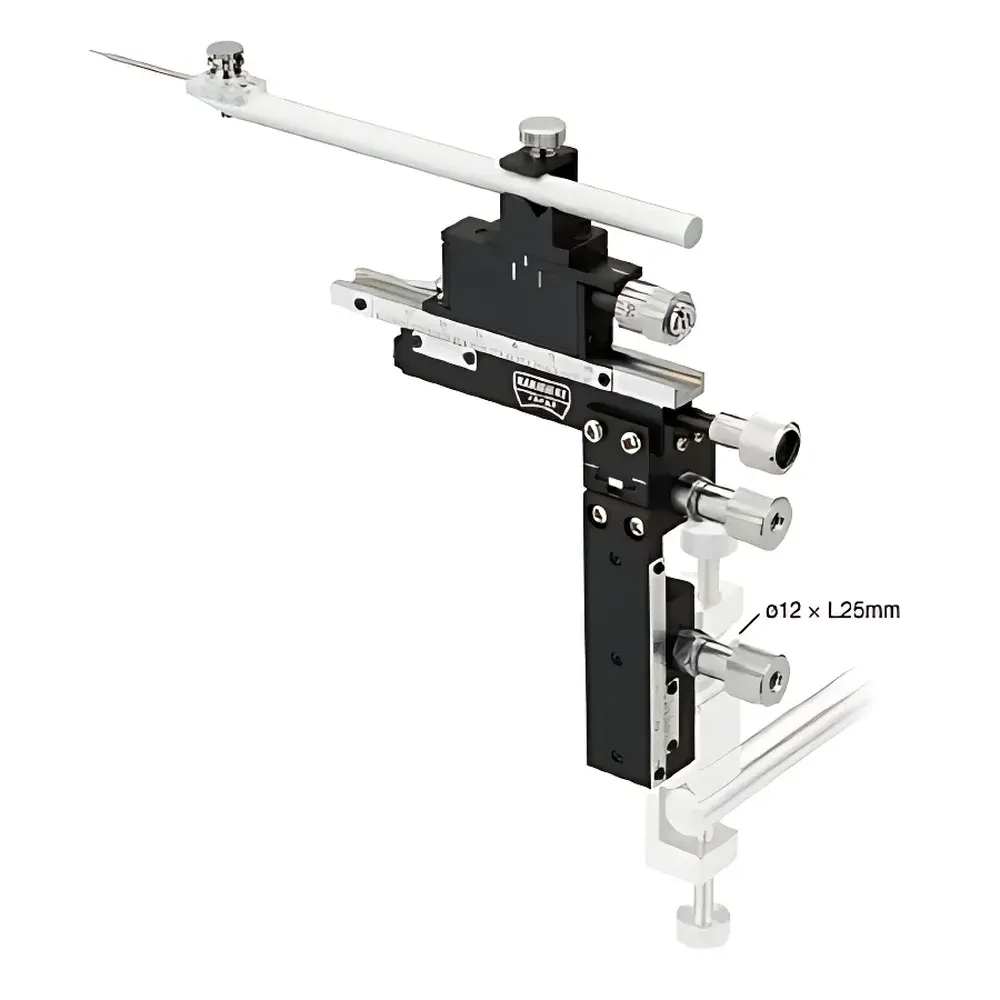
NARISHIGE M-3333 Micromanipulator
| Brand | NARISHIGE |
|---|---|
| Origin | Japan |
| Model | M-3333 |
| Coarse Travel (X/Y/Z) | 40 mm / 12 mm / 30 mm |
| Fine Travel (X) | 7 mm |
| Fine Adjustment Resolution | 10 µm per division |
| Full Rotation Displacement (X-axis knob) | 250 µm |
| Dimensions (W×D×H) | 126 × 43 × 145 mm |
| Weight | 340 g |
| Included Accessories | H-13 Electrode Holder, Universal Wrench |
Overview
The NARISHIGE M-3333 Micromanipulator is a precision mechanical positioning system engineered for high-fidelity microscale manipulation in electrophysiology, patch-clamp recording, microinjection, and single-cell probing applications. Designed using NARISHIGE’s decades-long expertise in microinstrumentation for life science research, the M-3333 operates on a dual-range kinematic architecture—integrating coarse translational movement for rapid target acquisition and fine-threaded micrometer drives for sub-micron positional control. Its compact, low-profile chassis (126 × 43 × 145 mm) enables seamless integration into inverted microscope stages, stereotaxic rigs, and multi-electrode recording setups without obstructing optical paths or limiting access to sample chambers. The device features orthogonal X-Y-Z motion axes with independently optimized travel ranges and resolution characteristics, ensuring both operational efficiency and experimental repeatability across diverse laboratory environments.
Key Features
- Dual-stage motion control: Coarse adjustment provides rapid positioning (X: ±20 mm, Y: ±6 mm, Z: ±15 mm from center), while fine adjustment delivers precise, backlash-minimized translation (X: ±3.5 mm) via a calibrated 250 µm/revolution micrometer screw with 10 µm graduation marks.
- Ultra-slim profile (43 mm depth) facilitates simultaneous deployment of multiple manipulators on confined microscope stages—critical for dual-patch, multi-electrode array (MEA), or optogenetic stimulation experiments.
- Unidirectional handle layout ensures ergonomic consistency during extended use; all control knobs align along the same lateral plane, reducing hand repositioning and operator fatigue.
- Modular compatibility: Accepts optional accessories including the X-4 Rotational X-block for angular alignment of electrode arrays, and single-axis fine-motion units (e.g., MO-202 series) for enhanced Z-axis approach control during delicate cell membrane contact.
- Robust aluminum alloy construction with precision-ground brass bushings ensures long-term dimensional stability and minimal thermal drift under continuous operation.
Sample Compatibility & Compliance
The M-3333 is compatible with standard glass micropipettes (1.0–1.5 mm OD), metal microelectrodes, fiber optic probes, and silicon-based neural probes. Its H-13 electrode holder accommodates pipettes secured via O-ring compression, supporting both rigid and flexible shank configurations. While the manipulator itself is a mechanical positioning tool and not a regulated medical device, its design adheres to general laboratory equipment safety standards (IEC 61010-1). When integrated into GLP- or GMP-compliant electrophysiology workflows—such as neuropharmacological screening or cardiac ion channel characterization—the M-3333 supports traceable manual positioning protocols. It is routinely deployed in laboratories conducting studies aligned with ISO/IEC 17025-accredited testing frameworks and referenced in peer-reviewed methodology sections for patch-clamp experiments compliant with NIH and EMBO reporting guidelines.
Software & Data Management
As a fully manual, non-motorized instrument, the M-3333 does not incorporate embedded electronics, firmware, or digital interfaces. Positional data are recorded manually or synchronized externally via stage encoders, camera-based tracking systems (e.g., using MATLAB or Python-based image analysis pipelines), or third-party motorized controller platforms (e.g., Sutter MP-285 or Scientifica PatchStar). For audit-trail requirements under FDA 21 CFR Part 11, users integrate the M-3333 into documented SOPs where positional settings, electrode type, and calibration logs are maintained in laboratory notebooks or ELN systems. NARISHIGE provides comprehensive mechanical calibration documentation and maintenance schematics upon request to support internal QA/QC validation.
Applications
- Whole-cell and perforated-patch clamp recordings in primary neuronal cultures, brain slices, and stem-cell-derived cardiomyocytes.
- Microinjection of plasmids, CRISPR-Cas9 ribonucleoproteins, or dyes into oocytes, zebrafish embryos, or C. elegans gonads.
- Targeted ablation or stimulation using infrared laser-coupled electrodes or carbon-fiber microstimulators.
- Alignment and positioning of microfluidic probes in organ-on-chip platforms requiring micron-level spatial registration.
- Manual calibration and alignment of AFM cantilevers or scanning ion-conductance microscopy (SICM) pipettes.
FAQ
Is the M-3333 compatible with vibration isolation tables?
Yes—the low mass (340 g) and rigid base design minimize resonance coupling, enabling stable operation on passive and active vibration isolation platforms commonly used in single-channel recording labs.
Can the M-3333 be mounted vertically or inverted?
It is designed for horizontal mounting on standard microscope stages; vertical or inverted orientation is not recommended due to gravity-induced drift in the fine-adjustment mechanism.
Does NARISHIGE provide calibration certificates for the M-3333?
While no factory-issued metrology certificate is included, NARISHIGE supplies detailed mechanical calibration procedures and tolerance specifications in the user manual, supporting in-house verification per ISO/IEC 17025 Clause 6.5.
What is the maximum electrode weight supported by the H-13 holder?
The H-13 holder is rated for electrodes up to 5 g; heavier probes require supplemental support brackets or alternative holders such as the H-102 series.
Is the M-3333 suitable for cryo-EM sample preparation workflows?
No—it is not rated for cryogenic temperatures or vacuum environments; for cryo-workflows, NARISHIGE recommends the MM-189 series with stainless-steel construction and low-outgassing materials.



