
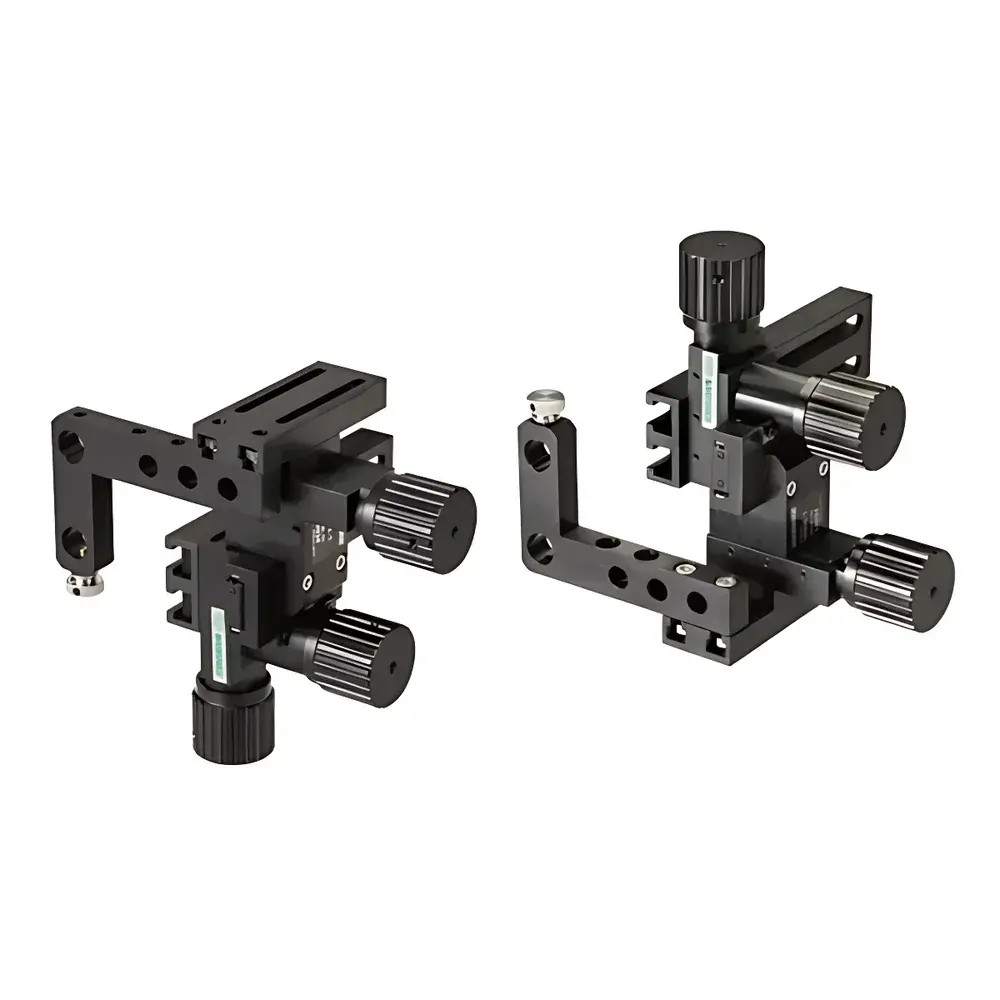
Narishige MMN-1 Coarse Manipulator
| Brand | Narishige |
|---|---|
| Origin | Japan |
| Model | MMN-1 |
| Coarse Adjustment Range (X/Y/Z) | 30 mm each axis |
| Dimensions (W × D × H) | 130 × 130 × 118 mm |
| Weight | 530 g |
| Accessories | Universal Wrench, Lead Screw Assembly |
| Manufacturer Type | Authorized Distributor (Imported Equipment) |
Overview
The Narishige MMN-1 Coarse Manipulator is a precision-engineered mechanical positioning device designed for integration into micromanipulation workflows in life science laboratories, electrophysiology rigs, and microinjection platforms. It operates on a robust lead-screw translation principle—providing smooth, backlash-minimized linear motion across three orthogonal axes (X, Y, Z) with manual coarse adjustment only. Unlike motorized or piezo-driven systems, the MMN-1 delivers high mechanical stability and zero electronic interference, making it ideal for applications where electromagnetic compatibility, vibration isolation, and long-term positional retention are critical—such as patch-clamp setups, intracellular electrode placement, or embryo micromanipulation under inverted microscopy. Its compact footprint and rigid aluminum alloy housing ensure compatibility with standard microscope stages and vibration-damped optical tables without compromising structural integrity.
Key Features
- Three-axis coarse positioning (X/Y/Z) with 30 mm travel per axis, enabling rapid macro-positioning prior to fine adjustment via complementary fine-manipulators (e.g., Narishige MO-202 or MN-401)
- High-rigidity monolithic base and precision-machined lead screws engineered for minimal hysteresis and consistent repeatability over extended use cycles
- Ergonomic dual-knob control system with tactile feedback and calibrated scale markings for intuitive, fatigue-resistant manual operation
- Compact dimensions (130 × 130 × 118 mm) and lightweight design (530 g) facilitate seamless mounting on modular microscope stages, custom rigs, or multi-manipulator arrays
- Non-magnetic construction compatible with magnetic resonance-compatible environments and sensitive electromagnetic measurement setups
- Tool-free assembly/disassembly of mounting brackets and interchangeable adapters for standardized stage interfaces (e.g., 3/8″-16 UNC, M4, or custom dovetail rails)
Sample Compatibility & Compliance
The MMN-1 is not a sample-contacting analytical instrument but a mechanical positioning platform; therefore, it imposes no intrinsic limitations on specimen type, size, or medium. It is routinely deployed in conjunction with glass micropipettes (0.5–2.0 µm tip diameter), tungsten or platinum-iridium electrodes, microinjection needles, and optical fibers. Its mechanical design conforms to ISO 9001-certified manufacturing practices at Narishige’s Tokyo facility. While the device itself does not require regulatory certification, its use in GLP-compliant electrophysiology or reproductive biology labs aligns with institutional SOPs governing equipment traceability, calibration frequency (recommended annually), and maintenance logs—particularly when integrated into FDA-regulated preclinical research workflows (e.g., USP on micromanipulation validation).
Software & Data Management
The MMN-1 is a purely manual, analog positioning device with no embedded electronics, firmware, or digital interface. Consequently, it generates no telemetry data, requires no driver installation, and introduces zero software dependency or cybersecurity surface area. This architecture ensures deterministic behavior and eliminates latency, synchronization errors, or version-compatibility issues common in digitally controlled manipulators. All positional adjustments are directly observable and verifiable through mechanical scale indicators and optical alignment references—supporting audit-ready documentation in regulated environments where 21 CFR Part 11 compliance mandates full traceability of physical actuation events. Calibration certificates and metrology reports (e.g., NIST-traceable dial indicator verification) may be provided upon request for quality assurance records.
Applications
- Pre-positioning of patch-clamp pipettes prior to gigaseal formation in whole-cell recordings
- Rapid relocation of intracellular recording electrodes across multiple neurons in acute brain slice preparations
- Coarse alignment of microinjection needles during zebrafish or mouse oocyte manipulation
- Staging support for laser capture microdissection (LCM) systems requiring stable XY repositioning between tissue sections
- Integration into dual-patch or multi-electrode array (MEA) rigs where electromagnetic silence and thermal drift stability are prioritized over automated motion
- Teaching laboratories for foundational micromanipulation training—emphasizing kinesthetic control, spatial awareness, and manual dexterity development
FAQ
Is the MMN-1 compatible with inverted microscopes from Nikon, Olympus, or Zeiss?
Yes—the MMN-1 features universal mounting options including 3/8″-16 UNC threaded holes and optional adapter plates for standard microscope stage rails (e.g., Zeiss Standard Stage, Olympus IX series).
Can the MMN-1 be used alongside fine manipulators like the Narishige MN-401?
Yes—it is specifically designed for tandem deployment: the MMN-1 handles macro-positioning (±30 mm), while fine manipulators provide sub-micron resolution (±1 µm) for final targeting.
Does the MMN-1 require periodic recalibration?
No internal calibration is required; however, annual verification of travel linearity and zero-reference consistency using a calibrated dial indicator is recommended for ISO/IEC 17025-aligned labs.
Is technical support available outside Japan?
Yes—authorized Narishige distributors in North America, EMEA, and APAC provide local application engineering support, spare parts logistics, and repair services under global warranty terms.
What materials are used in the MMN-1’s structural components?
Primary frame and lead-screw housings are machined from anodized aluminum alloy (A6061-T6); knobs and fasteners are stainless steel (SUS304) for corrosion resistance and dimensional stability.
Related Products



