
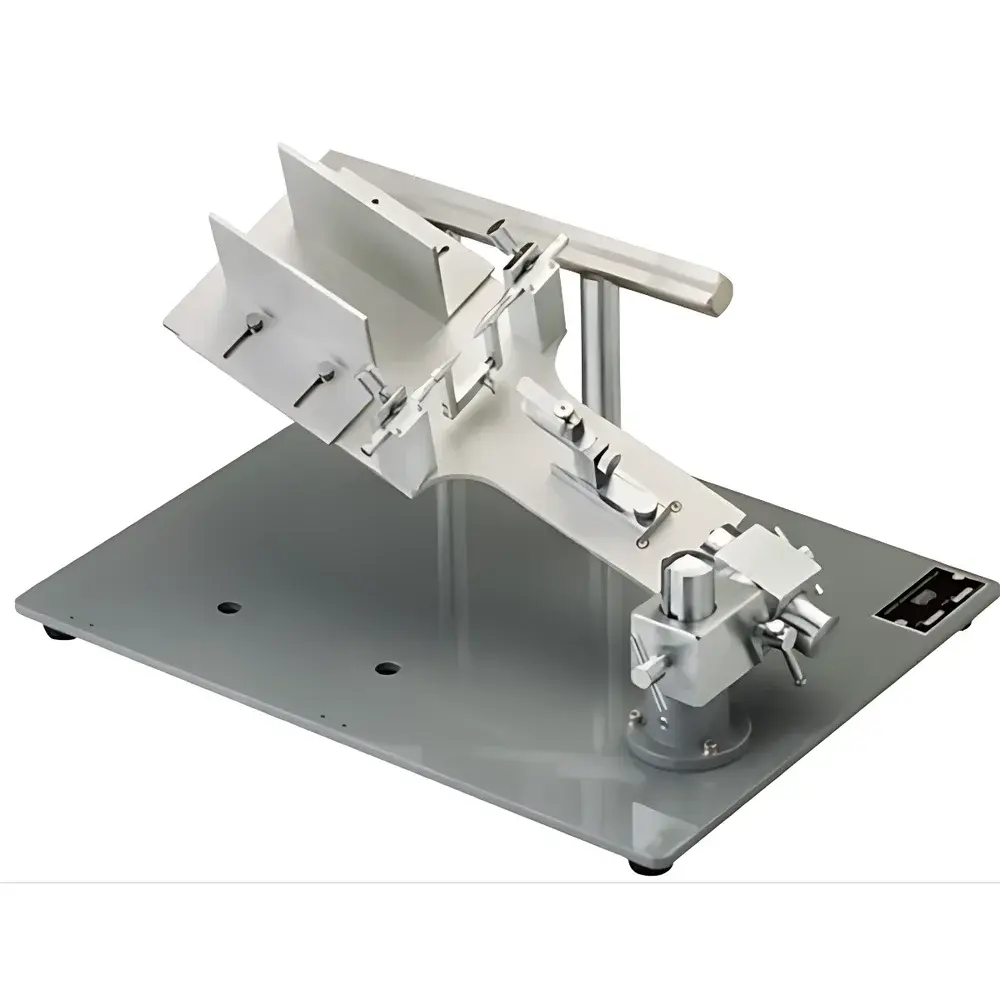
Narishige SR-50R-HT Stereotaxic Instrument for Rats
| Brand | Narishige (NARISHIGE) |
|---|---|
| Origin | Japan |
| Model | SR-50R-HT |
| Construction Material | Aerospace-grade aluminum alloy |
| Base Dimensions | 400 × 300 × 150 mm (W×D×H) |
| Total Weight | 10.4 kg |
| X/Y/Z Coarse Travel Range | ±25 mm |
| Micrometer Resolution | 0.1 mm |
| Tilt Adjustment Range | ±45° (pitch and roll) |
| Head Fixation | Three-point system (dual ear bars + nose clamp) |
| Biocompatible Components | Medical-grade POM per ISO 10993 |
| Sterilization Compatibility | Autoclavable at 121°C for 20 min |
| Standard AP Frame Bar | 18.7 mm square cross-section |
| Compatible Microdrive | SM-15R (Narishige) |
| Software Integration | HCC-Control Pro (optional automation interface) |
Overview
The Narishige SR-50R-HT Stereotaxic Instrument for Rats is a precision mechanical platform engineered for reproducible, high-fidelity intracranial interventions in rodent neuroscience. Designed specifically for adult rat models (typically 250–500 g), it implements classical stereotaxic methodology grounded in the Paxinos & Watson coordinate system, enabling accurate targeting of subcortical and cortical structures—including hippocampus, amygdala, nucleus accumbens, striatum, entorhinal cortex, and auditory cortex—via calibrated three-dimensional spatial referencing. Its fully manual, non-electronic architecture eliminates electromagnetic interference, making it suitable for concurrent electrophysiological recording, optogenetic stimulation, and fMRI-compatible preparations where signal integrity is paramount. The instrument’s rigid aerospace-grade aluminum frame and low center-of-gravity base (400 × 300 × 150 mm; 10.4 kg) ensure minimal vibration transmission during microinjection, electrode insertion, or chronic implantation procedures.
Key Features
- Precision 3-axis mechanical positioning with ±25 mm coarse travel and 0.1 mm micrometer resolution on all X, Y, and Z axes—enabling sub-millimeter targeting accuracy under standard surgical conditions.
- Independent dual-axis tilt mechanism (±45° pitch and roll) for oblique approach angles, facilitating access to laterally positioned or deep-seated targets without skull resection or craniotomy angle compromise.
- Three-point head fixation system comprising EB-3A primary ear bars and EB-4N auxiliary ear bars, combined with an adjustable nose clamp—providing stable, repeatable immobilization across multi-session chronic experiments.
- Modular 18.7 mm square AP frame bar compatible with Narishige SM-15R micromanipulators and third-party microdrives, allowing synchronized control of electrodes, glass pipettes, cannulae, or optical fibers.
- Biocompatible contact surfaces fabricated from medical-grade polyoxymethylene (POM), certified to ISO 10993-1 for cytotoxicity, sensitization, and intracutaneous reactivity—validated for direct in vivo use.
- Autoclavable components (ear bars, nose clamp, adapters) rated for repeated sterilization at 121°C / 20 min, supporting GLP-compliant longitudinal studies requiring strict biosafety protocols.
Sample Compatibility & Compliance
The SR-50R-HT accommodates standard adult Sprague-Dawley and Wistar rats, as well as transgenic lines within typical weight ranges. Skull flatness alignment is achieved via standardized bregma–lambda leveling using the integrated leveling screws and digital caliper interface. All structural and material specifications conform to ISO 13485 design control principles for research-grade neurosurgical instrumentation. While not a medical device per FDA 21 CFR Part 820, its biocompatibility profile meets preclinical regulatory expectations for IACUC-approved protocols and supports audit readiness for GLP/GCP-aligned CNS drug development workflows. Documentation includes material traceability certificates and sterilization validation guidelines.
Software & Data Management
The SR-50R-HT operates independently of embedded electronics; however, it integrates seamlessly with Narishige’s HCC-Control Pro software suite via optional encoder-based add-ons (e.g., motorized Z-stage upgrades). When paired, the system enables automated depth logging, injection volume tracking, coordinate recall, and experimental sequence scripting—fully compliant with ALCOA+ data integrity principles. Audit trails, electronic signatures, and user-access controls align with FDA 21 CFR Part 11 requirements for regulated pharmacology studies. Raw coordinate data exports to CSV or MATLAB-compatible formats for downstream statistical mapping in tools such as BrainRAT or QuickNII.
Applications
- Neural circuit mapping: Stereotactic delivery of AAV vectors, retrograde tracers, or Cre-dependent constructs into defined nuclei for functional connectivity analysis.
- In vivo electrophysiology: Chronic implantation of tetrodes, silicon probes, or Neuropixels arrays with precise dorsoventral registration relative to histological landmarks.
- Optogenetics and chemogenetics: Co-localized fiber optic cannula placement and viral vector injection in the same surgical session, minimizing inter-subject variability.
- CNS pharmacology: Region-specific microinfusion of small molecules, peptides, or oligonucleotides into basal ganglia or limbic structures for behavioral phenotyping.
- Biomaterial evaluation: Implantation of neural electrodes, hydrogels, or scaffolds into cortical or subcortical parenchyma to assess gliosis, neuronal survival, and vascular integration over time.
FAQ
Is the SR-50R-HT compatible with mice?
No—the SR-50R-HT is dimensionally optimized for rat anatomy. For murine applications, Narishige recommends the SR-5M or SR-6M series, which feature scaled ear bar spacing and reduced travel ranges.
Can the tilt function be locked during surgery?
Yes—both pitch and roll axes incorporate independent friction-locking knobs that maintain set angles under load without drift or slippage.
Does the system support real-time coordinate feedback?
Not natively; the SR-50R-HT is purely mechanical. Real-time positional readout requires optional digital encoders mounted on micrometer dials or integration with external motion-tracking systems.
What is the maximum recommended load capacity for the AP frame bar?
The 18.7 mm square bar supports up to 2.5 kg static load when used with SM-15R manipulators; dynamic loads during microinjection should remain below 1.8 kg to preserve long-term mechanical repeatability.
Are replacement ear bars available separately?
Yes—EB-3A (standard rat ear bars) and EB-4N (auxiliary ear bars) are stocked as consumable parts with full lot traceability and autoclave certification documentation.



