
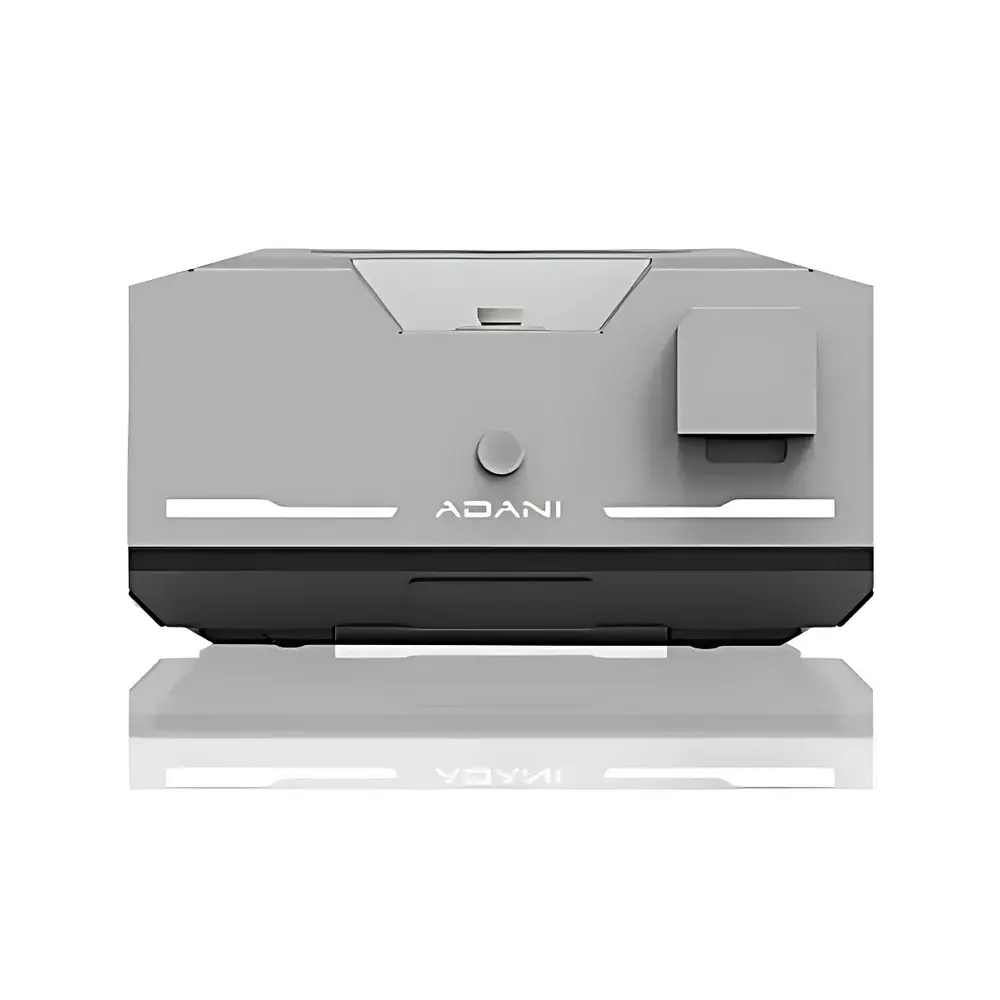
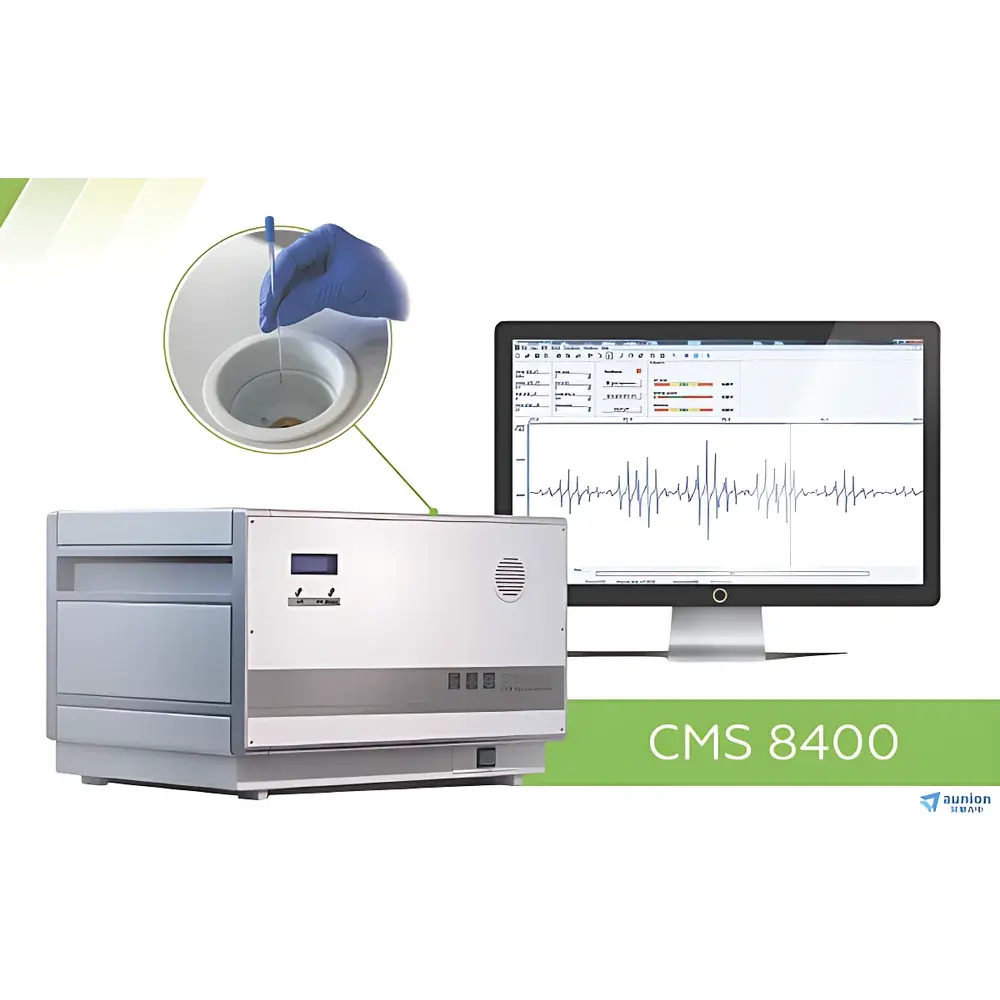
Auniontech CMS 8400 Electron Spin Resonance (ESR) Spectrometer
| Brand | Auniontech |
|---|---|
| Model | CMS 8400 |
| Type | Benchtop Continuous-Wave ESR Spectrometer |
| Operating Frequency | X-band (~9.5 GHz) |
| Magnet System | Compact Permanent Electromagnet |
| Microwave Bridge | Solid-State, Phase-Sensitive Detection |
| Sensitivity | < 1 × 10⁹ spins/Gauss·√Hz (typical, aqueous DPPH standard) |
| Field Range | 0–800 mT (adjustable, linear sweep) |
| Field Homogeneity | < 0.05 mT over 10 mm DSV |
| Temperature Capability | Ambient to +150 °C (optional cryostat support down to 4 K) |
| Data Acquisition | 16-bit ADC, Real-Time Lock-in Amplification |
| Software Control | Windows-based ESR Studio Suite with g-factor calibration, spectral simulation, and derivative/absorption mode conversion |
| Compliance | CE, RoHS, IEC 61326-1 |
Overview
The Auniontech CMS 8400 Electron Spin Resonance (ESR) Spectrometer is a benchtop continuous-wave (CW) ESR instrument engineered for high-fidelity detection of paramagnetic species—including organic and inorganic radicals, transition metal ions, point defects, and triplet states—in both liquid and solid matrices. Based on the fundamental principle of magnetic resonance absorption, the CMS 8400 applies a static magnetic field while irradiating the sample with monochromatic microwave radiation at X-band frequency (~9.5 GHz). When the Zeeman energy splitting matches the photon energy (ΔE = gμBB0 = hν), resonant absorption occurs, generating a first-derivative ESR signal detectable via phase-sensitive lock-in amplification. Its compact permanent electromagnet and integrated solid-state microwave bridge eliminate the need for bulky superconducting magnets or klystron-based sources—enabling stable, low-drift operation without liquid nitrogen or high-voltage supplies. Designed for routine laboratory deployment, the CMS 8400 delivers performance metrics—such as sub-millitesla field resolution, <1 × 10⁹ spin sensitivity, and real-time g-factor referencing—that are typically associated with larger, higher-cost research-grade systems.
Key Features
- Integrated X-band microwave bridge with solid-state source and harmonic suppression for minimal phase noise and enhanced signal-to-noise ratio
- Compact, air-cooled permanent electromagnet with digital current-controlled field sweep (0–800 mT), offering <0.05 mT field homogeneity across a 10 mm diameter spherical volume (DSV)
- Onboard 16-bit analog-to-digital converter and dual-phase lock-in amplifier enabling simultaneous acquisition of absorption and dispersion components
- Real-time g-factor calculation using built-in frequency counter and Hall-effect field sensor, traceable to NIST-calibrated standards
- Full computer control via ESR Studio software: automated parameter setup, spectral averaging, baseline correction, peak integration, and multi-spectrum overlay
- Modular sample compartment supporting standard quartz EPR tubes (3 mm & 4 mm OD), flat cells, and optional variable-temperature insert (VTI) or cryogenic dewar (4–300 K)
Sample Compatibility & Compliance
The CMS 8400 accommodates diverse sample forms—powders, frozen solutions, thin films, catalysts, polymers, and biological tissues—without requiring specialized preparation beyond standard EPR handling protocols. Its non-destructive, non-contact measurement modality preserves sample integrity for longitudinal studies. The system complies with IEC 61326-1 for electromagnetic compatibility in laboratory environments and meets CE and RoHS directives for safety and environmental conformity. All firmware and software modules adhere to ALCOA+ principles for data integrity; audit trails, electronic signatures, and user-access-level controls are configurable to support GLP and GMP workflows. While not FDA 21 CFR Part 11–certified out-of-the-box, the ESR Studio platform supports export of raw time-domain data (ASCII, HDF5) and processed spectra (CSV, PNG) for external validation and regulatory submission.
Software & Data Management
ESR Studio is a native Windows application providing full instrument orchestration—from magnet ramping and microwave power optimization to real-time spectral display and post-acquisition analysis. Key capabilities include automatic baseline subtraction using polynomial or spline fitting, Lorentzian/Gaussian line-shape deconvolution, hyperfine coupling constant extraction, and simulation-assisted assignment using spin Hamiltonian modeling. All acquisition parameters (field sweep rate, modulation amplitude/frequency, time constant, receiver gain) are stored with each dataset in embedded metadata. Data files include timestamped hardware logs (magnet current, cavity Q, detector voltage), ensuring full experimental reproducibility. Batch processing scripts (Python API available) enable high-throughput screening of dose-response curves or kinetic series—critical for radiation dosimetry or catalytic turnover studies.
Applications
- Chemistry: Kinetic monitoring of radical intermediates in redox reactions; spin-trapping identification of short-lived ROS/RNS; characterization of organometallic complexes (e.g., Cu²⁺, Mn²⁺, Fe³⁺); mechanistic studies in polymerization and photocatalysis
- Materials Science: Defect profiling in semiconductors (Si, GaN), diamond NV centers, optical fibers, and battery electrode materials; investigation of charge carrier localization and hopping conduction
- Life Sciences: Quantification of nitric oxide (NO•) in cell lysates and tissue homogenates; redox status assessment via ascorbyl/semidehydroascorbate radical ratios; metalloprotein active-site geometry (e.g., Fe-S clusters, heme proteins)
- Industrial QA/QC: Radiation dose mapping using alanine/EPR dosimeters; oxidative stability testing of lubricants and food oils; degradation analysis of polymer insulation in aerospace wiring
FAQ
What sample types are compatible with the CMS 8400?
Liquid solutions (in quartz capillaries), frozen glasses (77 K), powders, thin films, and solid-state catalysts—provided they contain paramagnetic centers with sufficient concentration and relaxation times suitable for CW-EPR detection.
Does the system support variable temperature measurements?
Yes—standard operation covers ambient to +150 °C using a resistive heater stage; optional liquid-nitrogen or closed-cycle cryostat integration extends the range to 4 K.
Can ESR Studio generate reports compliant with ISO/IEC 17025 requirements?
While ESR Studio does not auto-generate accredited lab reports, it exports fully traceable, timestamped datasets with metadata required for internal QA documentation and third-party validation.
Is microwave frequency tunable across the X-band?
No—the CMS 8400 operates at a fixed center frequency near 9.5 GHz; fine-tuning is achieved via cavity plunger adjustment to maximize Q-factor, not source frequency modulation.
How is g-factor accuracy ensured during long-term operation?
Through continuous in situ calibration using the built-in Hall probe and frequency counter, referenced against DPPH (g = 2.0036) or Cr³⁺:MgO (g = 1.976) standards before each measurement session.




