
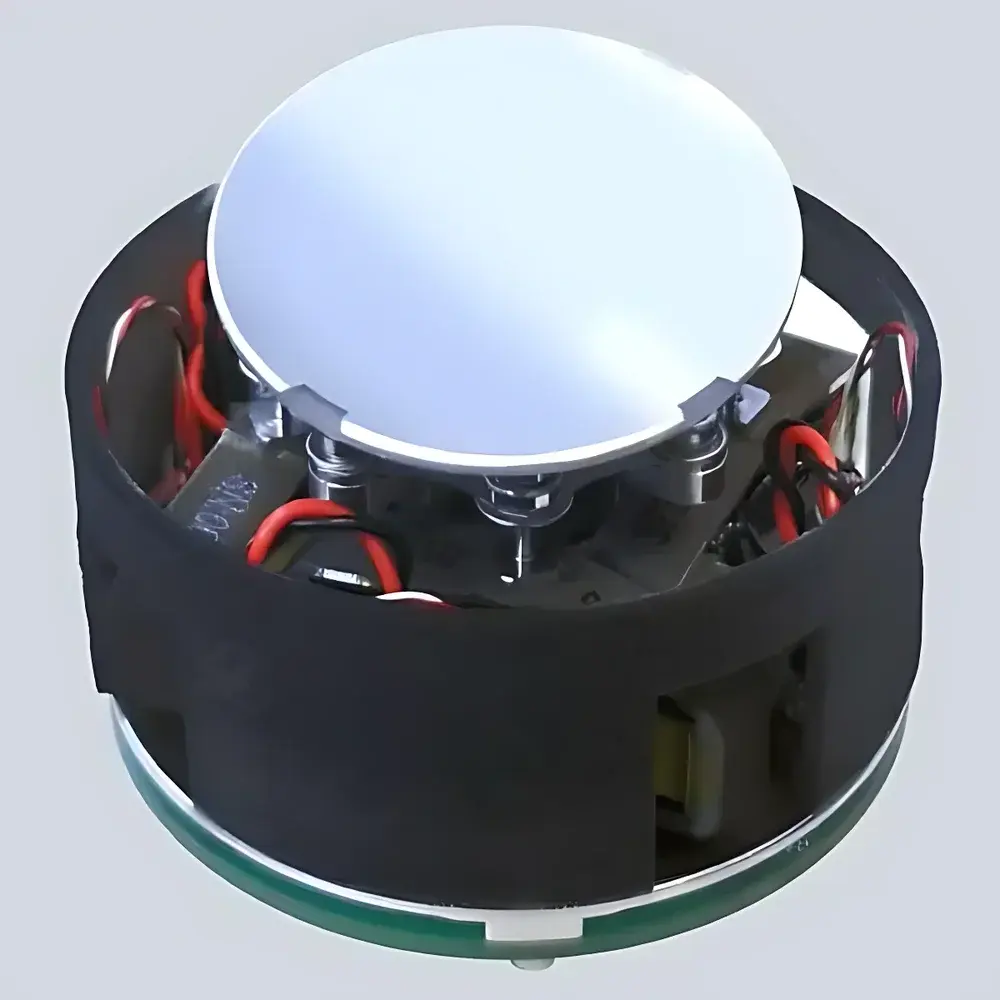
Auniontech FSM Series Fast Steering Mirrors
| Brand | Auniontech |
|---|---|
| Model | FSM-06M / FSM-45M / FSM-1400U / FSM-2000U |
| Type | Electromagnetic Fast Steering Mirror (FSM) |
| Angular Range | 6 mrad / 45 mrad / 1400 µrad / 2000 µrad |
| Resonant Frequency | 2200 Hz / 600 Hz / 2500 Hz (9 g) / 1500 Hz (25 g) / 500 Hz (60 g) |
| Guidance | Flexure-based zero-backlash kinematics |
| Feedback | Strain-gauge based closed-loop control (FSM-2000U), optional for others |
| Thermal Stability | Integrated thermal stabilization (FSM-2000U) |
| Load Capacity | Up to 5 mrad @ 60 g inertial load (FSM-2000U variant) |
| Compliance | Compatible with ISO 10110 optical mounting standards, RoHS-compliant construction |
Overview
Fast Steering Mirrors (FSMs) are precision optomechanical devices engineered to dynamically reorient reflected light beams with sub-millisecond response times and nanoradian-level repeatability. Unlike conventional motorized tip-tilt stages, FSMs employ electromagnetic actuation coupled with monolithic flexure hinges—eliminating backlash, stiction, and wear-related drift. The Auniontech FSM Series operates on the principle of Lorentz-force-driven mirror deflection: current applied to voice-coil actuators interacts with permanent magnetic fields, generating controlled torque about orthogonal axes. This architecture enables high-bandwidth angular modulation essential for real-time wavefront correction, beam pointing stabilization, and active vibration cancellation in demanding photonic systems. Designed for integration into vacuum-compatible, low-outgassing environments, these mirrors serve as core components in free-space optical communication terminals, adaptive optics wavefront correctors, confocal and super-resolution microscopy scanners, and airborne electro-optical tracking platforms.
Key Features
- Monolithic flexure guidance system ensures zero mechanical backlash and hysteresis-free motion across full angular range
- Strain-gauge position feedback integrated directly into the flexure structure—enabling closed-loop linearity better than ±0.5% FS over full stroke (FSM-2000U standard; optional on other models)
- High resonant frequencies (up to 2500 Hz at 9 g payload) support bandwidth-limited control loops exceeding 500 Hz in open-loop and 300 Hz in closed-loop configurations
- Compact form factor optimized for OEM integration: all models conform to standard Ø25.4 mm or Ø50.8 mm mirror mounts with M4 or M6 tapped holes per ISO 10110-7
- Thermally stabilized design (FSM-2000U) mitigates thermal drift to <50 nrad/°C over operational temperature range (15–35 °C)
- Configurable dual-axis operation with cross-coupling <0.3% between X and Y axes—critical for decoupled beam steering in multi-degree-of-freedom systems
Sample Compatibility & Compliance
The Auniontech FSM Series accommodates standard optical substrates including UV-fused silica, CaF₂, and protected aluminum or dielectric-coated mirrors up to Ø50.8 mm and 12 mm thickness. Mounting interfaces comply with ANSI/ISO 10110-7 mechanical drawing conventions and feature kinematic three-point contact geometry for repeatable alignment. All units meet RoHS Directive 2011/65/EU for hazardous substance restrictions and are rated for operation in non-condensing environments (5–40 °C, <80% RH). For regulated applications—including medical laser systems and aerospace-grade optical terminals—the FSM-2000U variant supports traceable calibration certificates (NIST-traceable angular metrology) and is compatible with GLP/GMP audit requirements when paired with validated control firmware.
Software & Data Management
Each FSM is supplied with a USB 2.0–based digital controller supporting analog ±10 V input (for legacy DAQ integration) and native SPI/I²C command protocols. The included Auniontech FSM Control Suite provides real-time waveform generation (sine, sawtooth, arbitrary LUT-based trajectories), Bode plot acquisition for loop characterization, and automated step-response analysis. Export formats include CSV and HDF5 for post-processing in MATLAB, Python (NumPy/SciPy), or LabVIEW. Firmware supports IEEE 1588-2008 Precision Time Protocol (PTP) synchronization—enabling time-stamped actuation across distributed optical subsystems. Audit trails, user access levels, and configuration change logging are implemented in accordance with FDA 21 CFR Part 11 requirements for systems used in regulated research environments.
Applications
- Laser Communication Terminals: Compensating for platform jitter and atmospheric tilt in ground-to-satellite and inter-satellite optical links—maintaining beam overlap efficiency >92% at 10 km range under 50 Hz broadband vibration
- Adaptive Optics Systems: Serving as low-order wavefront correctors in conjunction with deformable mirrors; correcting tip/tilt modes at bandwidths exceeding 1 kHz in astronomical observatories and ophthalmic imaging systems
- Confocal & STED Microscopy: Enabling high-speed resonant scanning with <20 ns latency and <0.1 µrad RMS noise floor—supporting frame rates up to 240 fps at 1024 × 1024 resolution
- Industrial Laser Processing: Stabilizing focus position during high-acceleration galvo scanning; reducing spot wander to <0.3 µm RMS at 10 m/s stage velocity
- Quantum Optics Experiments: Providing active path-length equalization in Mach–Zehnder interferometers for photon-pair correlation measurements with coherence times >10 ns
FAQ
What is the maximum supported mirror substrate weight and thickness?
Standard configurations support mirrors up to 12 mm thick and 120 g mass. Custom variants accommodate up to 250 g with modified suspension stiffness—contact engineering support for static deflection modeling.
Is vacuum compatibility available?
Yes. Vacuum-rated versions (10⁻⁶ mbar) are offered with stainless-steel housings, ceramic-coated flexures, and outgassing-tested adhesives—certified per ASTM E595.
Can multiple FSMs be synchronized in a master-slave topology?
Yes. Using the PTP-enabled controller firmware, up to 16 units can achieve sub-100 ns timestamp alignment across independent Ethernet segments.
Do you provide optical coating specifications for the mirror mounts?
Mounts accept user-supplied optics; we supply detailed surface flatness (λ/10 @ 633 nm), centration (<5 arcsec), and wedge (<2 arcsec) tolerances per ISO 10110-3 for custom-coated substrates.
What calibration documentation is included?
Each unit ships with factory calibration report listing measured angular gain (mrad/V), linearity error, resonance frequency, and damping ratio—traceable to NIST via accredited third-party metrology lab.




